Genesis 32:1–33:20
The Message: The Bible in Contemporary LanguageOther versions
English
- MSG The Message: The Bible in Contemporary Language
- DARBY 1890 Darby Bible
- ASV American Standard Version
- AV 1873 The Cambridge Paragraph Bible of the Authorized English Version
- CSB Christian Standard Bible
- D-R Douay-Rheims Bible
- ESV English Standard Version
- GW GOD’S WORD Translation
- GNB Good News Translation
- HCSB The Holman Christian Standard Bible
- KJV 1900 King James Version
- LSB Legacy Standard Bible
- LEB The Lexham English Bible
- NET The NET Bible
- NASB95 New American Standard Bible (1995)
- NCV New Century Version
- NIrV New International Reader’s Version (1998)
- NIV New International Version (2011)
- NKJV The New King James Version
- NLT New Living Translation
- NRSVue New Revised Standard Version: Updated Edition
- RSV The Revised Standard Version
- RSVCE The Revised Standard Version, Catholic Edition
- YLT Young’s Literal Translation
Arabic
Czech
French
German
Hebrew
Hungarian
Italian
Korean
Latin
Portuguese
Russian
Simplified Chinese
Spanish
Traditional Chinese
1–232And Jacob went his way. Angels of God met him. When Jacob saw them he said, “Oh! God’s Camp!” And he named the place Mahanaim (Campground).
3–5Then Jacob sent messengers on ahead to his brother Esau in the land of Seir in Edom. He instructed them: “Tell my master Esau this, ‘A message from your servant Jacob: I’ve been staying with Laban and couldn’t get away until now. I’ve acquired cattle and donkeys and sheep; also men and women servants. I’m telling you all this, my master, hoping for your approval.’ ”
6The messengers came back to Jacob and said, “We talked to your brother Esau and he’s on his way to meet you. But he has four hundred men with him.”
7–8Jacob was scared. Very scared. Panicked, he divided his people, sheep, cattle, and camels into two camps. He thought, “If Esau comes on the first camp and attacks it, the other camp has a chance to get away.”
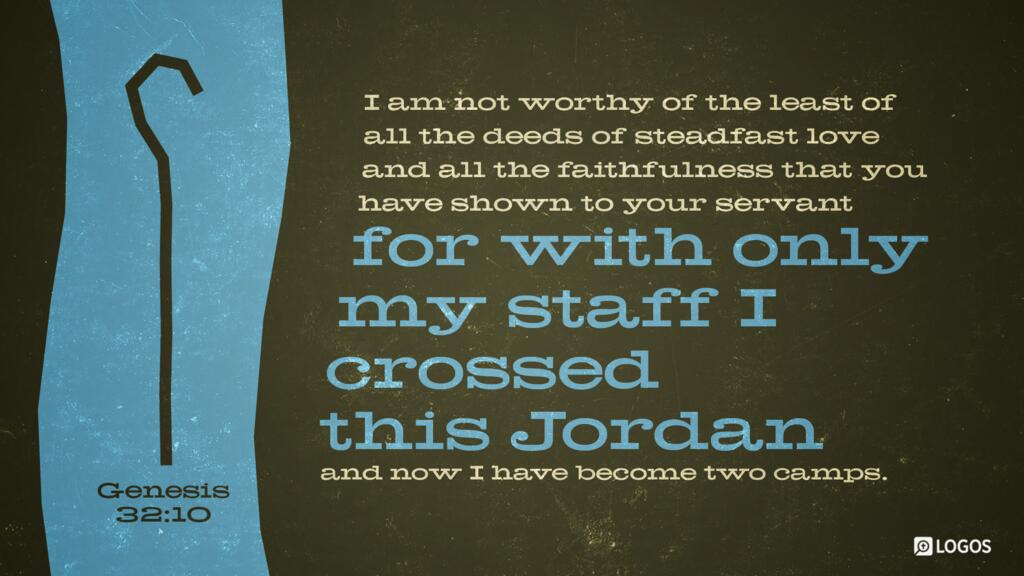
9–12And then Jacob prayed, “God of my father Abraham, God of my father Isaac, God who told me, ‘Go back to your parents’ homeland and I’ll treat you well.’ I don’t deserve all the love and loyalty you’ve shown me. When I left here and crossed the Jordan I only had the clothes on my back, and now look at me—two camps! Save me, please, from the violence of my brother, my angry brother! I’m afraid he’ll come and attack us all, me, the mothers and the children. You yourself said, ‘I will treat you well; I’ll make your descendants like the sands of the sea, far too many to count.’ ”
13–16He slept the night there. Then he prepared a present for his brother Esau from his possessions: two hundred female goats, twenty male goats, two hundred ewes and twenty rams, thirty camels with their nursing young, forty cows and ten bulls, twenty female donkeys and ten male donkeys. He put a servant in charge of each herd and said, “Go ahead of me and keep a healthy space between each herd.”
17–18Then he instructed the first one out: “When my brother Esau comes close and asks, ‘Who is your master? Where are you going? Who owns these?’—answer him like this, ‘Your servant Jacob. They are a gift to my master Esau. He’s on his way.’ ”
19–20He gave the same instructions to the second servant and to the third—to each in turn as they set out with their herds: “Say ‘Your servant Jacob is on his way behind us.’ ” He thought, “I will soften him up with the succession of gifts. Then when he sees me face-to-face, maybe he’ll be glad to welcome me.”
21So his gifts went before him while he settled down for the night in the camp.
22–23But during the night he got up and took his two wives, his two maidservants, and his eleven children and crossed the ford of the Jabbok. He got them safely across the brook along with all his possessions.
24–25But Jacob stayed behind by himself, and a man wrestled with him until daybreak. When the man saw that he couldn’t get the best of Jacob as they wrestled, he deliberately threw Jacob’s hip out of joint.
26The man said, “Let me go; it’s daybreak.”
Jacob said, “I’m not letting you go ’til you bless me.”
27The man said, “What’s your name?”
He answered, “Jacob.”
28The man said, “But no longer. Your name is no longer Jacob. From now on it’s Israel (God-Wrestler); you’ve wrestled with God and you’ve come through.”
29Jacob asked, “And what’s your name?”
The man said, “Why do you want to know my name?” And then, right then and there, he blessed him.
30Jacob named the place Peniel (God’s Face) because, he said, “I saw God face-to-face and lived to tell the story!”
31–32The sun came up as he left Peniel, limping because of his hip. (This is why Israelites to this day don’t eat the hip muscle; because Jacob’s hip was thrown out of joint.)
1–433Jacob looked up and saw Esau coming with his four hundred men. He divided the children between Leah and Rachel and the two maidservants. He put the maidservants out in front, Leah and her children next, and Rachel and Joseph last. He led the way and, as he approached his brother, bowed seven times, honoring his brother. But Esau ran up and embraced him, held him tight and kissed him. And they both wept.
5Then Esau looked around and saw the women and children: “And who are these with you?”
Jacob said, “The children that God saw fit to bless me with.”
6–7Then the maidservants came up with their children and bowed; then Leah and her children, also bowing; and finally, Joseph and Rachel came up and bowed to Esau.
8Esau then asked, “And what was the meaning of all those herds that I met?”
“I was hoping that they would pave the way for my master to welcome me.”
9Esau said, “Oh, brother. I have plenty of everything—keep what is yours for yourself.”
10–11Jacob said, “Please. If you can find it in your heart to welcome me, accept these gifts. When I saw your face, it was as the face of God smiling on me. Accept the gifts I have brought for you. God has been good to me and I have more than enough.” Jacob urged the gifts on him and Esau accepted.
12Then Esau said, “Let’s start out on our way; I’ll take the lead.”
13–14But Jacob said, “My master can see that the children are frail. And the flocks and herds are nursing, making for slow going. If I push them too hard, even for a day, I’d lose them all. So, master, you go on ahead of your servant, while I take it easy at the pace of my flocks and children. I’ll catch up with you in Seir.”
15Esau said, “Let me at least lend you some of my men.”
“There’s no need,” said Jacob. “Your generous welcome is all I need or want.”
16So Esau set out that day and made his way back to Seir.
17And Jacob left for Succoth. He built a shelter for himself and sheds for his livestock. That’s how the place came to be called Succoth (Sheds).
18–20And that’s how it happened that Jacob arrived all in one piece in Shechem in the land of Canaan—all the way from Paddan Aram. He camped near the city. He bought the land where he pitched his tent from the sons of Hamor, the father of Shechem. He paid a hundred silver coins for it. Then he built an altar there and named it El-Elohe-Israel (Mighty Is the God of Israel).
Copyright 2005 Eugene H. Peterson.