Exodus 13:1–16
The Message: The Bible in Contemporary LanguageOther versions
English
- MSG The Message: The Bible in Contemporary Language
- DARBY 1890 Darby Bible
- ASV American Standard Version
- AV 1873 The Cambridge Paragraph Bible of the Authorized English Version
- CSB Christian Standard Bible
- D-R Douay-Rheims Bible
- ESV English Standard Version
- GW GOD’S WORD Translation
- GNB Good News Translation
- HCSB The Holman Christian Standard Bible
- KJV 1900 King James Version
- LSB Legacy Standard Bible
- LEB The Lexham English Bible
- NET The NET Bible
- NASB95 New American Standard Bible (1995)
- NCV New Century Version
- NIrV New International Reader’s Version (1998)
- NIV New International Version (2011)
- NKJV The New King James Version
- NLT New Living Translation
- NRSVue New Revised Standard Version: Updated Edition
- RSV The Revised Standard Version
- RSVCE The Revised Standard Version, Catholic Edition
- TNIV Today’s New International Version
- YLT Young’s Literal Translation
Arabic
Czech
French
German
Hebrew
Hungarian
Italian
Korean
Latin
Portuguese
Russian
Simplified Chinese
Spanish
Traditional Chinese
1–213God spoke to Moses, saying, “Consecrate every firstborn to me—the first one to come from the womb among the Israelites, whether person or animal, is mine.”
3Moses said to the people, “Always remember this day. This is the day when you came out of Egypt from a house of slavery. God brought you out of here with a powerful hand. Don’t eat any raised bread.
4–5“You are leaving in the spring month of Abib. When God brings you into the land of the Canaanite, the Hittite, the Amorite, the Hivite, and the Jebusite, which he promised to your fathers to give you, a land lavish with milk and honey, you are to observe this service during this month:
6“You are to eat unraised bread for seven days; on the seventh day there is a festival celebration to God.
7“Only unraised bread is to be eaten for seven days. There is not to be a trace of anything fermented—no yeast anywhere.
8“Tell your child on that day: ‘This is because of what God did for me when I came out of Egypt.’
9–10“The day of observance will be like a sign on your hand, a memorial between your eyes, and the teaching of God in your mouth. It was with a powerful hand that God brought you out of Egypt. Follow these instructions at the set time, year after year after year.
11–13“When God brings you into the land of the Canaanites, as he promised you and your fathers, and turns it over to you, you are to set aside the first birth out of every womb to God. Every first birth from your livestock belongs to God. You can redeem every first birth of a donkey if you want to by substituting a lamb; if you decide not to redeem it, you must break its neck.
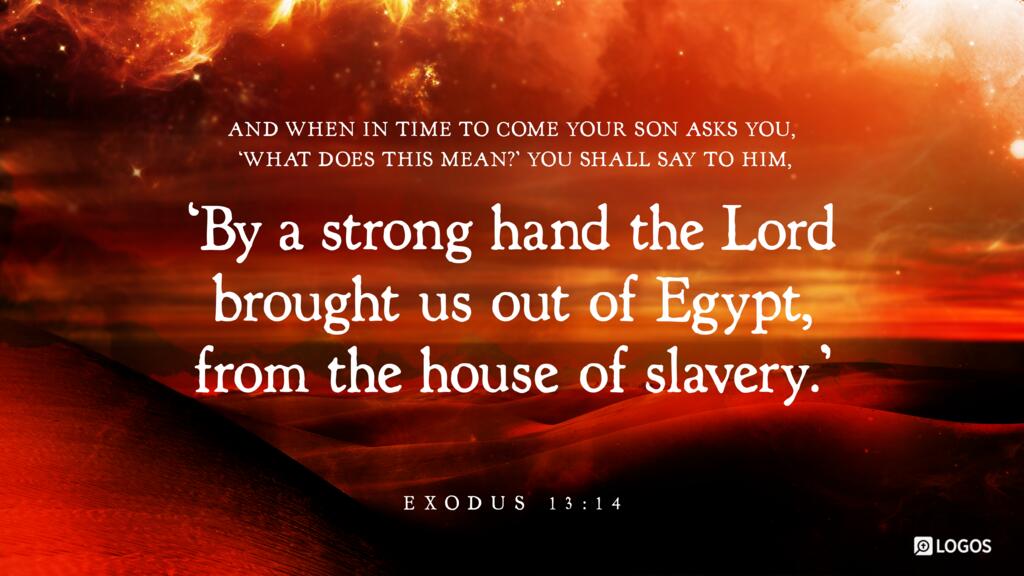
13–16“Redeem every firstborn child among your sons. When the time comes and your son asks you, ‘What does this mean?’ you tell him, ‘God brought us out of Egypt, out of a house of slavery, with a powerful hand. When Pharaoh stubbornly refused to let us go, God killed every firstborn in Egypt, the firstborn of both humans and animals. That’s why I make a sacrifice for every first male birth from the womb to God and redeem every firstborn son.’ The observance functions like a sign on your hands or a symbol on the middle of your forehead: God brought us out of Egypt with a powerful hand.”
Copyright 2005 Eugene H. Peterson.