John 4:1–14
Legacy Standard BibleOther versions
English
- LSB Legacy Standard Bible
- DARBY 1890 Darby Bible
- ASV American Standard Version
- AV 1873 The Cambridge Paragraph Bible of the Authorized English Version
- CSB Christian Standard Bible
- D-R Douay-Rheims Bible
- ESV English Standard Version
- GW GOD’S WORD Translation
- GNB Good News Translation
- HCSB The Holman Christian Standard Bible
- KJV 1900 King James Version
- LEB The Lexham English Bible
- MSG The Message: The Bible in Contemporary Language
- NET The NET Bible
- NASB95 New American Standard Bible (1995)
- NCV New Century Version
- NIrV New International Reader’s Version (1998)
- NIV New International Version (2011)
- NKJV The New King James Version
- NLT New Living Translation
- NRSVue New Revised Standard Version: Updated Edition
- RSV The Revised Standard Version
- RSVCE The Revised Standard Version, Catholic Edition
- YLT Young’s Literal Translation
Arabic
Czech
French
German
Greek
Hungarian
Italian
Korean
Latin
Portuguese
Russian
Simplified Chinese
Spanish
Traditional Chinese
Jesus Goes to Galilee
1Therefore when aJesus knew that the Pharisees had heard that Jesus was making and bbaptizing more disciples than John
2(although aJesus Himself was not baptizing, but His bdisciples were),
3He left aJudea and went away bagain into Galilee.
4And He had to pass through aSamaria.
5So He *came to a city of aSamaria called Sychar, near bthe field that cJacob gave to his son Joseph;
6and Jacob’s well was there. So Jesus, being wearied from His journey, was sitting thus by the well. It was about 1the sixth hour.
Jesus and the Samaritan Woman
7A woman of Samaria *came to draw water. Jesus *said to her, “Give Me a drink.”
8For His adisciples had gone away into bthe city to buy food.
9Therefore the aSamaritan woman *said to Him, “How do You, being a Jew, ask for a drink from me, being a Samaritan woman?” (For bJews have no dealings with Samaritans.)
10Jesus answered and said to her, “If you knew the gift of God, and who it is who says to you, ‘Give Me a drink,’ you would have asked Him, and He would have given you aliving water.”
11She *said to Him, “1Sir, You have nothing to draw with and the well is deep. Where then do You get that aliving water?
12“Are You greater than our father Jacob, who agave us this well, and drank of it himself and his sons and his cattle?”
13Jesus answered and said to her, “Everyone who drinks of this water will thirst again;
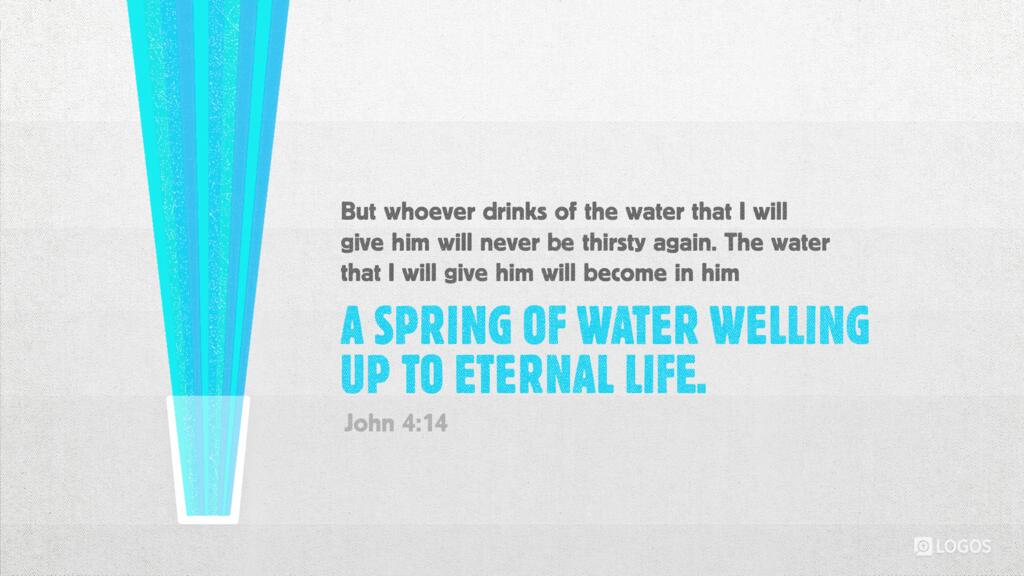
14but whoever drinks of the water that I will give him awill never thirst—ever; but the water that I will give him will become in him a well of water springing up to beternal life.”
Footnotes
Cross references
- aLuke 7:13
- bJohn 3:22, 26; 1 Cor 1:17
- aJohn 3:22, 26; 1 Cor 1:17
- bJohn 2:2
- aJohn 3:22
- bJohn 2:11f
- aLuke 9:52
- aLuke 9:52
- bGen 33:19; Josh 24:32
- cGen 48:22; John 4:12
- aJohn 2:2
- bJohn 4:5, 39
- aLuke 9:52
- bEzra 4:3–6, 11ff; Matt 10:5; John 8:48; Acts 10:28
- aJer 2:13; John 4:14; 7:37f; Rev 7:17; 21:6; 22:1, 17
- aJer 2:13; John 4:14; 7:37f; Rev 7:17; 21:6; 22:1, 17
- aJohn 4:6
- aJohn 6:35; 7:38
- bMatt 25:46; John 6:27
Copyright 2024 The Lockman Foundation