Song of Solomon 6:13–7:13
The Lexham English BibleOther versions
English
- LEB The Lexham English Bible
- DARBY 1890 Darby Bible
- ASV American Standard Version
- AV 1873 The Cambridge Paragraph Bible of the Authorized English Version
- CSB Christian Standard Bible
- D-R Douay-Rheims Bible
- ESV English Standard Version
- GW GOD’S WORD Translation
- GNB Good News Translation
- HCSB The Holman Christian Standard Bible
- KJV 1900 King James Version
- LSB Legacy Standard Bible
- MSG The Message: The Bible in Contemporary Language
- NET The NET Bible
- NASB95 New American Standard Bible (1995)
- NCV New Century Version
- NIrV New International Reader’s Version (1998)
- NIV New International Version (2011)
- NKJV The New King James Version
- NLT New Living Translation
- NRSVue New Revised Standard Version: Updated Edition
- RSV The Revised Standard Version
- RSVCE The Revised Standard Version, Catholic Edition
- YLT Young’s Literal Translation
Arabic
Czech
French
German
Hebrew
Hungarian
Italian
Korean
Latin
Portuguese
Russian
Simplified Chinese
Spanish
Traditional Chinese
13p Turn, turn,q O Shulammite!r
Turn, turns so that we may look upon you!
Why do you look upon the Shulammite
as at a dance of the two armies?
Solomon’s Praise of His Dancing Maiden
7How beautiful are your feet in sandals,
O royal princess!a
The curves of your thighsb are like jewels,c
the work of the hands of a craftsman.
2Your navel is a round wine-mixing bowld
that does not lack mixede wine!
Your belly is a heap of wheat
encircled with lilies.
3Your two breasts are like two fawns,
twins of a gazelle.
4Your neck is like a tower of ivory;
your eyes are pools in Heshbon at the gate of Beth Rabbim.
Your nose is like the tower of Lebanon
looking out over Damascus.f
5Your head crowns you like Carmel;gh
the flowing locks of your head are like purple tapestry;i
a king is held captive in the tresses!
6How beautiful you are and how pleasant,
O loved one in the delights!
7Your staturej is like the palm tree,
and your breasts are like clusters.
8I say, “I will climb up the palm tree;
I will lay hold of its fruit clusters.”
Let your breasts be pleasing like clusters of the vine
and the scent of your breath like the apples.
9Your palate is like the best wine that goes down for my beloved,
smoothly gliding over my lips and teeth.k
Mutual Possession Refrain
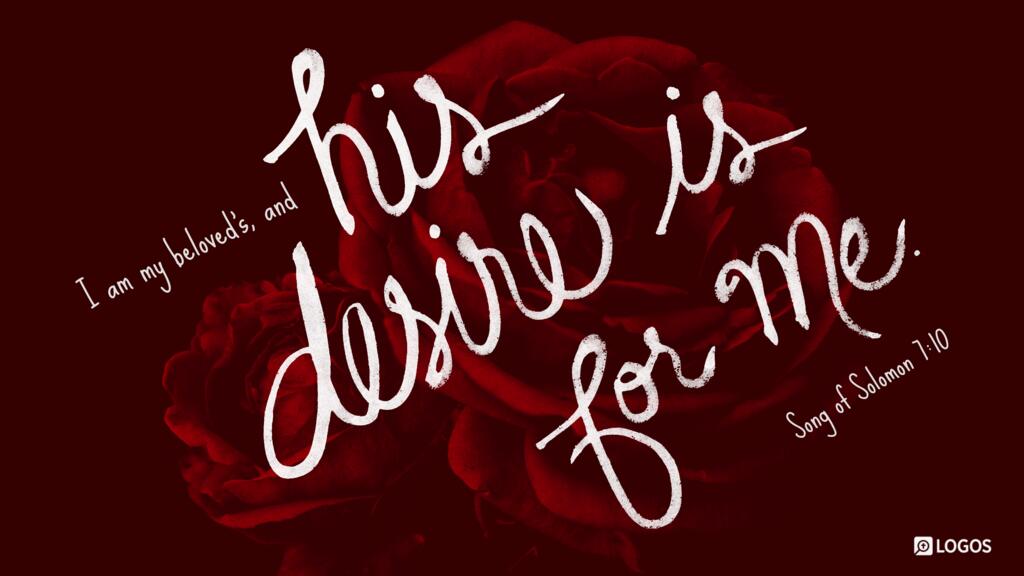
10I belong to my beloved,l
and he desires me!m
Rendezvous in the Countryside
11Come, my beloved, let us go out to the countryside;n
let us spend the nighto in the villages.
12Let us rise early to gop to the vineyards;
let us see whether the vine has budded,q
whether the grape blossom has opened,
and whether the pomegranates are in bloom;r
there I will give my love to you.
13The mandrakes give off their fragrance,
and over our doorway is every kind of delicious fruit;s
both fresh and dried fruit I have stored upt for you, O my beloved.
Footnotes
- pSong of Songs 6:13–7:13 in the English Bible is 7:1–14 in the Hebrew Bible
- qOr “Return, return …!”
- rOr “O perfect one,” “O peaceful one,” “O bride.” Many interpreters take this moniker as suggesting the maiden was from the village of Shulem (alternately called Shunem)
- sOr “Return, return …!”
- aOr “O daughter of leader”
- bLiterally “thigh”
- cLiterally “ornaments”
- dLiterally “a bowl of the roundness”
- eOr “blended”
- fLiterally “looking out over the face of Damascus”
- gLiterally “Your head is on you like the Carmel”
- hBecause of its height and fertility, Mount Carmel is often associated with royalty
- iLiterally “the purple”
- jLiterally “this your height”
- kOr “over lips of sleepers.” One Hebrew textual tradition preserves the reading “lips of those who sleep” (MT). Another Hebrew tradition reads “my lips and my teeth,” as reflected by the ancient versions (LXX, Latin Vulgate, Aramaic Targum, Syriac Peshitta). The latter is adopted here since it makes the most sense poetically
- lLiterally “I am for my beloved”
- mLiterally “and his desire is for me.” Or “and his desire belongs to me”
- nLiterally “go forth into the field”
- oOr “lodge”
- pOr “let us go”
- qOr “sprouted”
- rLiterally “have bloomed”
- sOr “over our doorways all choice things”
- tLiterally “new also old I have laid up”
Copyright 2012 Lexham Press