Romans 5:6–15
The Lexham English BibleOther versions
English
- LEB The Lexham English Bible
- DARBY 1890 Darby Bible
- ASV American Standard Version
- AV 1873 The Cambridge Paragraph Bible of the Authorized English Version
- CSB Christian Standard Bible
- D-R Douay-Rheims Bible
- ESV English Standard Version
- GW GOD’S WORD Translation
- GNB Good News Translation
- HCSB The Holman Christian Standard Bible
- KJV 1900 King James Version
- LSB Legacy Standard Bible
- MSG The Message: The Bible in Contemporary Language
- NET The NET Bible
- NASB95 New American Standard Bible (1995)
- NCV New Century Version
- NIrV New International Reader’s Version (1998)
- NIV New International Version (2011)
- NKJV The New King James Version
- NLT New Living Translation
- NRSVue New Revised Standard Version: Updated Edition
- RSV The Revised Standard Version
- RSVCE The Revised Standard Version, Catholic Edition
- YLT Young’s Literal Translation
Arabic
Czech
French
German
Greek
Hungarian
Italian
Korean
Latin
Portuguese
Russian
Simplified Chinese
Spanish
Traditional Chinese
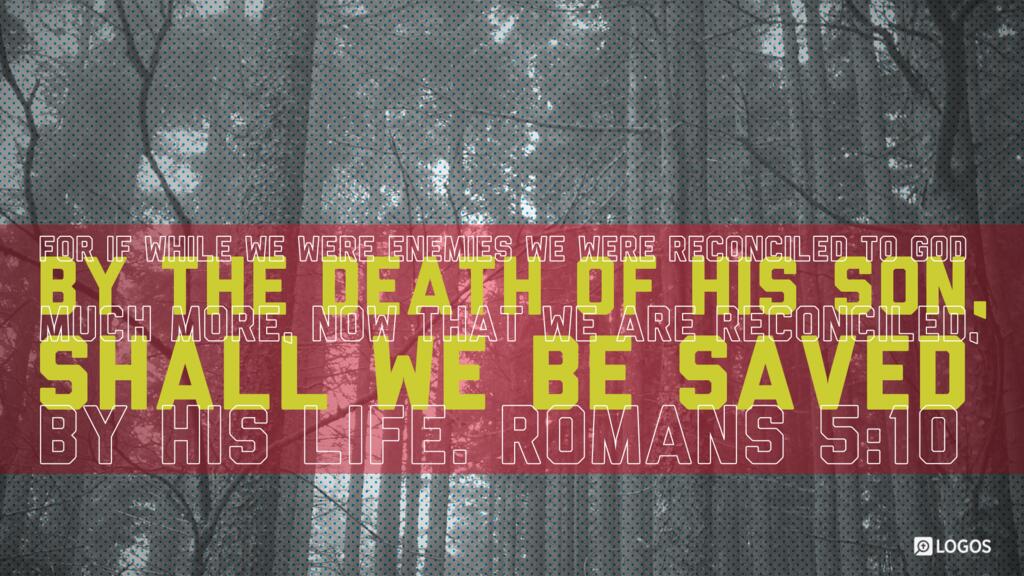
6For while* we were still helpless, yet at the proper time Christ died for the ungodly. 7For only rarely will someone die on behalf of a righteous person (for on behalf of a good person possibly someone might even dare to die), 8but God demonstrates his own love for us, in that while* we were still sinners, Christ died for us. 9Therefore, by much more, because we* have been declared righteous now by his blood, we will be saved through him from the wrath. 10For if, while we* were enemies, we were reconciled to God through the death of his Son, by much more, having been reconciled, we will be saved by his life. 11And not only this, but also we are boasting in God through our Lord Jesus Christ, through whom we have now received the reconciliation.
Death Came through Adam but Life Comes through Christ
12Because of this, just as sin entered into the world through one man, and death through sin, so also death spread to all people because all sinned. 13For until the law, sin was in the world, but sin is not charged to one’s account when there* is no law. 14But death reigned from Adam until Moses even over those who did not sin in the likeness of the transgression of Adam, who is a type of the one who is to come. 15But the gift is not like the trespassb, for if by the trespass of the one, the many died, by much more did the grace of God and the gift by the grace of the one man, Jesus Christ, multiply to the many.
Footnotes
- *Here “while” is supplied as a component of the participle (“were”) which is understood as temporal
- *Here “while” is supplied as a component of the participle (“were”) which is understood as temporal
- *Here “because” is supplied as a component of the participle (“have been declared righteous”) which is understood as causal
- *Here “while” is supplied as a component of the participle (“were”) which is understood as temporal
- *Here “when” is supplied as a component of the participle (“is”) which is understood as temporal
- bLiterally “but not like the trespass so also the gift”
Copyright 2012 Lexham Press