Revelation 1:10–20
The Lexham English BibleOther versions
English
- LEB The Lexham English Bible
- DARBY 1890 Darby Bible
- ASV American Standard Version
- AV 1873 The Cambridge Paragraph Bible of the Authorized English Version
- CSB Christian Standard Bible
- D-R Douay-Rheims Bible
- ESV English Standard Version
- GW GOD’S WORD Translation
- GNB Good News Translation
- HCSB The Holman Christian Standard Bible
- KJV 1900 King James Version
- LSB Legacy Standard Bible
- MSG The Message: The Bible in Contemporary Language
- NET The NET Bible
- NASB95 New American Standard Bible (1995)
- NCV New Century Version
- NIrV New International Reader’s Version (1998)
- NIV New International Version (2011)
- NKJV The New King James Version
- NLT New Living Translation
- NRSVue New Revised Standard Version: Updated Edition
- RSV The Revised Standard Version
- RSVCE The Revised Standard Version, Catholic Edition
- YLT Young’s Literal Translation
Arabic
Czech
French
German
Greek
Hungarian
Italian
Korean
Latin
Portuguese
Russian
Simplified Chinese
Spanish
Traditional Chinese
10I was in the Spirit on the Lord’s day, and I heard behind me a great sound like a trumpet 11saying, “What you see, write in a book and send it to the seven churches: to Ephesus and to Smyrna and to Pergamum and to Thyatira and to Sardis and to Philadelphia and to Laodicea.”
12And I turned to see the voice which was speaking with me, and when I* turned, I saw seven gold lampstands, 13and in the midst of the lampstands one like a son of man, dressed in a robe reaching to the feet and girded around his* chest with a golden belt, 14and his head and hair were white like wool, white as snow, and his eyes were like a fiery flame, 15and his feet were like fine bronze when it has been fired in a furnace, and his voice was like the sound of many waters, 16and he had in his right hand seven stars, and a sharp double-edged sword coming out of his mouth, and his face was like the sun shining in its strength.
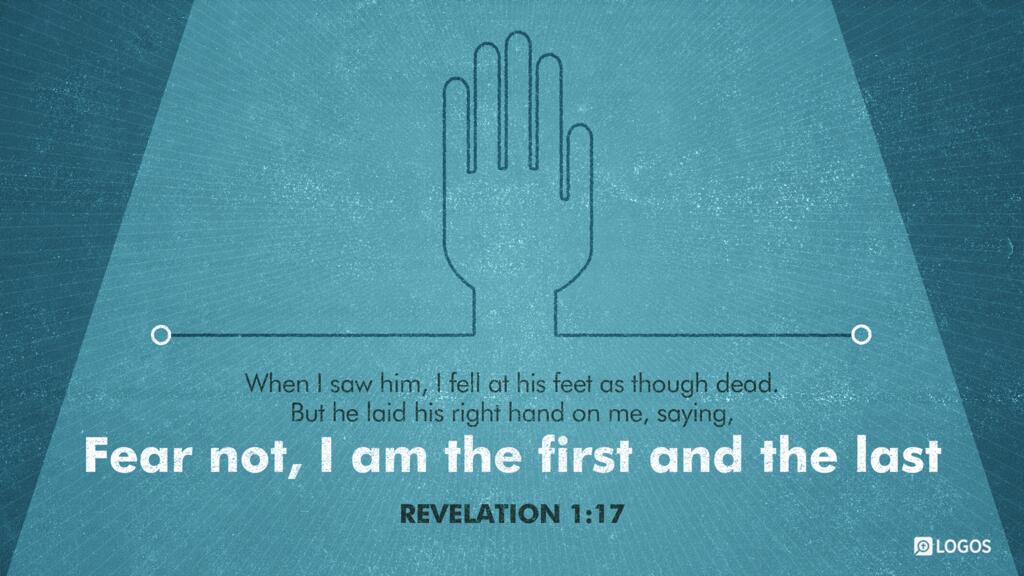
17And when I saw him, I fell at his feet like a dead person, and he placed his right hand on me, saying, “Do not be afraid! I am the first and the last, 18and the one who lives, and I was dead, and behold, I am living forever and everc, and I hold the keys of death and of Hades. 19Therefore, write the things which you saw, and the things which are, and the things which are about to take place after these things. 20As for the mystery of the seven stars which you saw in my right hand and the seven gold lampstands—the seven stars are the angels of the seven churches, and the seven lampstands are the seven churches.
Footnotes
Copyright 2012 Lexham Press