Matthew 21:1–11
The Lexham English BibleOther versions
English
- LEB The Lexham English Bible
- DARBY 1890 Darby Bible
- ASV American Standard Version
- AV 1873 The Cambridge Paragraph Bible of the Authorized English Version
- CSB Christian Standard Bible
- D-R Douay-Rheims Bible
- ESV English Standard Version
- GW GOD’S WORD Translation
- GNB Good News Translation
- HCSB The Holman Christian Standard Bible
- KJV 1900 King James Version
- LSB Legacy Standard Bible
- MSG The Message: The Bible in Contemporary Language
- NET The NET Bible
- NASB95 New American Standard Bible (1995)
- NCV New Century Version
- NIrV New International Reader’s Version (1998)
- NIV New International Version (2011)
- NKJV The New King James Version
- NLT New Living Translation
- NRSVue New Revised Standard Version: Updated Edition
- RSV The Revised Standard Version
- RSVCE The Revised Standard Version, Catholic Edition
- TNIV Today’s New International Version
- YLT Young’s Literal Translation
Arabic
Czech
French
German
Greek
Hungarian
Italian
Korean
Latin
Portuguese
Russian
Simplified Chinese
Spanish
Traditional Chinese
The Triumphal Entry
21And when they drew near to Jerusalem and came to Bethphage at the Mount of Olives, then Jesus sent two disciples, 2saying to them, “Go into the village before you, and right away you will find a donkey tied and a colt with her. Untie them* and* bring them* to me. 3And if anyone says anything to you, you will say, ‘The Lord needs them,’a and he will send them at once.” 4Now this took place so that what was spoken through the prophet would be fulfilled, saying,
5“Say to the daughter of Zion,
‘Behold, your king is coming to you,
humble and mounted on a donkey,
andb on a colt, the foal of a pack animal.’ ”c
6So the disciples went* and did* just as Jesus directed them, 7and* brought the donkey and the colt and put their* cloaks on them, and he sat on them. 8And a very large crowd spread their cloaks on the road, and others were cutting branches from the trees and spreading them* on the road. 9And the crowds who went ahead of him and the ones who followed were shouting, saying,
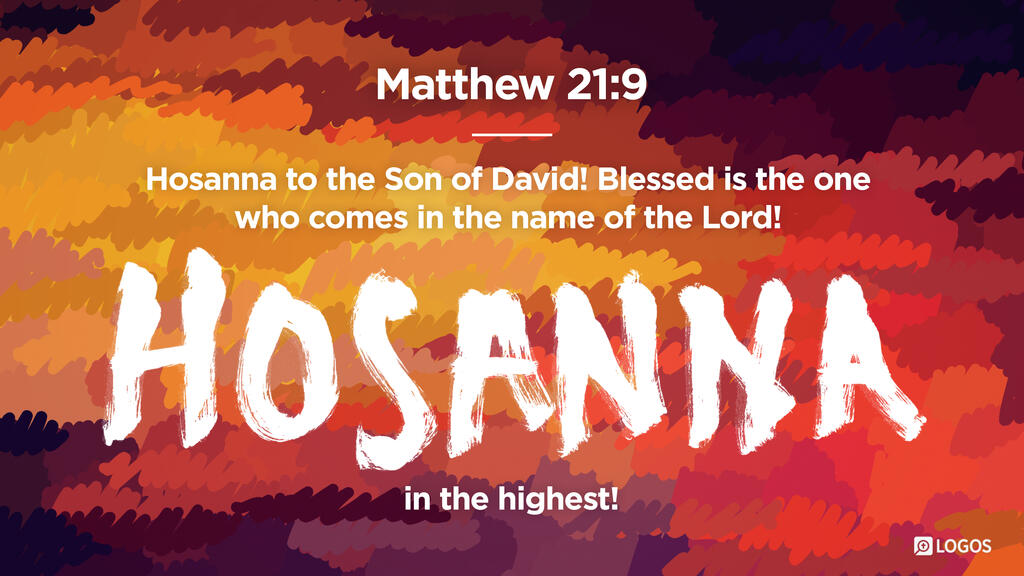
“Hosanna to the Son of David!
Blessed is the one who comes in the name of the Lord!d
Hosanna in the highest heaven!”*
10And when* he entered into Jerusalem, the whole city was stirred up, saying, “Who is this?” 11And the crowds were saying, “This is the prophet Jesus from Nazareth of Galilee!”
Footnotes
- *Here the direct object is supplied from context in the English translation
- *Here “and” is supplied because the previous participle (“untie”) has been translated as a finite verb
- *Here the direct object is supplied from context in the English translation
- aLiterally “has need of them”
- bOr “even”
- cA quotation from Zech 9:9
- *Here the participle (“went”) is translated as a finite verb because of English style
- *Here the participle (“did”) is translated as a finite verb because of English style
- *Here “and” is supplied because the previous participles (“went” and “did” in the previous verse) have been translated as finite verbs
- *Literally “the”; the Greek article is used here as a possessive pronoun
- *Here the direct object is supplied from context in the English translation
- dA quotation from Ps 118:25–26
- *Here “heaven” is understood
- *Here “when” is supplied as a component of the temporal genitive absolute participle (“entered”)
Copyright 2012 Lexham Press