Matthew 1:6–2:1
The Lexham English BibleOther versions
English
- LEB The Lexham English Bible
- DARBY 1890 Darby Bible
- ASV American Standard Version
- AV 1873 The Cambridge Paragraph Bible of the Authorized English Version
- CSB Christian Standard Bible
- D-R Douay-Rheims Bible
- ESV English Standard Version
- GW GOD’S WORD Translation
- GNB Good News Translation
- HCSB The Holman Christian Standard Bible
- KJV 1900 King James Version
- LSB Legacy Standard Bible
- MSG The Message: The Bible in Contemporary Language
- NET The NET Bible
- NASB95 New American Standard Bible (1995)
- NCV New Century Version
- NIrV New International Reader’s Version (1998)
- NIV New International Version (2011)
- NKJV The New King James Version
- NLT New Living Translation
- NRSVue New Revised Standard Version: Updated Edition
- RSV The Revised Standard Version
- RSVCE The Revised Standard Version, Catholic Edition
- YLT Young’s Literal Translation
Arabic
Czech
French
German
Greek
Hungarian
Italian
Korean
Latin
Portuguese
Russian
Simplified Chinese
Spanish
Traditional Chinese
6and Jesse became the father of David the king.
And David became the father of Solomon by the wife* of Uriah, 7and Solomon became the father of Rehoboam, and Rehoboam became the father of Abijah, and Abijah became the father of Asa,b 8and Asa became the father of Jehoshaphat,c and Jehoshaphat became the father of Joram, and Joram became the father of Uzziah, 9and Uzziah became the father of Jotham, and Jotham became the father of Ahaz, and Ahaz became the father of Hezekiah, 10and Hezekiah became the father of Manasseh, and Manasseh became the father of Amon,d and Amon became the father of Josiah, 11and Josiah became the father of Jechoniah and his brothers, at the time of the deportation to Babylon.
12And after the deportation to Babylon, Jechoniah became the father of Shealtiel,e and Shealtiel became the father of Zerubbabel, 13and Zerubbabel became the father of Abiud, and Abiud became the father of Eliakim, and Eliakim became the father of Azor, 14and Azor became the father of Zadok, and Zadok became the father of Achim, and Achim became the father of Eliud, 15and Eliud became the father of Eleazar, and Eleazar became the father of Matthan, and Matthan became the father of Jacob, 16and Jacob became the father of Joseph, the husband of Mary by whomf was born Jesus, who is called Christ.
17Therefore all the generations from Abraham to David are fourteen generations, and from David to the deportation to Babylon are fourteen generations, and from the deportation to Babylon to the Christ are fourteen generations.
The Birth of Jesus Christ
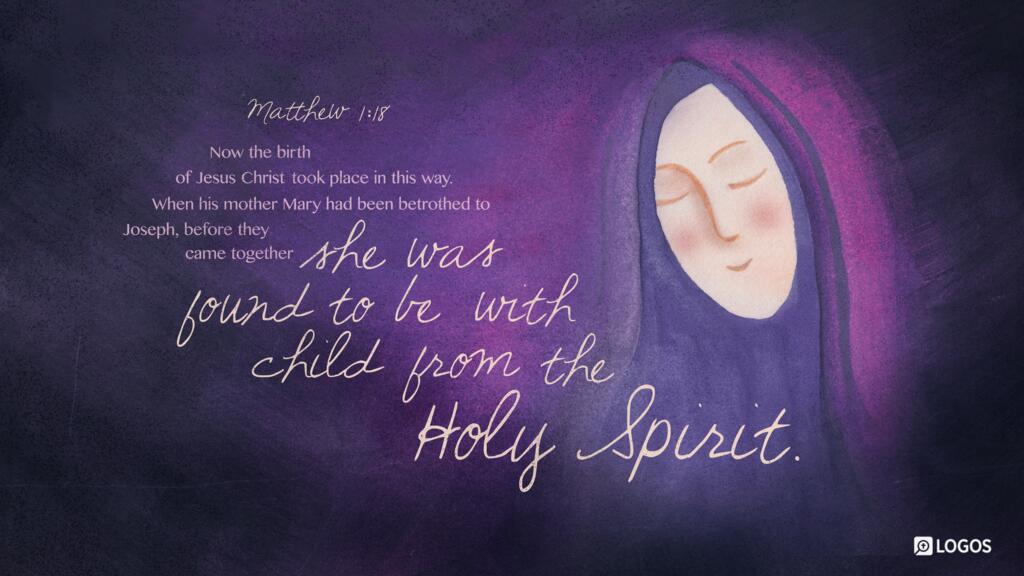
18Now the birth of Jesus Christ occurred in this way. His mother Mary had been betrothed to Joseph, but before they came together, she was found to be pregnantg by the Holy Spirit. 19So Joseph her husband, being righteous and not wanting to disgrace her, intended to divorce her secretly. 20But as* he was considering these things, behold, an angel of the Lord appeared to him in a dream, saying, “Joseph, son of David, do not be afraid to take Mary as your wife, for what has been conceived in her is from the Holy Spirit. 21And she will give birth to a son, and you will call his name ‘Jesus,’ because he will save his people from their sins.” 22Now all this happened in order that what was spoken by the Lord through the prophet would be fulfilled, saying,
23“Behold, the virgin will become pregnanth and will give birth to a son,
and they will call his name Emmanuel,”i
which is translated, “God with us.”j 24And Joseph, when he* woke up from sleep, did as the angel of the Lord commanded him, and he took his wife 25and did not have sexual relations withk her until she gave birth to a son. And he called his name Jesus.
Wise Men Visit Jesus
2Now after* Jesus was born in Bethlehem of Judea in the days of Herod the king, behold, wise men from the east came to Jerusalem,
Footnotes
- *The word “wife” is not in the Greek text, but is implied idiomatically
- bGreek “Asaph,” alternately spelled “Asa” in many English versions here and in the following verse (cf. 1 Chr 3:10)
- cGreek “Josaphat”; alternately spelled “Jehoshaphat” in many English versions
- dThe earliest and best Greek manuscripts read “Amos,” but many English versions use the Old Testament form of the name here, “Amon” (cf. 2 Kgs 21:18)
- eGreek “Salathiel,” but many English versions use the Old Testament form of the name here, “Shealtiel” (cf. Ezra 3:2)
- fThe Greek relative pronoun is feminine gender and thus refers only to Mary, not Joseph
- gLiterally “to have in the womb”
- *Here “as” is supplied as a component of the temporal genitive absolute participle (“considering”)
- hLiterally “will have in the womb”
- iA quotation from Isa 7:14
- jAn allusion to Isa 8:8, 10 in the Greek OT (LXX)
- *Here “when” is supplied as a component of the participle (“woke up”) which is understood as temporal
- kLiterally “did not know”
- *Here “after” is supplied as a component of the temporal genitive absolute participle (“was born”)
Copyright 2012 Lexham Press