Matthew 1:18–2:12
The Lexham English BibleOther versions
English
- LEB The Lexham English Bible
- DARBY 1890 Darby Bible
- ASV American Standard Version
- AV 1873 The Cambridge Paragraph Bible of the Authorized English Version
- CSB Christian Standard Bible
- D-R Douay-Rheims Bible
- ESV English Standard Version
- GW GOD’S WORD Translation
- GNB Good News Translation
- HCSB The Holman Christian Standard Bible
- KJV 1900 King James Version
- LSB Legacy Standard Bible
- MSG The Message: The Bible in Contemporary Language
- NET The NET Bible
- NASB95 New American Standard Bible (1995)
- NCV New Century Version
- NIrV New International Reader’s Version (1998)
- NIV New International Version (2011)
- NKJV The New King James Version
- NLT New Living Translation
- NRSVue New Revised Standard Version: Updated Edition
- RSV The Revised Standard Version
- RSVCE The Revised Standard Version, Catholic Edition
- YLT Young’s Literal Translation
Arabic
Czech
French
German
Greek
Hungarian
Italian
Korean
Latin
Portuguese
Russian
Simplified Chinese
Spanish
Traditional Chinese
The Birth of Jesus Christ
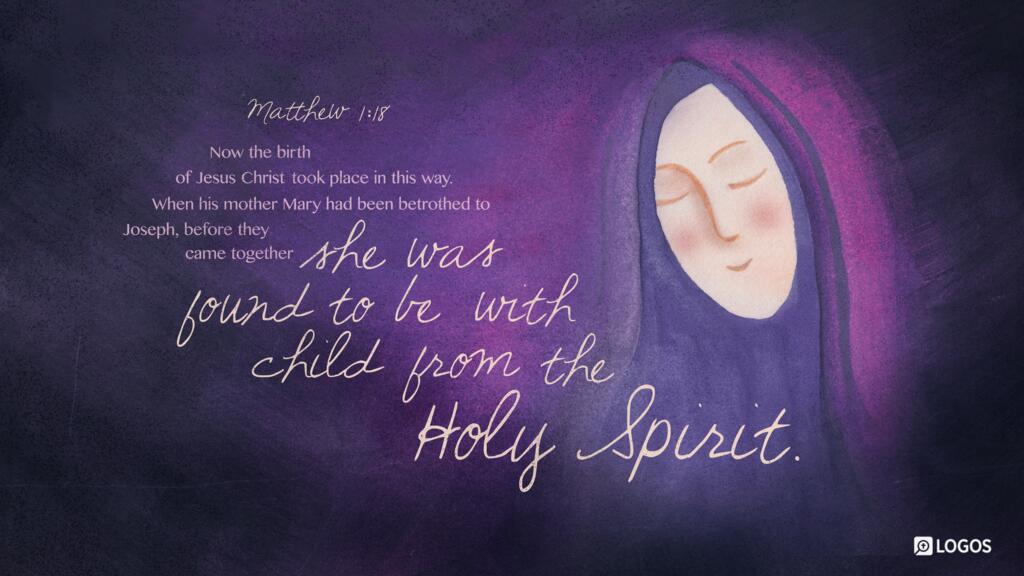
18Now the birth of Jesus Christ occurred in this way. His mother Mary had been betrothed to Joseph, but before they came together, she was found to be pregnantg by the Holy Spirit. 19So Joseph her husband, being righteous and not wanting to disgrace her, intended to divorce her secretly. 20But as* he was considering these things, behold, an angel of the Lord appeared to him in a dream, saying, “Joseph, son of David, do not be afraid to take Mary as your wife, for what has been conceived in her is from the Holy Spirit. 21And she will give birth to a son, and you will call his name ‘Jesus,’ because he will save his people from their sins.” 22Now all this happened in order that what was spoken by the Lord through the prophet would be fulfilled, saying,
23“Behold, the virgin will become pregnanth and will give birth to a son,
and they will call his name Emmanuel,”i
which is translated, “God with us.”j 24And Joseph, when he* woke up from sleep, did as the angel of the Lord commanded him, and he took his wife 25and did not have sexual relations withk her until she gave birth to a son. And he called his name Jesus.
Wise Men Visit Jesus
2Now after* Jesus was born in Bethlehem of Judea in the days of Herod the king, behold, wise men from the east came to Jerusalem, 2saying, “Where is the one who has been born king of the Jews? For we have seen his star at its risinga and have come to worship him.” 3And when* King Herod heard it,* he was troubled, and all Jerusalem with him, 4and after* calling together all the chief priests and scribes of the people, he inquired from them where the Christ was to be born. 5So they said to him, “In Bethlehem of Judea, for thus it is written by the prophet,
6‘And you, Bethlehem, land of Judah,
are by no means least among the rulers of Judah,
for from you will go out a ruler
who will shepherd my people Israel.’ ”b
7Then Herod secretly summoned the wise men and* determined precisely from them the time when* the star appeared. 8And he sent them to Bethlehem and* said, “Go, inquire carefully concerning the child, and when you have found him, report to me so that I also may come and* worship him.” 9After* they listened to the king, they went out, and behold, the star which they had seen at its risingc led them until it came and* stood above the place where the child was. 10Now when they* saw the star, they rejoiced with very great joy. 11And when they* came into the house, they saw the child with Mary his mother, and they fell down and* worshiped him. And opening their treasure boxes, they offered him gifts of gold and frankincense and myrrh. 12And being warned in a dream not to return to Herod, they went back to their own country by another route.
Footnotes
- gLiterally “to have in the womb”
- *Here “as” is supplied as a component of the temporal genitive absolute participle (“considering”)
- hLiterally “will have in the womb”
- iA quotation from Isa 7:14
- jAn allusion to Isa 8:8, 10 in the Greek OT (LXX)
- *Here “when” is supplied as a component of the participle (“woke up”) which is understood as temporal
- kLiterally “did not know”
- *Here “after” is supplied as a component of the temporal genitive absolute participle (“was born”)
- aOr, “when it rose”; traditionally rendered “in the east” by many English versions
- *Here “when” is supplied as a component of the participle (“heard”) which is understood as temporal
- *Here the direct object is supplied from context in the English translation
- *Here “after” is supplied as a component of the participle (“calling together”) which is understood as temporal
- bA quotation from Mic 5:2
- *Here “and” is supplied because the previous participle (“summoned”) has been translated as a finite verb
- *Here “when” is supplied as a component of the temporal genitive absolute participle (“appeared”)
- *Here “and” is supplied because the previous participle (“sent”) has been translated as a finite verb
- *Here “and” is supplied because the previous participle (“may come”) has been translated as a finite verb
- *Here “after” is supplied as a component of the participle (“listened to”) which is understood as temporal
- cOr, “when it rose”; traditionally rendered “in the east” by many English versions
- *Here “and” is supplied because the previous participle (“came”) has been translated as a finite verb
- *Here “when” is supplied as a component of the participle (“saw”) which is understood as temporal
- *Here “when” is supplied as a component of the participle (“came”) which is understood as temporal
- *Here “and” is supplied because the previous participle (“fell down”) has been translated as a finite verb
Copyright 2012 Lexham Press