Mark 15:1–15
The Lexham English BibleOther versions
English
- LEB The Lexham English Bible
- DARBY 1890 Darby Bible
- ASV American Standard Version
- AV 1873 The Cambridge Paragraph Bible of the Authorized English Version
- CSB Christian Standard Bible
- D-R Douay-Rheims Bible
- ESV English Standard Version
- GW GOD’S WORD Translation
- GNB Good News Translation
- HCSB The Holman Christian Standard Bible
- KJV 1900 King James Version
- LSB Legacy Standard Bible
- MSG The Message: The Bible in Contemporary Language
- NET The NET Bible
- NASB95 New American Standard Bible (1995)
- NCV New Century Version
- NIrV New International Reader’s Version (1998)
- NIV New International Version (2011)
- NKJV The New King James Version
- NLT New Living Translation
- NRSVue New Revised Standard Version: Updated Edition
- RSV The Revised Standard Version
- RSVCE The Revised Standard Version, Catholic Edition
- YLT Young’s Literal Translation
Arabic
Czech
French
German
Greek
Hungarian
Italian
Korean
Latin
Portuguese
Russian
Simplified Chinese
Spanish
Traditional Chinese
Jesus Taken to Pilate
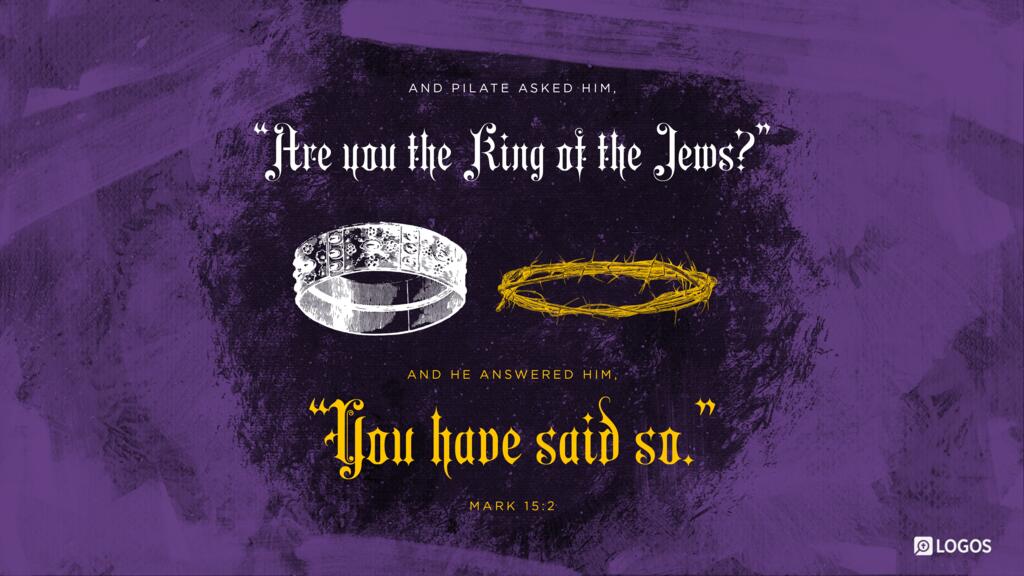
15And as soon as morning came, after* formulating a plan, the chief priests, with the elders and scribes and the whole Sanhedrin, tied up Jesus, led him* away, and handed him* over to Pilate. 2And Pilate asked him, “Are you the king of the Jews?” And he answered him and* said, “You say so.” 3And the chief priests began to accusea him of many things. 4So Pilate asked him again, saying, “Do you not answer anything? See how many charges* they are bringing against you!” 5But Jesus did not answer anything further, so that Pilate was astonished.
Pilate Releases Barabbas
6Now at each feast he customarily releasedb for them one prisoner whom they requested. 7And the one named Barabbasc was imprisoned with the rebels who had committed murder in the rebellion. 8And the crowd came up and* began to ask him to do as he customarily didd for them. 9So Pilate answered them, saying, “Do you want me to release for you the king of the Jews?” 10(For he realized that the chief priests had handed him over because of envy.) 11But the chief priests incited the crowd so that he would release for them Barabbas* instead. 12So Pilate answered and said to them again, “Then what do you want me to do with the one whom you call the king of the Jews?” 13And they shouted again, “Crucify him!” 14And Pilate said to them, “Why? What evil has he done?” But they shouted even louder, “Crucify him!”
15So Pilate, because he* wanted to satisfye the crowd, released for them Barabbas. And after* he had Jesus flogged, he handed him* over so that he could be crucified.
Footnotes
- *Here “after” is supplied as a component of the participle (“formulating”) which is understood as temporal
- *Here the direct object is supplied from context in the English translation
- *Here the direct object is supplied from context in the English translation
- *Here “and” is supplied because the previous participle (“answered”) has been translated as a finite verb
- aThe imperfect tense has been translated as ingressive here (“began to accuse”)
- *The word “charges” is not in the Greek text but is implied
- bThe imperfect tense has been translated as customary here (“customarily released”)
- c“Barabbas” means “son of the father” in Aramaic
- *Here “and” is supplied because the previous participle (“came up”) has been translated as a finite verb
- dThe imperfect tense has been translated as customary here (“customarily did”)
- *Here “and” is supplied because the previous participle (“answered”) has been translated as a finite verb
- *Here “because” is supplied as a component of the participle (“wanted”) which is understood as causal
- eLiterally “to make sufficient”
- *Here “after” is supplied as a component of the participle (“flogged”) which is understood as temporal
- *Here the direct object is supplied from context in the English translation
Copyright 2012 Lexham Press