Luke 4:16–29
The Lexham English BibleOther versions
English
- LEB The Lexham English Bible
- DARBY 1890 Darby Bible
- ASV American Standard Version
- AV 1873 The Cambridge Paragraph Bible of the Authorized English Version
- CSB Christian Standard Bible
- D-R Douay-Rheims Bible
- ESV English Standard Version
- GW GOD’S WORD Translation
- GNB Good News Translation
- HCSB The Holman Christian Standard Bible
- KJV 1900 King James Version
- LSB Legacy Standard Bible
- MSG The Message: The Bible in Contemporary Language
- NET The NET Bible
- NASB95 New American Standard Bible (1995)
- NCV New Century Version
- NIrV New International Reader’s Version (1998)
- NIV New International Version (2011)
- NKJV The New King James Version
- NLT New Living Translation
- NRSVue New Revised Standard Version: Updated Edition
- RSV The Revised Standard Version
- RSVCE The Revised Standard Version, Catholic Edition
- TNIV Today’s New International Version
- YLT Young’s Literal Translation
Arabic
Czech
French
German
Greek
Hungarian
Italian
Korean
Latin
Portuguese
Russian
Simplified Chinese
Spanish
Traditional Chinese
Rejected at Nazareth
16And he came to Nazareth, where he had been brought up,g and according to his customh he entered into the synagogue on the day of the Sabbath and stood up to read. 17And the scroll of the prophet Isaiah was given to him, and unrolling the scroll he found the place where it was written,
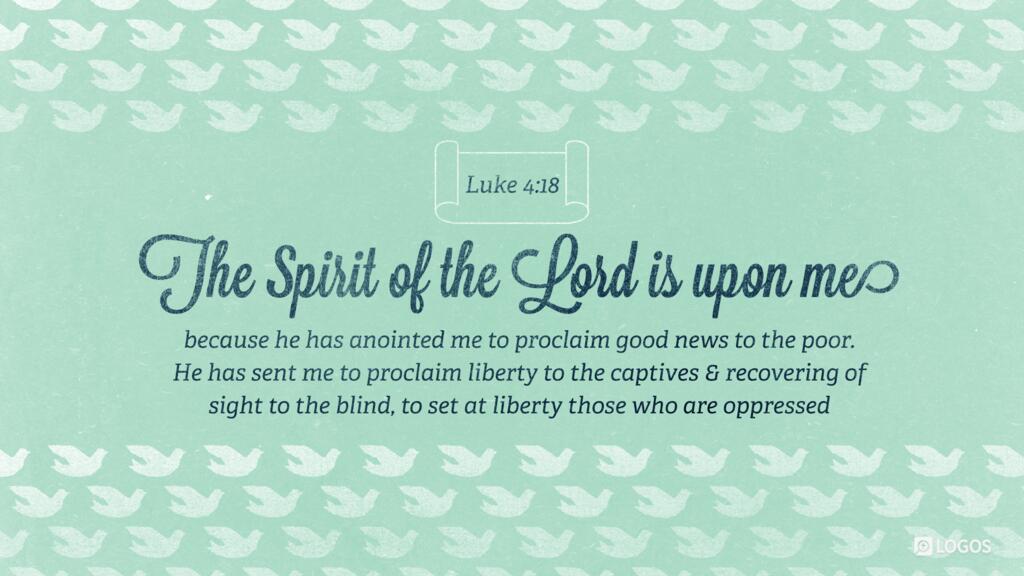
18“The Spirit of the Lord is upon me,
because of which he has anointed me
to proclaim good news to the poor.
He has sent me
to proclaim release to the captives,
and recovery of sight to the blind,
to send out in freedom those who are oppressed,
19to proclaim the favorable year of the Lord.”i
20And he rolled up the scroll and* gave it* back to the attendant and* sat down. And the eyes of everyone in the synagogue were looking intently at him. 21And he began to say to them, “Today this scripture has been fulfilled in your hearing.” 22And they were all speaking well of him, and were astonished at the gracious words that were coming out of his mouth. And they were saying, “Is this man not the son of Joseph?” 23And he said to them, “Doubtless you will tell me this parable: ‘Physician, heal yourself!’ Whatever we have heard that took place in Capernaum, do here in your hometown also!” 24And he said, “Truly I say to you that no prophet is acceptable in his own hometown. 25But in truth I say to you, there were many widows in Israel in the days of Elijah, when the sky was shut for three years and six months while a great famine took place over all the land. 26And Elijah was sent to none of them, but only to Zarephath in the region of Sidon, to a woman who was a widow. 27And there were many lepers in Israel in the time of the prophet Elisha, and none of them was made clean except Naaman the Syrian.” 28And all those in the synagogue were filled with anger when they* heard these things. 29And they stood up and* forced him out of the town and brought him up to the edge of the hill on which their town was built, so that they could throw him down the cliff.
Footnotes
- gLiterally “he was having been brought up”
- hLiterally “what he was accustomed to for him”
- iA quotation from Isa 61:1–2, with one line from Isa 58:6
- *Here “and” is supplied because the previous participle (“rolled up”) has been translated as a finite verb
- *Here the direct object is supplied from context in the English translation
- *Here “and” is supplied because the previous participle (“gave … back”) has been translated as a finite verb
- *Here “when” is supplied as a component of the participle (“heard”) which is understood as temporal
- *Here “and” is supplied because the previous participle (“stood up”) has been translated as a finite verb
Copyright 2012 Lexham Press