John 7:14–24
The Lexham English BibleOther versions
English
- LEB The Lexham English Bible
- DARBY 1890 Darby Bible
- ASV American Standard Version
- AV 1873 The Cambridge Paragraph Bible of the Authorized English Version
- CSB Christian Standard Bible
- D-R Douay-Rheims Bible
- ESV English Standard Version
- GW GOD’S WORD Translation
- GNB Good News Translation
- HCSB The Holman Christian Standard Bible
- KJV 1900 King James Version
- LSB Legacy Standard Bible
- MSG The Message: The Bible in Contemporary Language
- NET The NET Bible
- NASB95 New American Standard Bible (1995)
- NCV New Century Version
- NIrV New International Reader’s Version (1998)
- NIV New International Version (2011)
- NKJV The New King James Version
- NLT New Living Translation
- NRSVue New Revised Standard Version: Updated Edition
- RSV The Revised Standard Version
- RSVCE The Revised Standard Version, Catholic Edition
- YLT Young’s Literal Translation
Arabic
Czech
French
German
Greek
Hungarian
Italian
Korean
Latin
Portuguese
Russian
Simplified Chinese
Spanish
Traditional Chinese
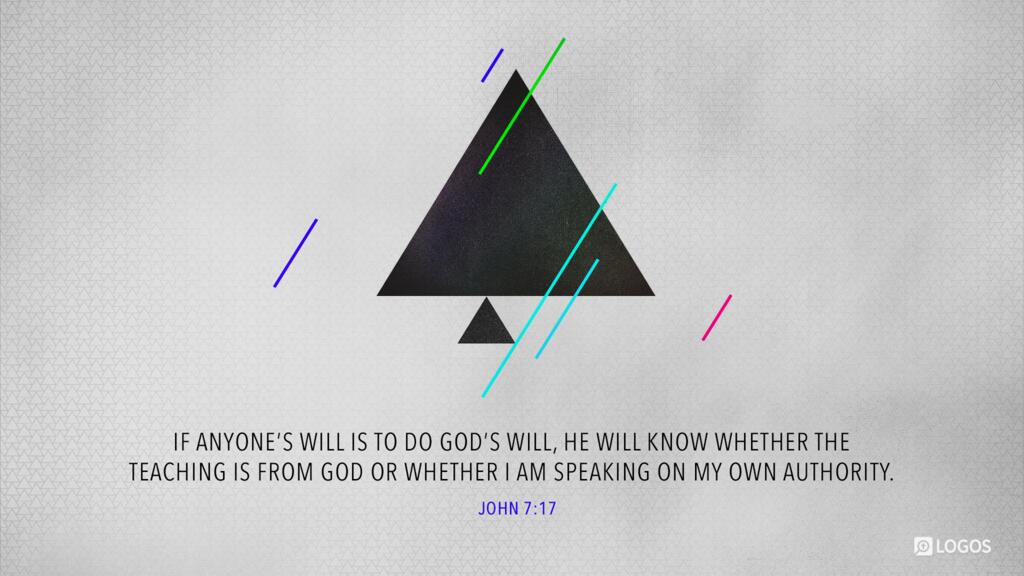
14Now when the feast was already half over,d Jesus went to the temple courts* and began to teach.* 15Then the Jews were astonished, saying, “How does this man possess knowledge,e because he* has not been taught?” 16So Jesus answered them and said, “My teaching is not mine, but is from the one who sent me. 17If anyone wants to do his will, he will know about my* teaching, whether it is from God or I am speaking from myself. 18The one who speaks from himself seeks his own glory. But the one who seeks the glory of the one who sent him—this one is true, and there is no unrighteousness in him. 19Has not Moses given you the law, and none of you carries out the law? Why do you seek to kill me?”
20The crowd replied, “You have a demon! Who is seeking to kill you?” 21Jesus answered and said to them, “I performed one work, and you are all astonished. 22Because of this Moses has given you circumcision (not that it is from Moses, but from the fathers), and you circumcise a man on the Sabbath. 23If a man receives circumcision on the Sabbath so that the law of Moses would not be broken, are you angry with me because I made a whole man wellf on the Sabbath? 24Do not judge according to outward appearance, but judge according to righteous judgment!”
Footnotes
- dLiterally “now it being already in the middle of the feast”
- *Here “courts” is supplied to distinguish this area from the interior of the temple building itself
- *The imperfect tense has been translated as ingressive here (“began to teach”)
- eLiterally “know letters”
- *Here “because” is supplied as a component of the participle (“been taught”) which is understood as causal
- *Literally “the”; the Greek article is used here as a possessive pronoun
- fOr “a man entirely well”
Copyright 2012 Lexham Press