John 4:13–26
The Lexham English BibleOther versions
English
- LEB The Lexham English Bible
- DARBY 1890 Darby Bible
- ASV American Standard Version
- AV 1873 The Cambridge Paragraph Bible of the Authorized English Version
- CSB Christian Standard Bible
- D-R Douay-Rheims Bible
- ESV English Standard Version
- GW GOD’S WORD Translation
- GNB Good News Translation
- HCSB The Holman Christian Standard Bible
- KJV 1900 King James Version
- LSB Legacy Standard Bible
- MSG The Message: The Bible in Contemporary Language
- NET The NET Bible
- NASB95 New American Standard Bible (1995)
- NCV New Century Version
- NIrV New International Reader’s Version (1998)
- NIV New International Version (2011)
- NKJV The New King James Version
- NLT New Living Translation
- NRSVue New Revised Standard Version: Updated Edition
- RSV The Revised Standard Version
- RSVCE The Revised Standard Version, Catholic Edition
- YLT Young’s Literal Translation
Arabic
Czech
French
German
Greek
Hungarian
Italian
Korean
Latin
Portuguese
Russian
Simplified Chinese
Spanish
Traditional Chinese
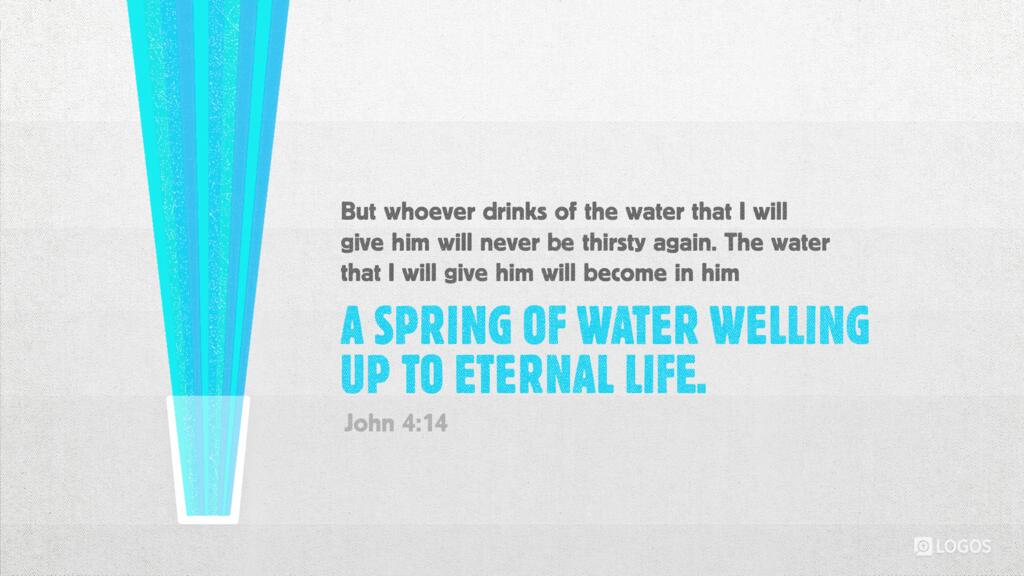
13Jesus answered and said to her, “Everyone who drinks of this water will be thirsty again. 14But whoever drinks of this water which I will give to him will never be thirsty for eternity, but the water which I will give to him will become in him a well of water springing up to eternal life.” 15The woman said to him, “Sir, give me this water, so that I will not be thirsty or come here to draw water!”* 16He said to her, “Go, call your husband and come here.” 17The woman answered and said to him, “I do not have a husband.” Jesus said to her, “You have said rightly, ‘I do not have a husband,’ 18for you have had five husbands, and the one whom you have now is not your husband; this you have said truthfully!”
19The woman said to him, “Sir, I see that you are a prophet. 20Our fathers worshiped on this mountain, and you people* say that in Jerusalem is the place where it is necessary to worship.” 21Jesus said to her, “Believe me, woman, that an hour is coming when neither on this mountain nor in Jerusalem will you worship the Father. 22You worship what you do not know. We worship what we know, because salvation is from the Jews. 23But an hour is coming—and now is here*—when the true worshipers will worship the Father in spirit and truth, for indeed the Father seeks such people to be his worshipers. 24God is spirit, and the ones who worship him must worship in spirit and truth.” 25The woman said to him, “I know that Messiah is coming” (the one called Christ); “whenever that one comes, he will proclaim all things to us.” 26Jesus said to her, “I, the one speaking to you, am he.*
Footnotes
Copyright 2012 Lexham Press