John 20:24–31
The Lexham English BibleOther versions
English
- LEB The Lexham English Bible
- DARBY 1890 Darby Bible
- ASV American Standard Version
- AV 1873 The Cambridge Paragraph Bible of the Authorized English Version
- CSB Christian Standard Bible
- D-R Douay-Rheims Bible
- ESV English Standard Version
- GW GOD’S WORD Translation
- GNB Good News Translation
- HCSB The Holman Christian Standard Bible
- KJV 1900 King James Version
- LSB Legacy Standard Bible
- MSG The Message: The Bible in Contemporary Language
- NET The NET Bible
- NASB95 New American Standard Bible (1995)
- NCV New Century Version
- NIrV New International Reader’s Version (1998)
- NIV New International Version (2011)
- NKJV The New King James Version
- NLT New Living Translation
- NRSVue New Revised Standard Version: Updated Edition
- RSV The Revised Standard Version
- RSVCE The Revised Standard Version, Catholic Edition
- TNIV Today’s New International Version
- YLT Young’s Literal Translation
Arabic
Czech
French
German
Greek
Hungarian
Italian
Korean
Latin
Portuguese
Russian
Simplified Chinese
Spanish
Traditional Chinese
Thomas Doubts But Later Believes
24Now Thomas, one of the twelve, who was called Didymus,b was not with them when Jesus came. 25So the other disciples said to him, “We have seen the Lord!” But he said to them, “Unless I see in his hands the mark of the nails, and put my finger into the mark of the nails, and put my hand into his side, I will never believe!”
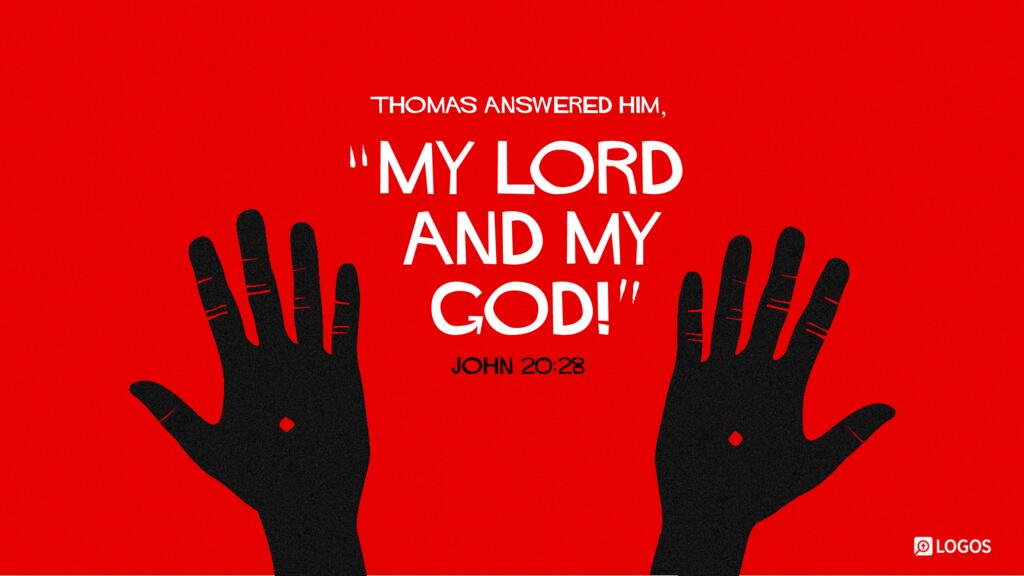
26And after eight days his disciples were again inside, and Thomas with them. Although* the doors had been shut, Jesus came and stood in their midst and said, “Peace to you.” 27Then he said to Thomas, “Place your finger here and see my hands, and place your hand and put it* into my side. And do not be unbelieving, but believing!” 28Thomas answered and said to him, “My Lord and my God!” 29Jesus said to him, “Because you have seen me, have you believed? Blessed are those who have not seen and have believed.”
Why This Book Was Written
30Now Jesus also performed many other signs in the presence of the disciplesc which are not recorded in this book, 31but these things are recorded in order that you may believe that Jesus is the Christ, the Son of God, and that by* believing you may have life in his name.
Footnotes
- bThe Greek term means “the Twin”
- *Here “although” is supplied as a component of the participle (“had been shut”) which is understood as concessive
- *Here the direct object is supplied from context in the English translation
- cSome manuscripts have “his disciples”
- *Here “by” is supplied as a component of the participle (“believing”) which is understood as means
Copyright 2012 Lexham Press