John 18:33–40
The Lexham English BibleOther versions
English
- LEB The Lexham English Bible
- DARBY 1890 Darby Bible
- ASV American Standard Version
- AV 1873 The Cambridge Paragraph Bible of the Authorized English Version
- CSB Christian Standard Bible
- D-R Douay-Rheims Bible
- ESV English Standard Version
- GW GOD’S WORD Translation
- GNB Good News Translation
- HCSB The Holman Christian Standard Bible
- KJV 1900 King James Version
- LSB Legacy Standard Bible
- MSG The Message: The Bible in Contemporary Language
- NET The NET Bible
- NASB95 New American Standard Bible (1995)
- NCV New Century Version
- NIrV New International Reader’s Version (1998)
- NIV New International Version (2011)
- NKJV The New King James Version
- NLT New Living Translation
- NRSVue New Revised Standard Version: Updated Edition
- RSV The Revised Standard Version
- RSVCE The Revised Standard Version, Catholic Edition
- TNIV Today’s New International Version
- YLT Young’s Literal Translation
Arabic
Czech
French
German
Greek
Hungarian
Italian
Korean
Latin
Portuguese
Russian
Simplified Chinese
Spanish
Traditional Chinese
Pilate Questions Jesus
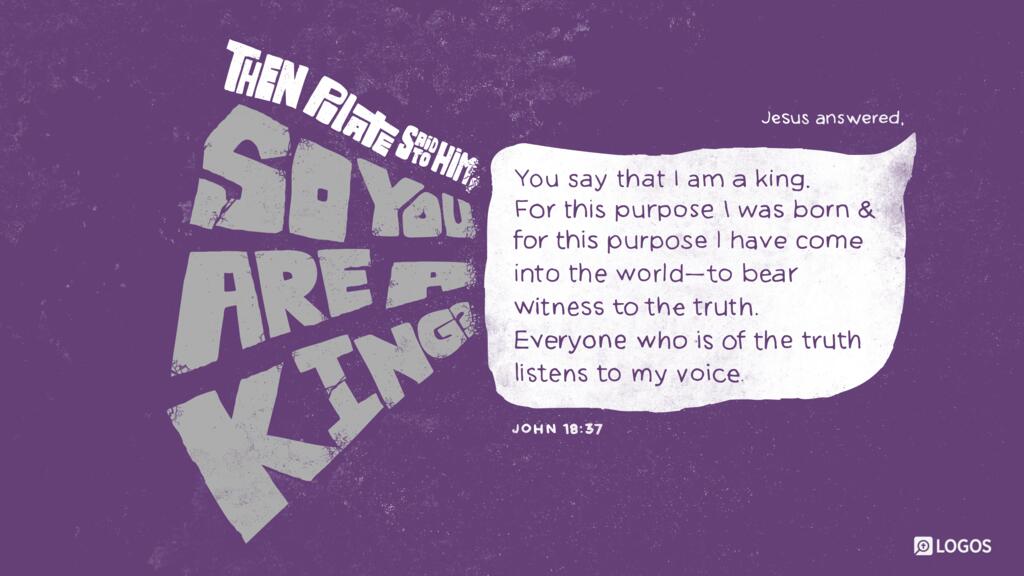
33Then Pilate entered again into the governor’s residence and summoned Jesus and said to him, “Are you the king of the Jews?” 34Jesus replied, “Do you say this from yourself, or have others said this* to you about me?” 35Pilate replied, “I am not a Jew, am I?* Your people and the chief priests handed you over to me! What have you done?” 36Jesus replied, “My kingdom is not of this world. If my kingdom were of this world, my servants would be fighting so that I would not be handed over to the Jews. But now my kingdom is not from here.” 37Then Pilate said to him, “So then you are a king!” Jesus replied, “You say that I am a king. For this reason I was born, and for this reason I have come into the world: in order that I can testify to the truth. Everyone who is of the truth hears my voice.” 38Pilate said to him, “What is truth?”
And when he* had said this, he went out again to the Jews and said to them, “I find no basis for an accusation against him. 39But it is your custom that I release for you one prisoner* at the Passover. So do you want me* to release for you the king of the Jews?” 40Then they shouted again, saying, “Not this man, but Barabbas!” (Now Barabbas was a revolutionary.)c
Footnotes
- *Here the direct object is supplied from context in the English translation
- *The negative construction in Greek anticipates a negative answer here, indicated in the translation by the phrase “am I”
- *Here “when” is supplied as a component of the participle (“had said”) which is understood as temporal
- *The word “prisoner” is not in the Greek text, but is implied
- *Here the direct object is supplied from context in the English translation
- cOr perhaps “robber”
Copyright 2012 Lexham Press