Acts 2:36–47
The Lexham English BibleOther versions
English
- LEB The Lexham English Bible
- DARBY 1890 Darby Bible
- ASV American Standard Version
- AV 1873 The Cambridge Paragraph Bible of the Authorized English Version
- CSB Christian Standard Bible
- D-R Douay-Rheims Bible
- ESV English Standard Version
- GW GOD’S WORD Translation
- GNB Good News Translation
- HCSB The Holman Christian Standard Bible
- KJV 1900 King James Version
- LSB Legacy Standard Bible
- MSG The Message: The Bible in Contemporary Language
- NET The NET Bible
- NASB95 New American Standard Bible (1995)
- NCV New Century Version
- NIrV New International Reader’s Version (1998)
- NIV New International Version (2011)
- NKJV The New King James Version
- NLT New Living Translation
- NRSVue New Revised Standard Version: Updated Edition
- RSV The Revised Standard Version
- RSVCE The Revised Standard Version, Catholic Edition
- YLT Young’s Literal Translation
Arabic
Czech
French
German
Greek
Hungarian
Italian
Korean
Latin
Portuguese
Russian
Simplified Chinese
Spanish
Traditional Chinese
36Therefore let all the house of Israel know beyond a doubt, that God has made him both Lord and Christ—this Jesus whom you crucified!”
The Response to Peter’s Sermon
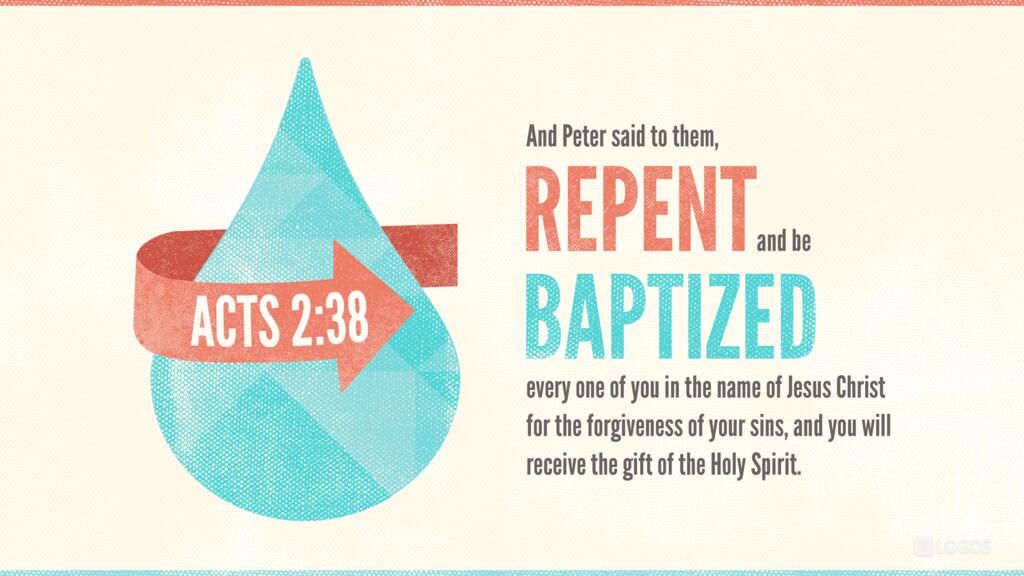
37Now when they* heard this,* they were pierced to the heart and said to Peter and the other apostles, “What should we do, men and brothers?” 38And Peter saidq to them, “Repent and be baptized, each one of you, in the name of Jesus Christ for the forgiveness of your sins, and you will receive the gift of the Holy Spirit. 39For the promise is for you and for your children, and for all those who are far away, as many as the Lord our God calls to himself.” 40And with many other words he solemnly urged and exhorted them, saying, “Be saved from this crooked generation!” 41So those who accepted his message were baptized, and on that day about three thousand souls were added.
The Fellowship of the First Believers
42And they were devoting themselves to the teaching of the apostles and to fellowship, to the breaking of bread and to prayers. 43And fear came on every soul, and many wonders and signs were being performed by the apostles. 44And all who believed were in the same place, and had everything in common. 45And they began selling* their* possessions and property, and distributing these things to all, to the degree that anyone had need. 46And every day, devoting themselves to meeting* with one purpose in the temple courts* and breaking bread from house to house, they were eating their food with joy and simplicity of heart, 47praising God and having favor with all the people. And the Lord was adding every day to the total of those who were being saved.
Footnotes
- *Here “when” is supplied as a component of the participle (“heard”) which is understood as temporal
- *Here the direct object is supplied from context in the English translation
- qSome manuscripts explicitly add “said”
- *The imperfect tense has been translated as ingressive here (“began selling”)
- *Literally “the”; the Greek article is used here as a possessive pronoun
- *The words “to meeting” are not in the Greek text but are implied
- *Here “courts” is supplied to distinguish this area from the interior of the temple building itself
Copyright 2012 Lexham Press