Acts 2:1–29
The Lexham English BibleOther versions
English
- LEB The Lexham English Bible
- DARBY 1890 Darby Bible
- ASV American Standard Version
- AV 1873 The Cambridge Paragraph Bible of the Authorized English Version
- CSB Christian Standard Bible
- D-R Douay-Rheims Bible
- ESV English Standard Version
- GW GOD’S WORD Translation
- GNB Good News Translation
- HCSB The Holman Christian Standard Bible
- KJV 1900 King James Version
- LSB Legacy Standard Bible
- MSG The Message: The Bible in Contemporary Language
- NET The NET Bible
- NASB95 New American Standard Bible (1995)
- NCV New Century Version
- NIrV New International Reader’s Version (1998)
- NIV New International Version (2011)
- NKJV The New King James Version
- NLT New Living Translation
- NRSVue New Revised Standard Version: Updated Edition
- RSV The Revised Standard Version
- RSVCE The Revised Standard Version, Catholic Edition
- YLT Young’s Literal Translation
Arabic
Czech
French
German
Greek
Hungarian
Italian
Korean
Latin
Portuguese
Russian
Simplified Chinese
Spanish
Traditional Chinese
Pentecost and the Coming of the Holy Spirit
2And when the day of Pentecost had come, they were all together in the same place. 2And suddenly a sound like a violent rushing wind came from heaven and filled the whole house where they were sitting. 3And divideda tongues like fire appeared to them and rested on each one of them. 4And they were all filled with the Holy Spirit and began to speak in other languagesb as the Spirit gave them ability to speak out.
5Now there were Jews residing in Jerusalem, devout men from every nation under heaven. 6And when* this sound occurred, the crowd gathered and was in confusion, because each one was hearing them speaking in his own language. 7And they were astounded and astonished, saying, “Behold, are not all these who are speaking Galileans? 8And how do we hear, each one of us, in our own native language?c 9Parthians and Medes and Elamites and those residing in Mesopotamia, Judea and Cappadocia, Pontus and Asia,d 10Phrygia and Pamphylia, Egypt and the parts of Libya toward Cyrene, and the Romans who were in town, 11both Jews and proselytes, Cretans and Arabs—we hear them speaking in our own languages the great deeds of God!” 12And all were amazed and greatly perplexed, saying to one another,e “What can this mean?”f 13But others jeered and* said, “They are full of sweet new wine!”
Peter’s Sermon on the Day of Pentecost
14But Peter, standing with the eleven, raised his voice and declared to them, “Judean men, and all those who live in Jerusalem, let this be known to you, and pay attention to my words! 15For these men are not drunk, as you assume, because it is the third hour of the day. 16But this is what was spoken through the prophet Joel:
17‘And it will be in the last days,’ God says,
‘I will pour out my Spirit on all flesh,
and your sons and your daughters will prophesy,
and your young men will see visions,
and your old men will dream dreams.
18And even on my male slaves and on my female slaves
I will pour out my Spirit in those days, and they will prophesy.
19And I will cause wonders in the heaveng above
and signs on the earth below,
blood and fire and vapor of smoke.
20The sun will be changed to darkness
and the moon to blood,
before the great and glorious day of the Lord comes.
21And it will be that everyone who calls upon the name of the Lord will be saved.’h
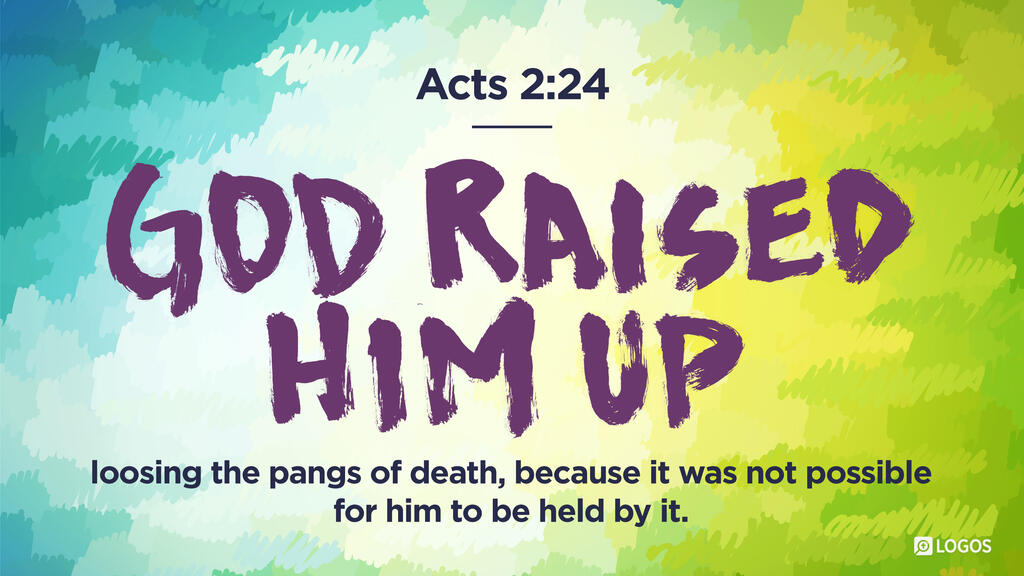
22“Israelite men, listen to these words! Jesus the Nazarene, a man attested to you by God with deeds of power and wonders and signs that God did through him in your midst, just as you yourselves know—23this man, delivered up by the determined plan and foreknowledge of God, you executed by* nailing to a cross* through the hand of lawless men. 24God raised himi up, having brought to an end the pains of death, because it was not possible for him to be held by it. 25For David says with reference to him,
‘I saw the Lord before me continually,j
for he is at my right hand so that I will not be shaken.
26For this reason my heart was glad
and my tongue rejoiced greatly,
furthermore also my flesh will live in hope,
27because you will not abandon my soul in Hades,
nor will you permit your Holy One to experience decay.
28You have made known to me the paths of life;
you will fill me with gladness with your presence.’k
29“Men and brothers, it is possible to speak with confidence to you about the patriarch David, that he both died and was buried, and his tomb is with us until this day.
Footnotes
- aOr perhaps “distributed”
- bOr “tongues”
- *Here “when” is supplied as a component of the temporal genitive absolute participle (“happened”)
- cLiterally “our own language in which we were born”
- dA reference to the Roman province of Asia (modern Asia Minor)
- eLiterally “one to the other”
- fLiterally “what does this want to be”
- *Here “and” is supplied because the previous participle (“jeered”) has been translated as a finite verb
- gOr “sky”
- hA quotation from Joel 2:28–32
- *Here “by” is supplied as a component of the participle (“nailing to”) which is understood as means
- *The words “a cross” are not in the Greek text but are implied by the nature of the verb
- iLiterally “whom”; it is necessary to specify “him” in the translation to avoid confusion with the “lawless men” in the previous verse
- jLiterally “through everything”
- kA quotation from Ps 16:8–11
Copyright 2012 Lexham Press