Acts 17:22–31
The Lexham English BibleOther versions
English
- LEB The Lexham English Bible
- DARBY 1890 Darby Bible
- ASV American Standard Version
- AV 1873 The Cambridge Paragraph Bible of the Authorized English Version
- CSB Christian Standard Bible
- D-R Douay-Rheims Bible
- ESV English Standard Version
- GW GOD’S WORD Translation
- GNB Good News Translation
- HCSB The Holman Christian Standard Bible
- KJV 1900 King James Version
- LSB Legacy Standard Bible
- MSG The Message: The Bible in Contemporary Language
- NET The NET Bible
- NASB95 New American Standard Bible (1995)
- NCV New Century Version
- NIrV New International Reader’s Version (1998)
- NIV New International Version (2011)
- NKJV The New King James Version
- NLT New Living Translation
- NRSVue New Revised Standard Version: Updated Edition
- RSV The Revised Standard Version
- RSVCE The Revised Standard Version, Catholic Edition
- TNIV Today’s New International Version
- YLT Young’s Literal Translation
Arabic
Czech
French
German
Greek
Hungarian
Italian
Korean
Latin
Portuguese
Russian
Simplified Chinese
Spanish
Traditional Chinese
Paul Speaks to the Areopagus
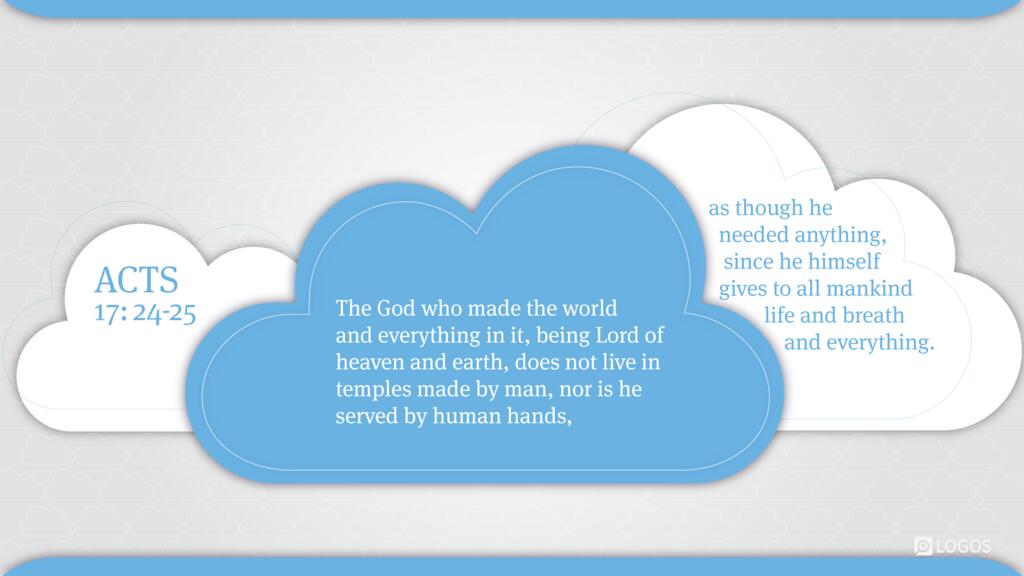
22So Paul stood there in the middle of the Areopagus and* said, “Men of Athens, I see you are very religious in every respect.h 23For as I* was passing through and observing carefully your objects of worship, I even found an altar on which was inscribed, ‘To an unknown God.’ Therefore what you worship without knowing it,* this I proclaim to you—24the God who made the world and all the things in it. This one, being Lord of heaven and earth, does not live in temples made by human hands, 25nor is he served by human hands as if he* needed anything, because* he himself gives to everyone life and breath and everything. 26And he made from one man every nation of humanity to live on all the face of the earth, determining their fixed times and the fixed boundaries of their habitation, 27to search for God, if perhaps indeed they might feel around for him and find him.* And indeed he is not far away from each one of us, 28for in him we live and move and exist,i as even some of your ownj poets have said: ‘For we also are hisk offspring.’l 29Therefore, because we* are offspring of God, we ought not to think the divine being is like gold or silver or stone, an image formed by human skill and thought. 30Therefore although* God has overlooked the times of ignorance, he now commands all people everywhere to repent, 31because he has set a day on which he is going to judge the world in righteousness by the man who he has appointed, having provided proof to everyone by* raising him from the dead.”
Footnotes
- *Here “and” is supplied because the previous participle (“stood there”) has been translated as a finite verb
- hLiterally “with respect to all things”
- *Here “as” is supplied as a component of the participle (“was passing through”) which is understood as temporal
- *Here the direct object is supplied from context in the English translation
- *Here “as if” is supplied as a component of the conditional adverbial participle (“needed”)
- *Here “because” is supplied as a component of the participle (“gives”) which is understood as causal
- *Here the direct object is supplied from context in the English translation
- iSome interpreters hold that the phrase “in him we live and move and exist” is a quotation from Epimenides of Crete, but more likely it is a traditional Greek formula
- jLiterally “with respect to you”
- kLiterally “of him”
- lA quotation from Aratus, Phaenomena 5
- *Here “because” is supplied as a component of the participle (“are”) which is understood as causal
- *Here “although” is supplied as a component of the participle (“has overlooked”) which is understood as concessive
- *Here “by” is supplied as a component of the participle (“raising”) which is understood as means
Copyright 2012 Lexham Press