Romans 8:18–39
The NET BibleOther versions
English
- NET The NET Bible
- DARBY 1890 Darby Bible
- ASV American Standard Version
- AV 1873 The Cambridge Paragraph Bible of the Authorized English Version
- CSB Christian Standard Bible
- D-R Douay-Rheims Bible
- ESV English Standard Version
- GW GOD’S WORD Translation
- GNB Good News Translation
- HCSB The Holman Christian Standard Bible
- KJV 1900 King James Version
- LSB Legacy Standard Bible
- LEB The Lexham English Bible
- MSG The Message: The Bible in Contemporary Language
- NASB95 New American Standard Bible (1995)
- NCV New Century Version
- NIrV New International Reader’s Version (1998)
- NIV New International Version (2011)
- NKJV The New King James Version
- NLT New Living Translation
- NRSVue New Revised Standard Version: Updated Edition
- RSV The Revised Standard Version
- RSVCE The Revised Standard Version, Catholic Edition
- YLT Young’s Literal Translation
Arabic
Czech
French
German
Greek
Hungarian
Italian
Korean
Latin
Portuguese
Russian
Simplified Chinese
Spanish
Traditional Chinese
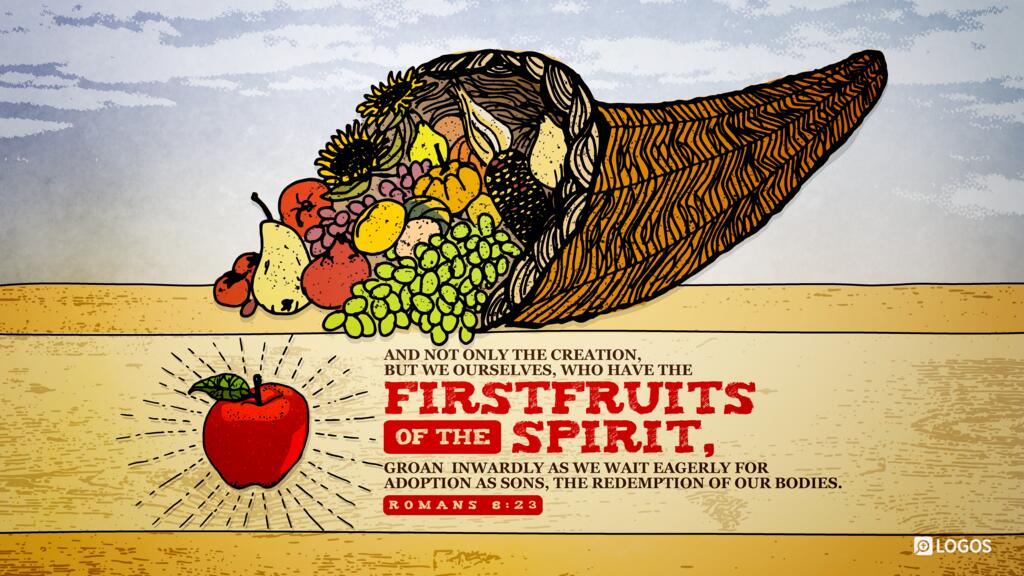
8:18For I consider that our present sufferings cannot even be compared23 to the glory that will be revealed to us. 8:19For the creation eagerly waits for the revelation of the sons of God. 8:20For the creation was subjected to futility—not willingly but because of God24 who subjected it—in hope 8:21that the creation itself will also be set free from the bondage of decay into the glorious freedom of God’s children. 8:22For we know that the whole creation groans and suffers together until now. 8:23Not only this, but we ourselves also, who have the firstfruits of the Spirit,25 groan inwardly as we eagerly await our adoption,26 the redemption of our bodies.278:24For in hope we were saved. Now hope that is seen is not hope, because who hopes for what he sees? 8:25But if we hope for what we do not see, we eagerly wait for it with endurance.28
8:26In the same way, the Spirit helps us in our weakness, for we do not know how we should pray,29 but the Spirit himself intercedes for us with inexpressible groanings. 8:27And he30 who searches our hearts knows the mind of the Spirit, because the Spirit31 intercedes on behalf of the saints according to God’s will. 8:28And we know that all things work together32 for good for those who love God, who are called according to his purpose, 8:29because those whom he foreknew he also predestined to be conformed to the image of his Son, that his Son33 would be the firstborn among many brothers and sisters.348:30And those he predestined, he also called; and those he called, he also justified; and those he justified, he also glorified.
8:31What then shall we say about these things? If God is for us, who can be against us? 8:32Indeed, he who35 did not spare his own Son, but gave him up for us all—how will he not also, along with him, freely give us all things? 8:33Who will bring any charge against God’s elect?36 It is God who justifies. 8:34Who is the one who will condemn? Christ37 is the one who died (and more than that, he was raised), who is at the right hand of God, and who also is interceding for us. 8:35Who will separate us from the love of Christ? Will trouble, or distress, or persecution, or famine, or nakedness, or danger, or sword?388:36As it is written, “For your sake we encounter death all day long; we were considered as sheep to be slaughtered.”398:37No, in all these things we have complete victory40 through him41 who loved us! 8:38For I am convinced that neither death, nor life, nor angels, nor heavenly rulers,42 nor things that are present, nor things to come, nor powers, 8:39nor height, nor depth, nor anything else in creation will be able to separate us from the love of God in Christ Jesus our Lord.
Footnotes
- 23 Grk “are not worthy [to be compared].”
- 24 Grk “because of the one”; the referent (God) has been specified in the translation for clarity.
- 25 Or “who have the Spirit as firstfruits.” The genitive πνεύματος (pneumatos) can be understood here as possessive (“the firstfruits belonging to the Spirit”) although it is much more likely that this is a genitive of apposition (“the firstfruits, namely, the Spirit”); cf. , .
- 26 See the note on “adoption” in v. .
- 27 Grk “body.”
- 28 Or “perseverance.”
- 29 Or “for we do not know what we ought to pray for.”
- 30 he refers to God here; Paul has not specifically identified him for the sake of rhetorical power (for by leaving the subject slightly ambiguous, he draws his audience into seeing God’s hand in places where he is not explicitly mentioned).
- 31 Grk “he,” or “it”; the referent (the Spirit) has been specified in the translation for clarity.
- 32 ὁ θεός (ho theos, “God”) is found after the verb συνεργεῖ (sunergei, “work”) in v. 28 by 𝔓46 A B 81 sa; the shorter reading is found in א C D F G Ψ 33 1739 1881 𝔐 latt sy bo. Although the inclusion is supported by a significant early papyrus, the alliance of significant Alexandrian and Western witnesses favors the shorter reading. As well, the longer reading is evidently motivated by a need for clarification. Since ὁ θεός is textually suspect, it is better to read the text without it. This leaves two good translational options: either “he works all things together for good” or “all things work together for good.” In the first instance the subject is embedded in the verb and “God” is clearly implied (as in v. 29). In the second instance, πάντα (panta) becomes the subject of an intransitive verb. In either case, “What is expressed is a truly biblical confidence in the sovereignty of God” (C. E. B. Cranfield, Romans [], 1:).
- 33 Grk “he”; the referent (God’s Son) has been specified in the translation for clarity.
- 34 Grk “brothers.” See note on the phrase “brothers and sisters” in .
- 35 Grk “[he] who.” The relative clause continues the question of v. 31 in a way that is awkward in English. The force of v. 32 is thus: “who indeed did not spare his own Son, but gave him up for us all—How will he not also with him give us all things?”
- 36 An allusion to Isa 50:8 where the reference is singular; Paul applies this to all believers (“God’s elect” is plural here).
- 37 A number of significant and early witnesses, along with several others (𝔓46vid א A C F G L Ψ 6 33 81 104 365 1505 lat bo), read Ἰησοῦς (Iēsous, “Jesus”) after χριστός (Christos, “Christ”) in v. 34. But the shorter reading is not unrepresented (B D 0289 1739 1881 𝔐 sa). Once Ἰησοῦς got into the text, what scribe would omit it? Although the external evidence is on the side of the longer reading, internally such an expansion seems suspect. The shorter reading is thus preferred. has the word in brackets, indicating doubt as to its authenticity. Grk “who also.”
- 38 Here “sword” is a metonymy that includes both threats of violence and acts of violence, even including death (although death is not necessarily the only thing in view here).
- 39 A quotation from Ps 44:22.
- 40 ὑπερνικάω states, “as a heightened form of νικᾶν prevail completely ὑπερνικῶμεν we are winning a most glorious victory Ro 8:37.”
- 41 Here the referent could be either God or Christ, but in v. 39 it is God’s love that is mentioned.
- 42 ἀρχή 6 takes this term as a reference to angelic or transcendent powers (as opposed to merely human rulers). To clarify this, the adjective “heavenly” has been supplied in the translation. Some interpreters see this as a reference to fallen angels or demonic powers, and this view is reflected in some recent translations (, ).
The NET Bible First Edition, Copyright 1996-2005 by Biblical Studies Press