Romans 8:18–27
The NET BibleOther versions
English
- NET The NET Bible
- DARBY 1890 Darby Bible
- ASV American Standard Version
- AV 1873 The Cambridge Paragraph Bible of the Authorized English Version
- CSB Christian Standard Bible
- D-R Douay-Rheims Bible
- ESV English Standard Version
- GW GOD’S WORD Translation
- GNB Good News Translation
- HCSB The Holman Christian Standard Bible
- KJV 1900 King James Version
- LSB Legacy Standard Bible
- LEB The Lexham English Bible
- MSG The Message: The Bible in Contemporary Language
- NASB95 New American Standard Bible (1995)
- NCV New Century Version
- NIrV New International Reader’s Version (1998)
- NIV New International Version (2011)
- NKJV The New King James Version
- NLT New Living Translation
- NRSVue New Revised Standard Version: Updated Edition
- RSV The Revised Standard Version
- RSVCE The Revised Standard Version, Catholic Edition
- YLT Young’s Literal Translation
Arabic
Czech
French
German
Greek
Hungarian
Italian
Korean
Latin
Portuguese
Russian
Simplified Chinese
Spanish
Traditional Chinese
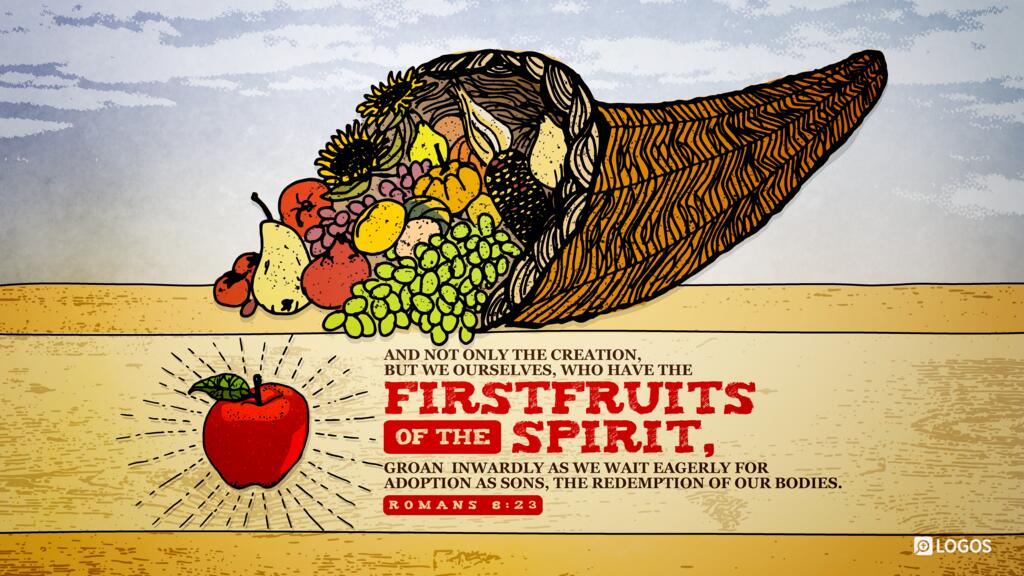
8:18For I consider that our present sufferings cannot even be compared23 to the glory that will be revealed to us. 8:19For the creation eagerly waits for the revelation of the sons of God. 8:20For the creation was subjected to futility—not willingly but because of God24 who subjected it—in hope 8:21that the creation itself will also be set free from the bondage of decay into the glorious freedom of God’s children. 8:22For we know that the whole creation groans and suffers together until now. 8:23Not only this, but we ourselves also, who have the firstfruits of the Spirit,25 groan inwardly as we eagerly await our adoption,26 the redemption of our bodies.278:24For in hope we were saved. Now hope that is seen is not hope, because who hopes for what he sees? 8:25But if we hope for what we do not see, we eagerly wait for it with endurance.28
8:26In the same way, the Spirit helps us in our weakness, for we do not know how we should pray,29 but the Spirit himself intercedes for us with inexpressible groanings. 8:27And he30 who searches our hearts knows the mind of the Spirit, because the Spirit31 intercedes on behalf of the saints according to God’s will.
Footnotes
- 23 Grk “are not worthy [to be compared].”
- 24 Grk “because of the one”; the referent (God) has been specified in the translation for clarity.
- 25 Or “who have the Spirit as firstfruits.” The genitive πνεύματος (pneumatos) can be understood here as possessive (“the firstfruits belonging to the Spirit”) although it is much more likely that this is a genitive of apposition (“the firstfruits, namely, the Spirit”); cf. , .
- 26 See the note on “adoption” in v. .
- 27 Grk “body.”
- 28 Or “perseverance.”
- 29 Or “for we do not know what we ought to pray for.”
- 30 he refers to God here; Paul has not specifically identified him for the sake of rhetorical power (for by leaving the subject slightly ambiguous, he draws his audience into seeing God’s hand in places where he is not explicitly mentioned).
- 31 Grk “he,” or “it”; the referent (the Spirit) has been specified in the translation for clarity.
The NET Bible First Edition, Copyright 1996-2005 by Biblical Studies Press