Romans 7:15–25
The NET BibleOther versions
English
- NET The NET Bible
- DARBY 1890 Darby Bible
- ASV American Standard Version
- AV 1873 The Cambridge Paragraph Bible of the Authorized English Version
- CSB Christian Standard Bible
- D-R Douay-Rheims Bible
- ESV English Standard Version
- GW GOD’S WORD Translation
- GNB Good News Translation
- HCSB The Holman Christian Standard Bible
- KJV 1900 King James Version
- LSB Legacy Standard Bible
- LEB The Lexham English Bible
- MSG The Message: The Bible in Contemporary Language
- NASB95 New American Standard Bible (1995)
- NCV New Century Version
- NIrV New International Reader’s Version (1998)
- NIV New International Version (2011)
- NKJV The New King James Version
- NLT New Living Translation
- NRSVue New Revised Standard Version: Updated Edition
- RSV The Revised Standard Version
- RSVCE The Revised Standard Version, Catholic Edition
- YLT Young’s Literal Translation
Arabic
Czech
French
German
Greek
Hungarian
Italian
Korean
Latin
Portuguese
Russian
Simplified Chinese
Spanish
Traditional Chinese
7:15For I don’t understand what I am doing. For I do not do what I want—instead, I do what I hate.227:16But if I do what I don’t want, I agree that the law is good.237:17But now it is no longer me doing it, but sin that lives in me. 7:18For I know that nothing good lives in me, that is, in my flesh. For I want to do the good, but I cannot do it.247:19For I do not do the good I want, but I do the very evil I do not want! 7:20Now if I do what I do not want, it is no longer me doing it but sin that lives in me.
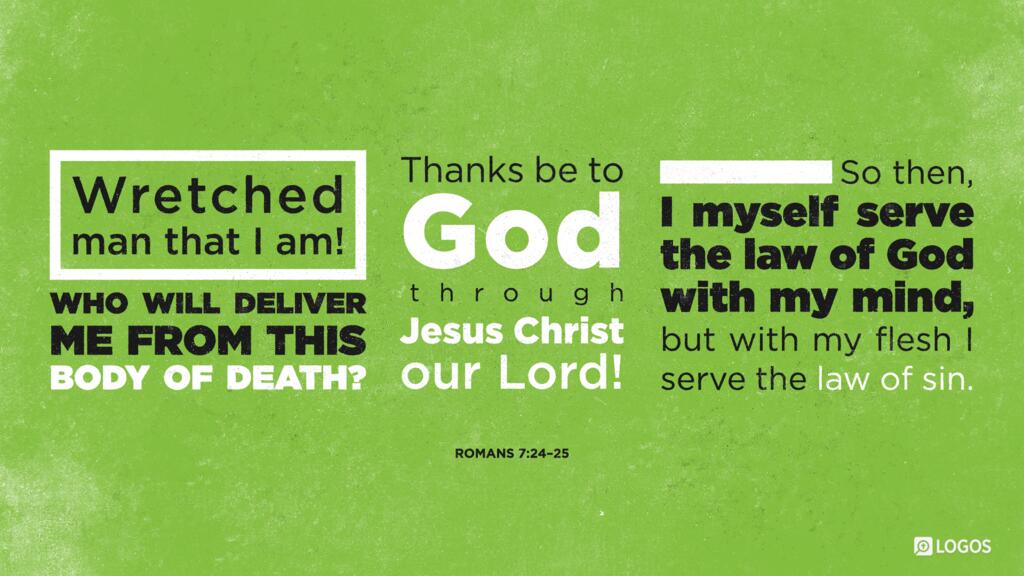
7:21So, I find the law that when I want to do good, evil is present with me. 7:22For I delight in the law of God in my inner being. 7:23But I see a different law in my members waging war against the law of my mind and making me captive to the law of sin that is in my members. 7:24Wretched man that I am! Who will rescue me from this body of death? 7:25Thanks be25 to God through Jesus Christ our Lord! So then,26 I myself serve the law of God with my mind, but27 with my flesh I serve28 the law of sin.
Footnotes
- 22 Grk “but what I hate, this I do.”
- 23 Grk “I agree with the law that it is good.”
- 24 Grk “For to wish is present in/with me, but not to do it.”
- 25 Most (א* A 1739 1881 𝔐 sy) read “I give thanks to God” rather than “Now thanks be to God” (א1 [B] Ψ 33 81 104 365 1506 ), the reading of . The reading with the verb (εὐχαριστῶ τῷ θεῷ, eucharistō tō theō) possibly arose from a transcriptional error in which several letters were doubled ( ). The conjunction δέ (de, “now”) is included in some as well (א1 Ψ 33 81 104 365 1506 ), but it should probably not be considered original. The support for the omission of δέ is both excellent and widespread (א* A B D 1739 1881 𝔐 lat sy), and its addition can be explained as an insertion to smooth out the transition between v. 24 and 25.
- 26 There is a double connective here that cannot be easily preserved in English: “consequently therefore,” emphasizing the conclusion of what he has been arguing.
- 27 Greek emphasizes the contrast between these two clauses more than can be easily expressed in English.
- 28 The words “I serve” have been repeated here for clarity.
The NET Bible First Edition, Copyright 1996-2005 by Biblical Studies Press
In other versions
ESVEnglish Standard Version
For I do not understand my own actions. For I do not do what I want, but I do the very thing I hate. Now if I do what I do not want, I agree with the law, that it is good. So now it is no longer I who do it, but sin that dwells within me. For I know that nothing good dwells in me, that is, in my flesh. For I have the desire to do what is right, but not the ability to carry it out. For I do not do the good I want, but the evil I do not want is what I keep on doing. Now if I do what I do not want, it is no longer I who do it, but sin that dwells within me.
So I find it to be a law that when I want to do right, evil lies close at hand. For I delight in the law of God, in my inner being, but I see in my members another law waging war against the law of my mind and making me captive to the law of sin that dwells in my members. Wretched man that I am! Who will deliver me from this body of death? Thanks be to God through Jesus Christ our Lord! So then, I myself serve the law of God with my mind, but with my flesh I serve the law of sin.
Copyright 2001 Crossway Bibles
NIVNew International Version (2011)
I do not understand what I do. For what I want to do I do not do, but what I hate I do. And if I do what I do not want to do, I agree that the law is good. As it is, it is no longer I myself who do it, but it is sin living in me. For I know that good itself does not dwell in me, that is, in my sinful nature. For I have the desire to do what is good, but I cannot carry it out. For I do not do the good I want to do, but the evil I do not want to do—this I keep on doing. Now if I do what I do not want to do, it is no longer I who do it, but it is sin living in me that does it.
So I find this law at work: Although I want to do good, evil is right there with me. For in my inner being I delight in God’s law; but I see another law at work in me, waging war against the law of my mind and making me a prisoner of the law of sin at work within me. What a wretched man I am! Who will rescue me from this body that is subject to death? Thanks be to God, who delivers me through Jesus Christ our Lord!
So then, I myself in my mind am a slave to God’s law, but in my sinful nature a slave to the law of sin.
Copyright 1973, 1978, 1984, 2011 Biblica, Inc.
CSBChristian Standard Bible
For I do not understand what I am doing, because I do not practice what I want to do, but I do what I hate. Now if I do what I do not want to do, I agree with the law that it is good. So now I am no longer the one doing it, but it is sin living in me. For I know that nothing good lives in me, that is, in my flesh. For the desire to do what is good is with me, but there is no ability to do it. For I do not do the good that I want to do, but I practice the evil that I do not want to do. Now if I do what I do not want, I am no longer the one that does it, but it is the sin that lives in me. So I discover this law: When I want to do what is good, evil is present with me. For in my inner self I delight in God’s law, but I see a different law in the parts of my body, waging war against the law of my mind and taking me prisoner to the law of sin in the parts of my body. What a wretched man I am! Who will rescue me from this body of death? Thanks be to God through Jesus Christ our Lord! So then, with my mind I myself am serving the law of God, but with my flesh, the law of sin.
Copyright 2017 Holman Bible Publishers
NLTNew Living Translation
I don’t really understand myself, for I want to do what is right, but I don’t do it. Instead, I do what I hate. But if I know that what I am doing is wrong, this shows that I agree that the law is good. So I am not the one doing wrong; it is sin living in me that does it.
And I know that nothing good lives in me, that is, in my sinful nature. I want to do what is right, but I can’t. I want to do what is good, but I don’t. I don’t want to do what is wrong, but I do it anyway. But if I do what I don’t want to do, I am not really the one doing wrong; it is sin living in me that does it.
I have discovered this principle of life—that when I want to do what is right, I inevitably do what is wrong. I love God’s law with all my heart. But there is another power within me that is at war with my mind. This power makes me a slave to the sin that is still within me. Oh, what a miserable person I am! Who will free me from this life that is dominated by sin and death? Thank God! The answer is in Jesus Christ our Lord. So you see how it is: In my mind I really want to obey God’s law, but because of my sinful nature I am a slave to sin.
Holy Bible, New Living Translation, copyright © 1996, 2004, 2015 by Tyndale House Foundation. Used by permission of Tyndale House Publishers. All rights reserved.
LEBThe Lexham English Bible
For what I am doing I do not understand, because what I want to do, this I do not practice, but what I hate, this I do. But if what I do not want to do, this I do, I agree with the law that it is good. But now I am no longer the one doing it, but sin that lives in me. For I know that good does not live in me, that is, in my flesh. For the willing is present in me, but the doing of the good is not. For the good that I want to do, I do not do, but the evil that I do not want to do, this I do. But if what I do not want to do, this I am doing, I am no longer the one doing it, but sin that lives in me.
Consequently, I find the principle with me, the one who wants to do good, that evil is present with me. For I joyfully agree with the law of God in my inner person, but I observe another law in my members, at war with the law of my mind and making me captive to the law of sin that exists in my members. Wretched man that I am! Who will rescue me from this body of death? Thanks be to God through Jesus Christ our Lord! So then, I myself with my mind am enslaved to the law of God, but with my flesh I am enslaved to the law of sin.
Copyright 2012 Lexham Press
KJV 1900King James Version
For that which I do I allow not: for what I would, that do I not; but what I hate, that do I. If then I do that which I would not, I consent unto the law that it is good. Now then it is no more I that do it, but sin that dwelleth in me. For I know that in me (that is, in my flesh,) dwelleth no good thing: for to will is present with me; but how to perform that which is good I find not. For the good that I would I do not: but the evil which I would not, that I do. Now if I do that I would not, it is no more I that do it, but sin that dwelleth in me. I find then a law, that, when I would do good, evil is present with me. For I delight in the law of God after the inward man: But I see another law in my members, warring against the law of my mind, and bringing me into captivity to the law of sin which is in my members. O wretched man that I am! who shall deliver me from the body of this death? I thank God through Jesus Christ our Lord. So then with the mind I myself serve the law of God; but with the flesh the law of sin.
Public Domain