Revelation 12:7–12
The NET BibleOther versions
English
- NET The NET Bible
- DARBY 1890 Darby Bible
- ASV American Standard Version
- AV 1873 The Cambridge Paragraph Bible of the Authorized English Version
- CSB Christian Standard Bible
- D-R Douay-Rheims Bible
- ESV English Standard Version
- GW GOD’S WORD Translation
- GNB Good News Translation
- HCSB The Holman Christian Standard Bible
- KJV 1900 King James Version
- LSB Legacy Standard Bible
- LEB The Lexham English Bible
- MSG The Message: The Bible in Contemporary Language
- NASB95 New American Standard Bible (1995)
- NCV New Century Version
- NIrV New International Reader’s Version (1998)
- NIV New International Version (2011)
- NKJV The New King James Version
- NLT New Living Translation
- NRSVue New Revised Standard Version: Updated Edition
- RSV The Revised Standard Version
- RSVCE The Revised Standard Version, Catholic Edition
- YLT Young’s Literal Translation
Arabic
Czech
French
German
Greek
Hungarian
Italian
Korean
Latin
Portuguese
Russian
Simplified Chinese
Spanish
Traditional Chinese
War in Heaven
12:7Then20 war broke out in heaven: Michael21 and his angels fought against the dragon, and the dragon and his angels fought back. 12:8But22 the dragon was not strong enough to prevail,23 so there was no longer any place left24 in heaven for him and his angels.2512:9So26 that huge dragon—the ancient serpent, the one called the devil and Satan, who deceives the whole world—was thrown down to the earth, and his angels along with him. 12:10Then27 I heard a loud voice in heaven saying,
“The salvation and the power
and the kingdom of our God,
and the ruling authority28 of his Christ,29 have now come,
because the accuser of our brothers and sisters,30
the one who accuses them day and night31 before our God,
has been thrown down.
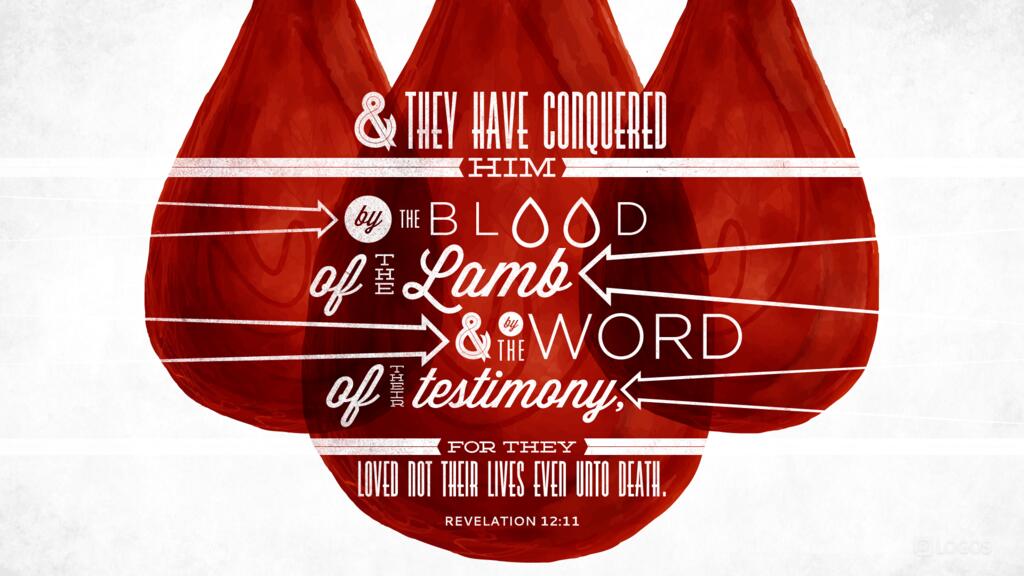
12:11But32 they overcame him
by the blood of the Lamb
and by the word of their testimony,
and they did not love their lives33 so much that they were afraid to die.
12:12Therefore you heavens rejoice, and all who reside in them!
But34 woe to the earth and the sea
because the devil has come down to you!
He35 is filled with terrible anger,
for he knows that he only has a little time!”
Footnotes
- 20 Here καί (kai) has been translated as “then” to indicate the implied sequence within the narrative.
- 21 The archangel Michael had a special role in protecting the nation of Israel in the OT (Dan 10:13, 21; 12:1; see also Jude 9).
- 22 Here καί (kai) has been translated as “but” to indicate the implied contrast.
- 23 The words “to prevail” are not in the Greek text, but are implied.
- 24 Grk “found.”
- 25 Grk “for them”; the referent (the dragon and his angels, v. 7) has been specified in the translation for clarity.
- 26 Here καί (kai) has been translated as “so” to indicate the result of the war in heaven.
- 27 Here καί (kai) has been translated as “then” to indicate the implied sequence of events within the vision.
- 28 Or “the right of his Messiah to rule.” See L&N 37.35.
- 29 Or “Messiah”; both “Christ” (Greek) and “Messiah” (Hebrew and Aramaic) mean “one who has been anointed.”
- 30 Grk “brothers,” but the Greek word may be used for “brothers and sisters” or “fellow Christians” (cf. ἀδελφός 1, where considerable nonbiblical evidence for the plural ἀδελφοί [adelphoi] meaning “brothers and sisters” is cited). The translation “fellow believer” would normally apply (L&N 11.23), but since the speaker(s) are not specified in this context, it is not clear if such a translation would be appropriate here. The more generic “brothers and sisters” was chosen to emphasize the fact of a relationship without specifying its type.
- 31 Or “who accuses them continually.”
- 32 Here καί (kai) has been translated as “but” to indicate the contrast.
- 33 They did not love their lives. See Matt 16:25; Luke 17:33; John 12:25.
- 34 The word “But” is not in the Greek text, but the contrast is clearly implied. This is a case of asyndeton (lack of a connective).
- 35 Grk “and is filled,” a continuation of the previous sentence. Because English tends to use shorter sentences (especially when exclamations are involved), a new sentence was started here in the translation.
The NET Bible First Edition, Copyright 1996-2005 by Biblical Studies Press