Revelation 1:9–18
The NET BibleOther versions
English
- NET The NET Bible
- DARBY 1890 Darby Bible
- ASV American Standard Version
- AV 1873 The Cambridge Paragraph Bible of the Authorized English Version
- CSB Christian Standard Bible
- D-R Douay-Rheims Bible
- ESV English Standard Version
- GW GOD’S WORD Translation
- GNB Good News Translation
- HCSB The Holman Christian Standard Bible
- KJV 1900 King James Version
- LSB Legacy Standard Bible
- LEB The Lexham English Bible
- MSG The Message: The Bible in Contemporary Language
- NASB95 New American Standard Bible (1995)
- NCV New Century Version
- NIrV New International Reader’s Version (1998)
- NIV New International Version (2011)
- NKJV The New King James Version
- NLT New Living Translation
- NRSVue New Revised Standard Version: Updated Edition
- RSV The Revised Standard Version
- RSVCE The Revised Standard Version, Catholic Edition
- YLT Young’s Literal Translation
Arabic
Czech
French
German
Greek
Hungarian
Italian
Korean
Latin
Portuguese
Russian
Simplified Chinese
Spanish
Traditional Chinese
1:9I, John, your brother and the one who shares35 with you in the persecution, kingdom, and endurance that36 are in Jesus, was on the island called Patmos because of the word of God and the testimony about Jesus.371:10I was in the Spirit38 on the Lord’s Day39 when40 I heard behind me a loud voice like a trumpet, 1:11saying: “Write in a book what you see and send it to the seven churches—to Ephesus,41 Smyrna,42 Pergamum, Thyatira, Sardis, Philadelphia, and Laodicea.”
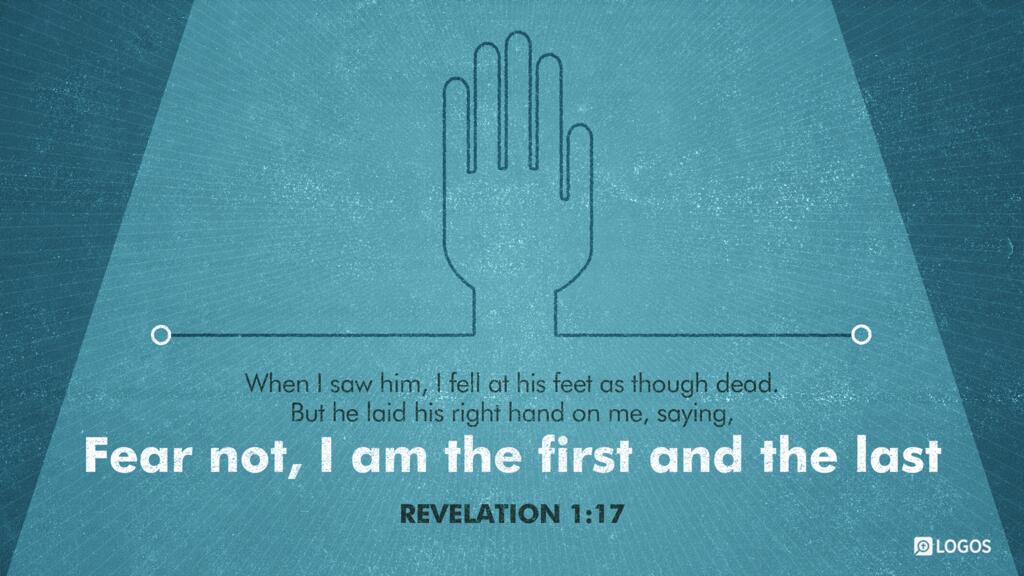
1:12I43 turned to see whose voice was speaking to me,44 and when I did so,45 I saw seven golden lampstands, 1:13and in the midst of the lampstands was one like a son of man.46 He was dressed in a robe extending down to his feet and he wore a wide golden belt47 around his chest. 1:14His48 head and hair were as white as wool, even as white as snow,49 and his eyes were like a fiery50 flame. 1:15His feet were like polished bronze51 refined52 in a furnace, and his voice was like the roar53 of many waters. 1:16He held54 seven stars in his right hand, and a sharp double-edged sword extended out of his mouth. His55 face shone like the sun shining at full strength. 1:17When56 I saw him I fell down at his feet as though I were dead, but57 he placed his right hand on me and said: “Do not be afraid! I am the first and the last, 1:18and the one who lives! I58 was dead, but look, now I am alive—forever and ever—and I hold the keys of death and of Hades!59
Footnotes
- 35 The translation attempts to bring out the verbal idea in συγκοινωνός (sunkoinōnos, “co-sharer”); John was suffering for his faith at the time he wrote this.
- 36 The prepositional phrase ἐν Ἰησοῦ (en Iēsou) could be taken with ὑπομονῇ (hupomonē) as the translation does or with the more distant συγκοινωνός (sunkoinōnos), in which case the translation would read “your brother and the one who shares with you in Jesus in the persecution, kingdom, and endurance.”
- 37 The phrase “about Jesus” has been translated as an objective genitive.
- 38 Or “in the spirit.” “Spirit” could refer either to the Holy Spirit or the human spirit, but in either case John was in “a state of spiritual exaltation best described as a trance” (R. H. Mounce, Revelation [], ).
- 39 Concerning the phrase κυριακῇ ἡμέρᾳ (kuriakē hēmera) κυριακός states: “pert. to belonging to the Lord, the Lord’s … κ. ἡμέρᾳ the Lord’s day (Kephal. I 192, 1; 193, 31 …) i.e. certainly Sunday (so in Mod. Gk.…) Rv 1:10 (WStott, 12, ’65, 70–75).”
- 40 The conjunction καί (kai) is not introducing a coordinate thought, but one that is logically subordinate to the main verb ἐγενόμην (egenomēn).
- 41 For location see ; ; ; .
- 42 Grk “and to Smyrna.” For stylistic reasons the conjunction καί (kai) and the preposition εἰς (eis) have not been translated before the remaining elements of the list. In lists with more than two elements contemporary English generally does not repeat the conjunction except between the next to last and last elements.
- 43 Throughout the translation John’s use of καί (kai) often reflects the varied usage of the Hebrew conjunction ו (vav). A clause which καί introduces has been translated in terms of its semantic relationship to the clause that preceded it. If the καί seemed redundant, however, it was left untranslated; that is the case in this verse.
- 44 Grk “with me.” The translation “with me” implies that John was engaged in a dialogue with the one speaking to him (e.g., Jesus or an angel) when in reality it was a one-sided conversation, with John doing all the listening. For this reason, μετʼ ἐμοῦ (met’ emou, “with me”) was translated as “to me.”
- 45 Grk “and turning I saw.” The repetition of ἐπιστρέφω (epistrephō) is somewhat redundant in contemporary English and has been translated generally.
- 46 This phrase constitutes an allusion to Dan 7:13. Concerning υἱὸς τοῦ ἀνθρώπου (huios tou anthrōpou), υἱός 2.d.γ says: “ὁ υἱὸς τοῦ ἀνθρώπου lit. ‘the son of the man’ … ‘the human being, the human one, the man’ … On Israelite thought contemporary w. Jesus and alleged knowledge of a heavenly being looked upon as a ‘Son of Man’ or ‘Man’, who exercises Messianic functions such as judging the world (metaph., pictorial passages in En 46–48; 4 Esdr 13:3, 51f) … Outside the gospels: Ac 7:56 … Rv 1:13; 14:14 (both after Da 7:13 …).” The term “son” here in this expression is anarthrous and as such lacks specificity. Some commentators and translations take the expression as an allusion to Daniel 7:13 and not to “the son of man” found in gospel traditions (e.g., Mark 8:31; 9:12; cf. D. E. Aune, Revelation [], 2:; cf. also ). Other commentators and versions, however, take the phrase “son of man” as definite, involving allusions to Dan 7:13 and “the son of man” gospel traditions (see G. K. Beale, Revelation [], ; ).
- 47 Or “a wide golden sash,” but this would not be diagonal, as some modern sashes are, but horizontal. The Greek term can refer to a wide band of cloth or leather worn on the outside of one’s clothing (L&N 6.178).
- 48 Here δέ (de) has not been translated.
- 49 The clause, “even as white as snow” seems to heighten the preceding clause and is so understood in this ascensive sense (“even”) in the translation.
- 50 The genitive noun πυρός (puros) has been translated as an attributive genitive.
- 51 The precise meaning of the term translated “polished bronze” (χαλκολιβάνῳ, chalkolibanō), which appears nowhere else in Greek literature outside of the book of Revelation (see 2:18), is uncertain. Without question it is some sort of metal. χαλκολίβανον suggests “fine brass/bronze.” L&N 2.57 takes the word to refer to particularly valuable or fine bronze, but notes that the emphasis here and in Rev 2:18 is more on the lustrous quality of the metal.
- 52 Or “that has been heated in a furnace until it glows.”
- 53 Grk “sound,” but the idea is closer to the roar of a waterfall or rapids.
- 54 Grk “and having.” In the Greek text this is a continuation of the previous sentence, but because contemporary English style employs much shorter sentences, a new sentence was started here in the translation by supplying the pronoun “he.”
- 55 This is a continuation of the previous sentence in the Greek text, but a new sentence was started here in the translation.
- 56 Grk “And when.” Because of the difference between Greek style, which often begins sentences or clauses with “and,” and English style, which generally does not, καί (kai) has not been translated here.
- 57 Here the Greek conjunction καί (kai) has been translated as a contrastive (“but”) due to the contrast between the two clauses.
- 58 Here καί (kai) has not been translated because of differences between Greek and English style.
- 59 Concerning “Hades” ᾅδης 1 and 2 states: “Orig. proper noun, god of the nether world, ‘Hades’, then the nether world, Hades as place of the dead, Ac 2:27, 31 (Ps 15:10; Eccl 9:10; 1, 179; 16, 8; Philo, Mos. 1, 195; Jos., Bell. 1, 596, 6, 332). Of Jonah’s fish ἐκ τοῦ κατωτάτου ᾅδου. In the depths, contrasted w. heaven ἕως (τοῦ) ᾅδου Mt 11:23; Lk 10:15 ( 15:10; cp.; Is 14:11, 15); ἐν τῷ ᾅδῃ 16:23; ἐν Ἅιδου ApcPt Rainer. Accessible by gates (but the is also used [e.g. Hom., X., Ael. Aristid. 47, 20 K.=23 p. 450 D.] when only one gate is meant), hence πύλαι ᾅδου (Il. 5, 646; Is 38:10; Wsd 16:13; 3 Macc 5:51; Pss. Sol. 16:2.—Lucian, Menipp. 6 the magicians can open τοῦ Ἃιδου τὰς πύλας and conduct people in and out safely) Mt 16:18 … locked ἔχω τὰς κλεῖς τοῦ θανάτου καὶ τοῦ ᾅδου Rv 1:18 (the genitives are either obj. [Ps.-Apollod. 3, 12, 6, 10 Aeacus, the son of Zeus holds the κλεῖς τοῦ Ἃιδου; SEG VIII, 574, 3 (III ad) τῷ τὰς κλεῖδας ἔχοντι τῶν καθʼ Ἂιδου (restored)] or possess.; in the latter case death and Hades are personif.; s. 2) … Hades personif.… w. θάνατος (cp. Is 28:15; Job 38:17 …) Rv 6:8; 20:13f.” In the OT, Hades was known as Sheol. It is the place where the unrighteous will reside (Matt 11:23; Luke 16:23; Rev 20:13–14).
The NET Bible First Edition, Copyright 1996-2005 by Biblical Studies Press