Psalm 8:1
The NET BibleOther versions
English
- NET The NET Bible
- DARBY 1890 Darby Bible
- ASV American Standard Version
- AV 1873 The Cambridge Paragraph Bible of the Authorized English Version
- CSB Christian Standard Bible
- D-R Douay-Rheims Bible
- ESV English Standard Version
- GW GOD’S WORD Translation
- GNB Good News Translation
- HCSB The Holman Christian Standard Bible
- KJV 1900 King James Version
- LSB Legacy Standard Bible
- LEB The Lexham English Bible
- MSG The Message: The Bible in Contemporary Language
- NASB95 New American Standard Bible (1995)
- NCV New Century Version
- NIrV New International Reader’s Version (1998)
- NIV New International Version (2011)
- NKJV The New King James Version
- NLT New Living Translation
- NRSVue New Revised Standard Version: Updated Edition
- RSV The Revised Standard Version
- RSVCE The Revised Standard Version, Catholic Edition
- YLT Young’s Literal Translation
Arabic
Czech
French
German
Hebrew
Hungarian
Italian
Korean
Latin
Portuguese
Russian
Simplified Chinese
Spanish
Traditional Chinese
8:1O Lord, our Lord,1
how magnificent2 is your reputation3 throughout the earth!
You reveal your majesty in the heavens above!4
Footnotes
- 1 The plural form of the title emphasizes the Lord’s absolute sovereignty.
- 2 Or “awesome”; or “majestic.”
- 3 Heb “name,” which here stands metonymically for God’s reputation.
- 4 Heb “which, give, your majesty on the heavens.” The verb form תְּנָה (ténah; an imperative?) is corrupt. The form should be emended to a second masculine singular perfect (נָתַתָּה, natatah) or imperfect (תִתֵן, titen) form. The introductory אֲשֶׁר (’asher, “which”) can be taken as a relative pronoun (“you who”) or as a causal conjunction (“because”). One may literally translate, “you who [or “because you”] place your majesty upon the heavens.” For other uses of the phrase “place majesty upon” see Num 27:20 and 1 Chr 29:25.
The NET Bible First Edition, Copyright 1996-2005 by Biblical Studies Press
In other versions
ESVEnglish Standard Version
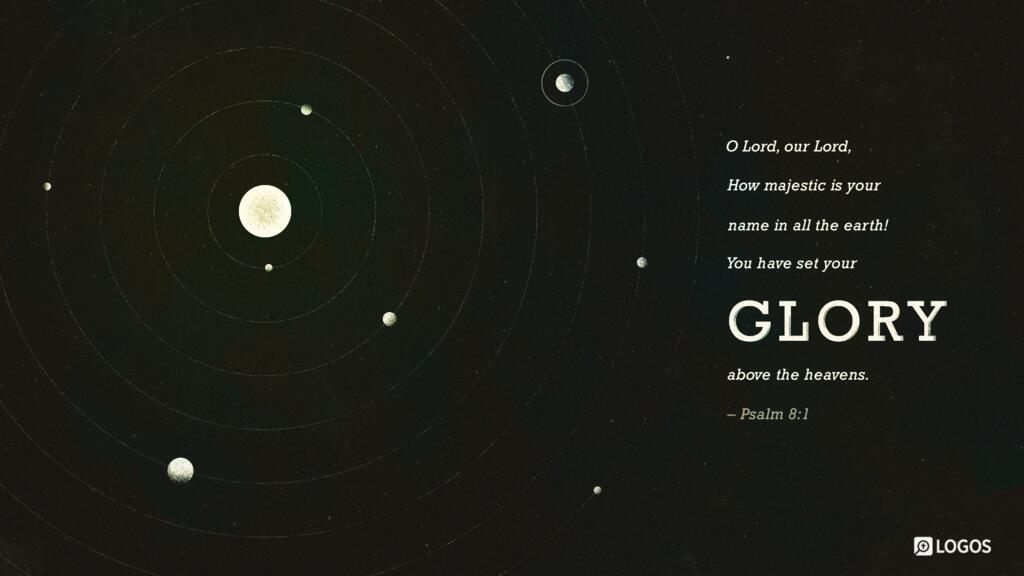
O Lord, our Lord,
how majestic is your name in all the earth!
You have set your glory above the heavens.
Copyright 2001 Crossway Bibles
NIVNew International Version (2011)
Lord, our Lord,
how majestic is your name in all the earth!
You have set your glory
in the heavens.
Copyright 1973, 1978, 1984, 2011 Biblica, Inc.
CSBChristian Standard Bible
Lord, our Lord,
how magnificent is your name throughout the earth!
You have covered the heavens with your majesty.
Copyright 2017 Holman Bible Publishers
NLTNew Living Translation
O Lord, our Lord, your majestic name fills the earth!
Your glory is higher than the heavens.
Holy Bible, New Living Translation, copyright © 1996, 2004, 2015 by Tyndale House Foundation. Used by permission of Tyndale House Publishers. All rights reserved.
LEBThe Lexham English Bible
Yahweh, our Lord, how majestic is your name in all the earth,
who put your splendor above the heavens.
Copyright 2012 Lexham Press
KJV 1900King James Version
O Lord our Lord,
How excellent is thy name in all the earth!
Who hast set thy glory above the heavens.
Public Domain