Psalm 49:5–9
The NET BibleOther versions
English
- NET The NET Bible
- DARBY 1890 Darby Bible
- ASV American Standard Version
- AV 1873 The Cambridge Paragraph Bible of the Authorized English Version
- CSB Christian Standard Bible
- D-R Douay-Rheims Bible
- ESV English Standard Version
- GW GOD’S WORD Translation
- GNB Good News Translation
- HCSB The Holman Christian Standard Bible
- KJV 1900 King James Version
- LSB Legacy Standard Bible
- LEB The Lexham English Bible
- MSG The Message: The Bible in Contemporary Language
- NASB95 New American Standard Bible (1995)
- NCV New Century Version
- NIrV New International Reader’s Version (1998)
- NIV New International Version (2011)
- NKJV The New King James Version
- NLT New Living Translation
- NRSVue New Revised Standard Version: Updated Edition
- RSV The Revised Standard Version
- RSVCE The Revised Standard Version, Catholic Edition
- YLT Young’s Literal Translation
Arabic
Czech
French
German
Hebrew
Hungarian
Italian
Korean
Latin
Portuguese
Russian
Simplified Chinese
Spanish
Traditional Chinese
49:5Why should I be afraid in times of trouble,6
when the sinful deeds of deceptive men threaten to overwhelm me?7
49:6They trust8 in their wealth
and boast9 in their great riches.
49:7Certainly a man cannot rescue his brother;10
he cannot pay God an adequate ransom price11
49:8(the ransom price for a human life12 is too high,
and people go to their final destiny),13
49:9so that he might continue to live14 forever
and not experience death.15
Footnotes
- 6 Heb “days of trouble.” The phrase also occurs in Ps 94:13. The question is rhetorical; there is no reason to be afraid when the rich oppressors threaten the weak (see v. 17). The following verses explain why this is so.
- 7 The has, “the iniquity of my heels surrounds me.” The clause is best understood as temporal and as elaborating on the preceding phrase “times of trouble.” If the is retained, the genitive “of my heels” would probably indicate location (“the iniquity at my heels”); the sinful actions of the rich threaten to overtake the psalmist, as it were. It is better, however, to emend עֲקֵבַי (’aqivay, “my heels”) to either (1) עֲקֻבַּי (’aqubay, “my deceitful ones,” i.e., “those who deceive me” [from the adjective עָקֹב (’aqov), “deceitful,” see Jer 17:9]) or (2) עֹקְבַי (’oqévay, “those who deceive me” [a suffixed active participle from עָקַב, ’aqav, “betray, deceive”]). Origen’s transliteration of the Hebrew text favors the first of these options. Either of the emendations provides a much smoother transition to v. 6, because “those who trust in their wealth” would then be appositional to “those who deceive me.”
- 8 Heb “the ones who trust.” The substantival participle stands in apposition to “those who deceive me” (v. 5).
- 9 The imperfect verbal form emphasizes their characteristic behavior.
- 10 Heb “a brother, he surely does not ransom, a man.” The sequence אִישׁ … אָח (’akh …’ ish, “a brother … a man”) is problematic, for the usual combination is אָח … אָח (“a brother … a brother”) or אִישׁ … אִישׁ (“a man … a man”). When אִישׁ and אָח are combined, the usual order is אָח … אִישׁ (“a man … a brother”), with “brother” having a third masculine singular suffix, “his brother.” This suggests that “brother” is the object of the verb and “man” the subject. (1) Perhaps the altered word order and absence of the suffix can be explained by the text’s poetic character, for ellipsis is a feature of Hebrew poetic style. (2) Another option, supported by a few medieval Hebrew , is to emend “brother” to the similar sounding אַךְ (’akh, “surely; but”) which occurs in v. 15 before the verb פָּדָה (padah, “ransom”). If this reading is accepted the Qal imperfect יִפְדֶּה (yifddeh, “he can [not] ransom”) would need to be emended to a Niphal (passive) form, יִפָּדֶה (yifadeh, “he can[not] be ransomed”) unless one understands the subject of the Qal verb to be indefinite (“one cannot redeem a man”). (A Niphal imperfect can be collocated with a Qal infinitive absolute. See §113.w.) No matter how one decides the textual issues, the imperfect in this case is modal, indicating potential, and the infinitive absolute emphasizes the statement.
- 11 Heb “he cannot pay to God his ransom price.” Num 35:31 may supply the legal background for the metaphorical language used here. The psalmist pictures God as having a claim on the soul of the individual. When God comes to claim the life that ultimately belongs to him, he demands a ransom price that is beyond the capability of anyone to pay. The psalmist’s point is that God has ultimate authority over life and death; all the money in the world cannot buy anyone a single day of life beyond what God has decreed.
- 12 Heb “their life.” Some emend the text to “his life,” understanding the antecedent of the pronoun as “brother” in v. 7. However, the man and brother of v. 7 are representative of the human race in general, perhaps explaining why a plural pronoun appears in v. 8. Of course, the plural pronoun could refer back to “the rich” mentioned in v. 6. Another option (the one assumed in the translation) is that the suffixed mem is enclitic. In this case the “ransom price for human life” is referred to an abstract, general way.
- 13 Heb “and one ceases forever.” The translation assumes an indefinite subject which in turn is representative of the entire human race (“one,” that refers to human beings without exception). The verb חָדַל (khadal, “cease”) is understood in the sense of “come to an end; fail” (i.e., die). Another option is to translate, “and one ceases/refrains forever.” In this case the idea is that the living, convinced of the reality of human mortality, give up all hope of “buying off” God and refrain from trying to do so.
- 14 The jussive verbal form with vav (ו) conjunctive is taken as indicating purpose/result in relation to the statement made in v. 8. (On this use of the jussive after an imperfect, see §109.f.) In this case v. 8 is understood as a parenthetical comment.
- 15 Heb “see the Pit.” The Hebrew term שַׁחַת (shakhat, “pit”) is often used as a title for Sheol (see Pss 16:10; 30:9; 55:24; 103:4).
The NET Bible First Edition, Copyright 1996-2005 by Biblical Studies Press
In other versions
ESVEnglish Standard Version
Why should I fear in times of trouble,
when the iniquity of those who cheat me surrounds me,
those who trust in their wealth
and boast of the abundance of their riches?
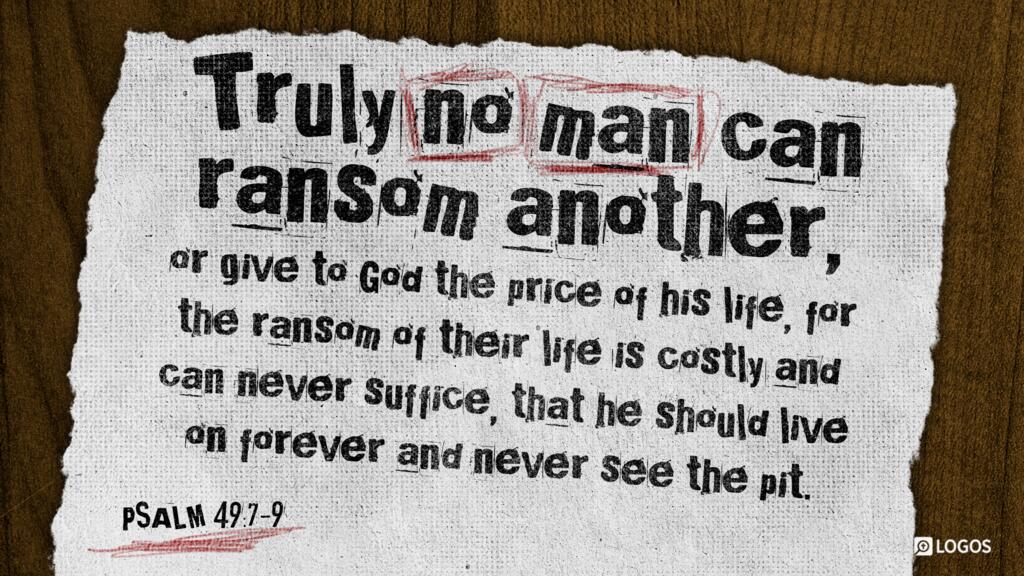
Truly no man can ransom another,
or give to God the price of his life,
for the ransom of their life is costly
and can never suffice,
that he should live on forever
and never see the pit.
Copyright 2001 Crossway Bibles
NIVNew International Version (2011)
Why should I fear when evil days come,
when wicked deceivers surround me—
those who trust in their wealth
and boast of their great riches?
No one can redeem the life of another
or give to God a ransom for them—
the ransom for a life is costly,
no payment is ever enough—
so that they should live on forever
and not see decay.
Copyright 1973, 1978, 1984, 2011 Biblica, Inc.
CSBChristian Standard Bible
Why should I fear in times of trouble?
The iniquity of my foes surrounds me.
They trust in their wealth
and boast of their abundant riches.
Yet these cannot redeem a person
or pay his ransom to God—
since the price of redeeming him is too costly,
one should forever stop trying—
so that he may live forever
and not see the Pit.
Copyright 2017 Holman Bible Publishers
NLTNew Living Translation
Why should I fear when trouble comes,
when enemies surround me?
They trust in their wealth
and boast of great riches.
Yet they cannot redeem themselves from death
by paying a ransom to God.
Redemption does not come so easily,
for no one can ever pay enough
to live forever
and never see the grave.
Holy Bible, New Living Translation, copyright © 1996, 2004, 2015 by Tyndale House Foundation. Used by permission of Tyndale House Publishers. All rights reserved.
LEBThe Lexham English Bible
Why should I fear in times of calamity,
when iniquity surrounds me at my heels,
those who trust their wealth
and boast about the abundance of their riches?
Surely a man cannot redeem a brother.
He cannot give to God his ransom
(since the redemption price for their life is costly
and it always fails),
so that he may stay alive forever
and not see the pit.
Copyright 2012 Lexham Press
KJV 1900King James Version
Wherefore should I fear in the days of evil,
When the iniquity of my heels shall compass me about?
They that trust in their wealth,
And boast themselves in the multitude of their riches;
None of them can by any means redeem his brother,
Nor give to God a ransom for him:
(For the redemption of their soul is precious,
And it ceaseth for ever:)
That he should still live for ever,
And not see corruption.
Public Domain