Psalm 40:1–8
The NET BibleOther versions
English
- NET The NET Bible
- DARBY 1890 Darby Bible
- ASV American Standard Version
- AV 1873 The Cambridge Paragraph Bible of the Authorized English Version
- CSB Christian Standard Bible
- D-R Douay-Rheims Bible
- ESV English Standard Version
- GW GOD’S WORD Translation
- GNB Good News Translation
- HCSB The Holman Christian Standard Bible
- KJV 1900 King James Version
- LSB Legacy Standard Bible
- LEB The Lexham English Bible
- MSG The Message: The Bible in Contemporary Language
- NASB95 New American Standard Bible (1995)
- NCV New Century Version
- NIrV New International Reader’s Version (1998)
- NIV New International Version (2011)
- NKJV The New King James Version
- NLT New Living Translation
- NRSVue New Revised Standard Version: Updated Edition
- RSV The Revised Standard Version
- RSVCE The Revised Standard Version, Catholic Edition
- YLT Young’s Literal Translation
Arabic
Czech
French
German
Hebrew
Hungarian
Italian
Korean
Latin
Portuguese
Russian
Simplified Chinese
Spanish
Traditional Chinese
40:1I relied completely1 on the Lord,
and he turned toward me
and heard my cry for help.
40:2He lifted me out of the watery pit,2
out of the slimy mud.3
He placed my feet on a rock
and gave me secure footing.4
40:3He gave me reason to sing a new song,5
praising our God.6
May many see what God has done,
so that they might swear allegiance to him and trust in the Lord!7
40:4How blessed8 is the one9 who trusts in the Lord10
and does not seek help from11 the proud or from liars!12
40:5O Lord, my God, you have accomplished many things;
you have done amazing things and carried out your purposes for us.13
No one can thwart you!14
I want to declare them and talk about them,
but they are too numerous to recount!15
40:6Receiving sacrifices and offerings are not your primary concern.16
You make that quite clear to me!17
You do not ask for burnt sacrifices and sin offerings.
40:7Then I say,
“Look! I come!
What is written in the scroll pertains to me.18
40:8I want to do what pleases you,19 my God.
Your law dominates my thoughts.”20
Footnotes
- 1 Heb “relying, I relied.” The infinitive absolute precedes the finite verbal form to emphasize the verbal idea. The emphasis is reflected in the translation through the adverb “completely.” Another option is to translate, “I waited patiently” (cf. , , ).
- 2 Heb “cistern of roaring.” The Hebrew noun בּוֹר (bor, “cistern, pit”) is used metaphorically here of Sheol, the place of death, which is sometimes depicted as a raging sea (see Ps 18:4, 15–16). The noun שָׁאוֹן (sha’on, “roaring”) refers elsewhere to the crashing sound of the sea’s waves (see Ps 65:7).
- 3 Heb “from the mud of mud.” The Hebrew phrase translated “slimy mud” employs an appositional genitive. Two synonyms are joined in a construct relationship to emphasize the single idea. For a detailed discussion of the grammatical point with numerous examples, see Y. Avishur, “Pairs of Synonymous Words in the Construct State (and in Appositional Hendiadys) in Biblical Hebrew,” Semitics 2 (1971): 17–81.
- 4 Heb “he established my footsteps.”
- 5 A new song was appropriate because the Lord had intervened in the psalmist’s experience in a fresh and exciting way.
- 6 Heb “and he placed in my mouth a new song, praise to our God.”
- 7 Heb “may many see and fear and trust in the Lord.” The translation assumes that the initial prefixed verbal form is a jussive (“may many see”), rather than an imperfect (“many will see”). The following prefixed verbal forms with vav (ו) conjunctive are taken as indicating purpose or result (“so that they might swear allegiance … and trust”) after the introductory jussive.
- 8 The Hebrew noun is an abstract plural. The word often refers metonymically to the happiness that God-given security and prosperity produce (see Pss 1:1, 3; 2:12; 34:9; 41:1; 65:4; 84:12; 89:15; 106:3; 112:1; 127:5; 128:1; 144:15).
- 9 Heb “man.” See the note on the word “one” in .
- 10 Heb “who has made the Lord his [object of] trust.”
- 11 Heb “and does not turn toward.”
- 12 Heb “those falling away toward a lie.”
- 13 Heb “many things you have done, you, O Lord my God, your amazing deeds and your thoughts toward us.” The precise meaning of the text is not clear, but the psalmist seems to be recalling the Lord’s miraculous deeds on Israel’s behalf (see Pss 9:1; 26:7), as well as his covenantal decrees and promises (see Ps 33:11).
- 14 Heb “there is none arrayed against you.” The precise meaning of the text is unclear, but the collocation עָרַךְ אֶל (’arakh ’el, “array against”) is used elsewhere of military (Judg 20:30; 1 Chr 19:17) or verbal opposition (Job 32:14).
- 15 Heb “I will declare and I will speak, they are too numerous to recount.” The present translation assumes that the cohortatives are used in a hypothetical manner in a formally unmarked conditional sentence, “Should I try to declare [them] and speak [of them] …” (cf. , , ). For other examples of cohortatives in the protasis (“if” clause) of a conditional sentence, see §108.e. (It should be noted, however, that understands this particular verse in a different manner. See §108.f, where it is suggested that the cohortatives are part of an apodosis with the protasis being suppressed.) Another option is to take the cohortatives as a declaration of the psalmist’s resolve to announce the truth expressed in the next line. In this case one might translate: “I will declare and speak [the truth]: They are too numerous to recount.”
- 16 Heb “sacrifice and offering you do not desire.” The statement is exaggerated for the sake of emphasis (see Ps 51:16 as well). God is pleased with sacrifices, but his first priority is obedience and loyalty (see 1 Sam 15:22). Sacrifices and offerings apart from genuine allegiance are meaningless (see Isa 1:11–20).
- 17 Heb “ears you hollowed out for me.” The meaning of this odd expression is debated (this is the only collocation of “hollowed out” and “ears” in the OT). It may have been an idiomatic expression referring to making a point clear to a listener. The has “but a body you have prepared for me,” a reading which is followed in Heb 10:5.
- 18 Heb “in the roll of the scroll it is written concerning me.” Apparently the psalmist refers to the law of God (see v. 8), which contains the commandments God desires him to obey. If this is a distinctly royal psalm, then the psalmist/king may be referring specifically to the regulations of kingship prescribed in Deut 17:14–20. See P. C. Craigie, Psalms 1–50 (), .
- 19 Or “your will.”
- 20 Heb “your law [is] in the midst of my inner parts.” The “inner parts” are viewed here as the seat of the psalmist’s thought life and moral decision making.
The NET Bible First Edition, Copyright 1996-2005 by Biblical Studies Press
In other versions
ESVEnglish Standard Version
I waited patiently for the Lord;
he inclined to me and heard my cry.
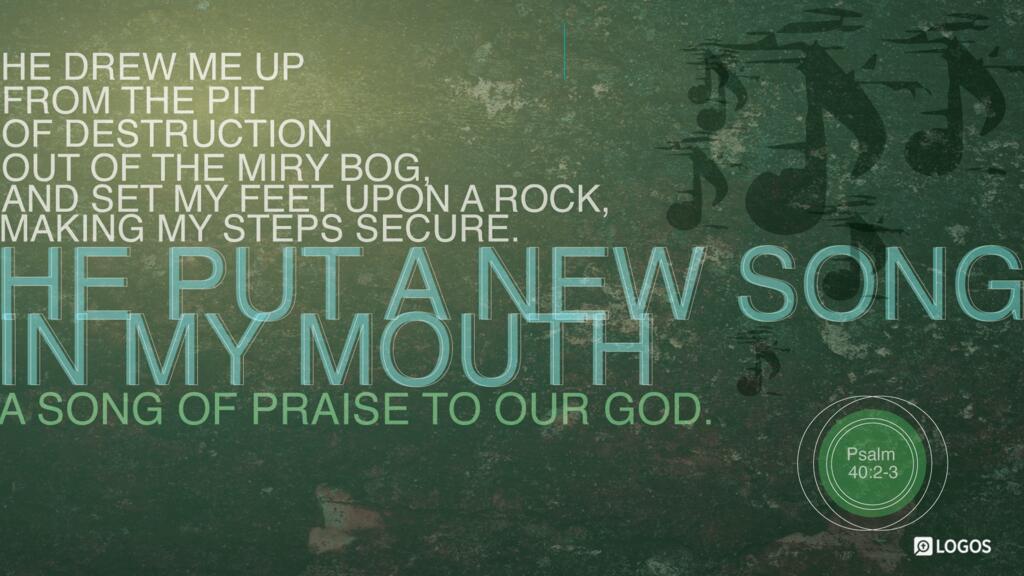
He drew me up from the pit of destruction,
out of the miry bog,
and set my feet upon a rock,
making my steps secure.
He put a new song in my mouth,
a song of praise to our God.
Many will see and fear,
and put their trust in the Lord.
Blessed is the man who makes
the Lord his trust,
who does not turn to the proud,
to those who go astray after a lie!
You have multiplied, O Lord my God,
your wondrous deeds and your thoughts toward us;
none can compare with you!
I will proclaim and tell of them,
yet they are more than can be told.
In sacrifice and offering you have not delighted,
but you have given me an open ear.
Burnt offering and sin offering
you have not required.
Then I said, “Behold, I have come;
in the scroll of the book it is written of me:
I delight to do your will, O my God;
your law is within my heart.”
Copyright 2001 Crossway Bibles
NIVNew International Version (2011)
I waited patiently for the Lord;
he turned to me and heard my cry.
He lifted me out of the slimy pit,
out of the mud and mire;
he set my feet on a rock
and gave me a firm place to stand.
He put a new song in my mouth,
a hymn of praise to our God.
Many will see and fear the Lord
and put their trust in him.
Blessed is the one
who trusts in the Lord,
who does not look to the proud,
to those who turn aside to false gods.
Many, Lord my God,
are the wonders you have done,
the things you planned for us.
None can compare with you;
were I to speak and tell of your deeds,
they would be too many to declare.
Sacrifice and offering you did not desire—
but my ears you have opened—
burnt offerings and sin offerings you did not require.
Then I said, “Here I am, I have come—
it is written about me in the scroll.
I desire to do your will, my God;
your law is within my heart.”
Copyright 1973, 1978, 1984, 2011 Biblica, Inc.
CSBChristian Standard Bible
I waited patiently for the Lord,
and he turned to me and heard my cry for help.
He brought me up from a desolate pit,
out of the muddy clay,
and set my feet on a rock,
making my steps secure.
He put a new song in my mouth,
a hymn of praise to our God.
Many will see and fear,
and they will trust in the Lord.
How happy is anyone
who has put his trust in the Lord
and has not turned to the proud
or to those who run after lies!
Lord my God, you have done many things—
your wondrous works and your plans for us;
none can compare with you.
If I were to report and speak of them,
they are more than can be told.
You do not delight in sacrifice and offering;
you open my ears to listen.
You do not ask for a whole burnt offering or a sin offering.
Then I said, “See, I have come;
in the scroll it is written about me.
I delight to do your will, my God,
and your instruction is deep within me.”
Copyright 2017 Holman Bible Publishers
NLTNew Living Translation
I waited patiently for the Lord to help me,
and he turned to me and heard my cry.
He lifted me out of the pit of despair,
out of the mud and the mire.
He set my feet on solid ground
and steadied me as I walked along.
He has given me a new song to sing,
a hymn of praise to our God.
Many will see what he has done and be amazed.
They will put their trust in the Lord.
Oh, the joys of those who trust the Lord,
who have no confidence in the proud
or in those who worship idols.
O Lord my God, you have performed many wonders for us.
Your plans for us are too numerous to list.
You have no equal.
If I tried to recite all your wonderful deeds,
I would never come to the end of them.
You take no delight in sacrifices or offerings.
Now that you have made me listen, I finally understand—
you don’t require burnt offerings or sin offerings.
Then I said, “Look, I have come.
As is written about me in the Scriptures:
I take joy in doing your will, my God,
for your instructions are written on my heart.”
Holy Bible, New Living Translation, copyright © 1996, 2004, 2015 by Tyndale House Foundation. Used by permission of Tyndale House Publishers. All rights reserved.
LEBThe Lexham English Bible
I waited patiently for Yahweh,
And he inclined to me
and heard my cry for help.
And so he brought me up from the roaring pit,
from the miry clay.
And he put my feet upon a rock;
he made my steps steady.
Then he put a new song in my mouth,
a praise to our God.
Many will see and fear,
and will trust Yahweh.
Blessed is the man who makes Yahweh his trust
and does not turn to the proud and to those who fall away to a lie.
Many things, O Yahweh my God, you have done—
your wonderful deeds and your thoughts toward us.
There is none to compare with you.
If I tried to proclaim and tell of them,
they would be too numerous to count.
A sacrifice and offering you do not desire.
My ears you have opened.
Burnt offering and sin offering you have not demanded.
Then I said, “Look, I come.
In the scroll of the book
it is written concerning me:
‘I delight to do your will, O my God,
and your law is deep within me.’ ”
Copyright 2012 Lexham Press
KJV 1900King James Version
I waited patiently for the Lord;
And he inclined unto me, and heard my cry.
He brought me up also out of an horrible pit, out of the miry clay,
And set my feet upon a rock, and established my goings.
And he hath put a new song in my mouth, even praise unto our God:
Many shall see it, and fear, and shall trust in the Lord.
Blessed is that man that maketh the Lord his trust,
And respecteth not the proud, nor such as turn aside to lies.
Many, O Lord my God, are thy wonderful works which thou hast done,
And thy thoughts which are to us-ward:
They cannot be reckoned up in order unto thee:
If I would declare and speak of them,
They are more than can be numbered.
Sacrifice and offering thou didst not desire;
Mine ears hast thou opened:
Burnt offering and sin offering hast thou not required.
Then said I, Lo, I come:
In the volume of the book it is written of me,
I delight to do thy will, O my God:
Yea, thy law is within my heart.
Public Domain