Proverbs 8:1–6
The NET BibleOther versions
English
- NET The NET Bible
- DARBY 1890 Darby Bible
- ASV American Standard Version
- AV 1873 The Cambridge Paragraph Bible of the Authorized English Version
- CSB Christian Standard Bible
- D-R Douay-Rheims Bible
- ESV English Standard Version
- GW GOD’S WORD Translation
- GNB Good News Translation
- HCSB The Holman Christian Standard Bible
- KJV 1900 King James Version
- LSB Legacy Standard Bible
- LEB The Lexham English Bible
- MSG The Message: The Bible in Contemporary Language
- NASB95 New American Standard Bible (1995)
- NCV New Century Version
- NIrV New International Reader’s Version (1998)
- NIV New International Version (2011)
- NKJV The New King James Version
- NLT New Living Translation
- NRSVue New Revised Standard Version: Updated Edition
- RSV The Revised Standard Version
- RSVCE The Revised Standard Version, Catholic Edition
- YLT Young’s Literal Translation
Arabic
Czech
French
German
Hebrew
Hungarian
Italian
Korean
Latin
Portuguese
Russian
Simplified Chinese
Spanish
Traditional Chinese
The Appeal of Wisdom58
8:1Does not wisdom call out?
Does not understanding raise her voice?
8:2At the top1 of the elevated places along the way,
at the intersection2 of the paths she takes her stand;
8:3beside the gates opening into3 the city,
at the entrance of the doorways she cries out:4
8:4“To you, O people,5 I call out,
and my voice calls6 to all mankind.7
8:5You who are naive, discern8 wisdom!
And you fools, understand discernment!9
8:6Listen, for I will speak excellent things,10
and my lips will utter11 what is right.
Footnotes
- 58 In this chapter wisdom is personified. In 1:20–33 wisdom proclaims her value, and in 3:19–26 wisdom is the agent of creation. Such a personification has affinities with the wisdom literature of the ancient Near East, and may have drawn on some of that literature, albeit with appropriate safeguards (Claudia V. Camp, Wisdom and the Feminine in the Book of Proverbs, 23–70). Wisdom in Proverbs 8, however, is not a deity like Egypt’s Ma`at or the Assyrian-Babylonian Ishtar. It is simply presented as if it were a self-conscious divine being distinct but subordinate to God; but in reality it is the personification of the attribute of wisdom displayed by God (R. B. Y. Scott, Proverbs, Ecclesiastes [], 69–72; and R. Marcus, “On Biblical Hypostases of Wisdom,” 23 [1950–1951]: 157–71). Many have equated wisdom in this chapter with Jesus Christ. This connection works only in so far as Jesus reveals the nature of the Father, just as Proverbs presents wisdom as an attribute of God. Jesus’ claims included wisdom (Matt 12:42) and a unique knowledge of God (Matt 11:25–27). He even personified wisdom in a way that was similar to Proverbs (Matt 11:19). Paul saw the fulfillment of wisdom in Christ (Col 1:15–20; 2:3) and affirmed that Christ became our wisdom in the crucifixion (1 Cor 1:24, 30). So this personification in Proverbs provides a solid foundation for the similar revelation of wisdom in Christ. But because wisdom is a creation of God in Proverbs 8, it is unlikely that wisdom here is to be identified with Jesus Christ. The chapter unfolds in three cycles: After an introduction (1–3), wisdom makes an invitation (4, 5) and explains that she is noble, just, and true (6–9); she then makes another invitation (10) and explains that she is valuable (11–21); and finally, she tells how she preceded and delights in creation (22–31) before concluding with the third invitation (32–36).
- 1 Heb “head.” The word רֹאשׁ (ro’sh, “head”) refers to the highest area or most important place in the elevated area. The contrast with chapter 7 is striking. There the wayward woman lurked at the corners in the street at night; here wisdom is at the highest point in the open places in view of all.
- 2 Heb “at the house of the paths.” The “house” is not literal here, but refers to where the paths meet (cf. , ), that is, the “crossroads” (so , , ).
- 3 Heb “at the mouth of.”
- 4 The cry is a very loud ringing cry that could not be missed. The term רָנַן (ranan) means “to give a ringing cry.” It is often only a shrill sound that might come with a victory in battle, but its use in the psalms for praise shows that it also can have clear verbal content, as it does here. For wisdom to stand in the street and give such a ringing cry would mean that it could be heard by all. It was a proclamation.
- 5 Heb “men.” Although it might be argued in light of the preceding material that males would be particularly addressed by wisdom here, the following material indicates a more universal appeal. Cf. , “to all of you.”
- 6 The verb “calls” does not appear in the Hebrew text, but is supplied in the translation for the sake of style.
- 7 Heb “sons of man.” Cf. “the children of men”; , “all people”; “all that live.”
- 8 The imperative of בִּין (bin) means “to understand; to discern.” The call is for the simple to understand what wisdom is, not just to gain it.
- 9 Heb “heart.” The noun לֵב (lev, “heart”) often functions metonymically for wisdom, understanding, discernment.
- 10 Heb “noble” or “princely.” Wisdom begins the first motivation by claiming to speak noble things, that is, excellent things.
- 11 Heb “opening of my lips” (so , ). The noun “lips” is a metonymy of cause, with the organ of speech put for what is said.
The NET Bible First Edition, Copyright 1996-2005 by Biblical Studies Press
In other versions
ESVEnglish Standard Version
Does not wisdom call?
Does not understanding raise her voice?
On the heights beside the way,
at the crossroads she takes her stand;
beside the gates in front of the town,
at the entrance of the portals she cries aloud:
“To you, O men, I call,
and my cry is to the children of man.
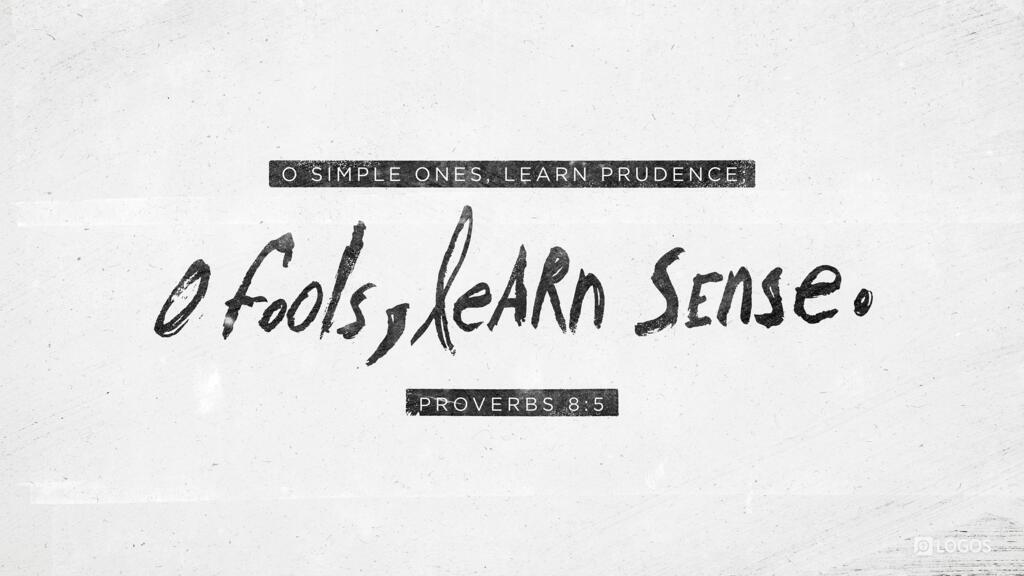
O simple ones, learn prudence;
O fools, learn sense.
Hear, for I will speak noble things,
and from my lips will come what is right,
Copyright 2001 Crossway Bibles
NIVNew International Version (2011)
Does not wisdom call out?
Does not understanding raise her voice?
At the highest point along the way,
where the paths meet, she takes her stand;
beside the gate leading into the city,
at the entrance, she cries aloud:
“To you, O people, I call out;
I raise my voice to all mankind.
You who are simple, gain prudence;
you who are foolish, set your hearts on it.
Listen, for I have trustworthy things to say;
I open my lips to speak what is right.
Copyright 1973, 1978, 1984, 2011 Biblica, Inc.
CSBChristian Standard Bible
Doesn’t wisdom call out?
Doesn’t understanding make her voice heard?
At the heights overlooking the road,
at the crossroads, she takes her stand.
Beside the gates leading into the city,
at the main entrance, she cries out:
“People, I call out to you;
my cry is to the children of Adam.
Learn to be shrewd, you who are inexperienced;
develop common sense, you who are foolish.
Listen, for I speak of noble things,
and what my lips say is right.
Copyright 2017 Holman Bible Publishers
NLTNew Living Translation
Listen as Wisdom calls out!
Hear as understanding raises her voice!
On the hilltop along the road,
she takes her stand at the crossroads.
By the gates at the entrance to the town,
on the road leading in, she cries aloud,
“I call to you, to all of you!
I raise my voice to all people.
You simple people, use good judgment.
You foolish people, show some understanding.
Listen to me! For I have important things to tell you.
Everything I say is right,
Holy Bible, New Living Translation, copyright © 1996, 2004, 2015 by Tyndale House Foundation. Used by permission of Tyndale House Publishers. All rights reserved.
LEBThe Lexham English Bible
Does not wisdom call,
and understanding raise its voice?
Atop the heights beside the road,
at the crossroads she stands.
Beside gates, before towns,
at the entrance of doors, she cries out:
“To you, O people, I call,
and my cry is to the children of humankind.
Learn prudence, O simple ones;
fools, learn intelligence.
Listen! For noble things I will speak,
and upright things from the opening of my lips.
Copyright 2012 Lexham Press
KJV 1900King James Version
Doth not wisdom cry?
And understanding put forth her voice?
She standeth in the top of high places, by the way
In the places of the paths.
She crieth at the gates, at the entry of the city,
At the coming in at the doors.
Unto you, O men, I call;
And my voice is to the sons of man.
O ye simple, understand wisdom:
And, ye fools, be ye of an understanding heart.
Hear; for I will speak of excellent things;
And the opening of my lips shall be right things.
Public Domain