Proverbs 30:8–9
The NET BibleOther versions
English
- NET The NET Bible
- DARBY 1890 Darby Bible
- ASV American Standard Version
- AV 1873 The Cambridge Paragraph Bible of the Authorized English Version
- CSB Christian Standard Bible
- D-R Douay-Rheims Bible
- ESV English Standard Version
- GW GOD’S WORD Translation
- GNB Good News Translation
- HCSB The Holman Christian Standard Bible
- KJV 1900 King James Version
- LSB Legacy Standard Bible
- LEB The Lexham English Bible
- MSG The Message: The Bible in Contemporary Language
- NASB95 New American Standard Bible (1995)
- NCV New Century Version
- NIrV New International Reader’s Version (1998)
- NIV New International Version (2011)
- NKJV The New King James Version
- NLT New Living Translation
- NRSVue New Revised Standard Version: Updated Edition
- RSV The Revised Standard Version
- RSVCE The Revised Standard Version, Catholic Edition
- YLT Young’s Literal Translation
Arabic
Czech
French
German
Hebrew
Hungarian
Italian
Korean
Latin
Portuguese
Russian
Simplified Chinese
Spanish
Traditional Chinese
30:8Remove falsehood and lies22 far from me;
do not give me poverty or riches,
feed me with my allotted portion23 of bread,24
30:9lest I become satisfied and act deceptively25
and say, “Who is the Lord?”
Or lest I become poor and steal
and demean26 the name of my God.
Footnotes
- 22 The two words might form a hendiadys: “falsehood and lies” being equivalent to “complete deception.” The word שָׁוְא means “false; empty; vain; to a false purpose.” The second word means “word of lying,” thus “a lying word.” Taken separately they might refer to false intentions and false words.
- 23 The word חֹק (khoq) means “statute”; it is also used of a definite assignment in labor (Exod 5:14; Prov 31:15), or of a set portion of food (Gen 47:22). Here it refers to food that is the proper proportion for the speaker.
- 24 Agur requested an honest life (not deceitful) and a balanced life (not self-sufficient). The second request about his provision is clarified in v. 9.
- 25 The verb כָּחַשׁ (kakhash) means “to be disappointing; to deceive; to fail; to grow lean.” In the Piel stem it means “to deceive; to act deceptively; to cringe; to disappoint.” The idea of acting deceptively is illustrated in Hos 9:2 where it has the connotation of “disowning” or “refusing to acknowledge” (a meaning very close to its meaning here).
- 26 The Hebrew verb literally means “to take hold of; to seize”; this produces the idea of doing violence to the reputation of God.
The NET Bible First Edition, Copyright 1996-2005 by Biblical Studies Press
In other versions
ESVEnglish Standard Version
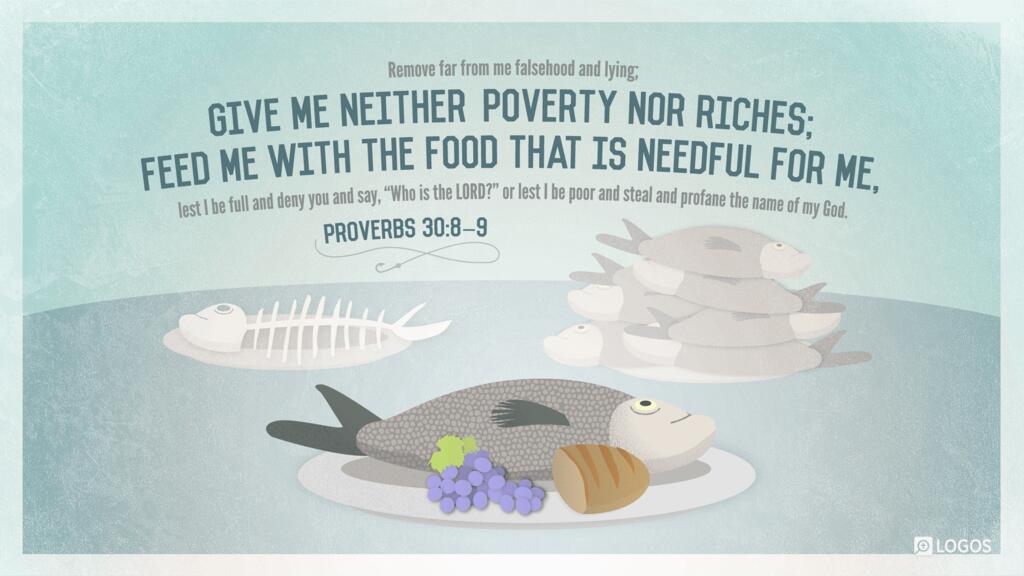
Remove far from me falsehood and lying;
give me neither poverty nor riches;
feed me with the food that is needful for me,
lest I be full and deny you
and say, “Who is the Lord?”
or lest I be poor and steal
and profane the name of my God.
Copyright 2001 Crossway Bibles
NIVNew International Version (2011)
Keep falsehood and lies far from me;
give me neither poverty nor riches,
but give me only my daily bread.
Otherwise, I may have too much and disown you
and say, ‘Who is the Lord?’
Or I may become poor and steal,
and so dishonor the name of my God.
Copyright 1973, 1978, 1984, 2011 Biblica, Inc.
CSBChristian Standard Bible
Keep falsehood and deceitful words far from me.
Give me neither poverty nor wealth;
feed me with the food I need.
Otherwise, I might have too much
and deny you, saying, “Who is the Lord?”
or I might have nothing and steal,
profaning the name of my God.
Copyright 2017 Holman Bible Publishers
NLTNew Living Translation
First, help me never to tell a lie.
Second, give me neither poverty nor riches!
Give me just enough to satisfy my needs.
For if I grow rich, I may deny you and say, “Who is the Lord?”
And if I am too poor, I may steal and thus insult God’s holy name.
Holy Bible, New Living Translation, copyright © 1996, 2004, 2015 by Tyndale House Foundation. Used by permission of Tyndale House Publishers. All rights reserved.
LEBThe Lexham English Bible
Keep falsehood and a lying word far from me;
do not give me poverty or wealth;
provide me with food only for my need.
Or else I will be satisfied and will deny him
and say “Who is Yahweh?”
Or I will be poor and will steal
and profane the name of my God.
Copyright 2012 Lexham Press
KJV 1900King James Version
Remove far from me vanity and lies:
Give me neither poverty nor riches;
Feed me with food convenient for me:
Lest I be full, and deny thee,
And say, Who is the Lord?
Or lest I be poor, and steal,
And take the name of my God in vain.
Public Domain