Proverbs 28:13
The NET BibleOther versions
English
- NET The NET Bible
- DARBY 1890 Darby Bible
- ASV American Standard Version
- AV 1873 The Cambridge Paragraph Bible of the Authorized English Version
- CSB Christian Standard Bible
- D-R Douay-Rheims Bible
- ESV English Standard Version
- GW GOD’S WORD Translation
- GNB Good News Translation
- HCSB The Holman Christian Standard Bible
- KJV 1900 King James Version
- LSB Legacy Standard Bible
- LEB The Lexham English Bible
- MSG The Message: The Bible in Contemporary Language
- NASB95 New American Standard Bible (1995)
- NCV New Century Version
- NIrV New International Reader’s Version (1998)
- NIV New International Version (2011)
- NKJV The New King James Version
- NLT New Living Translation
- NRSVue New Revised Standard Version: Updated Edition
- RSV The Revised Standard Version
- RSVCE The Revised Standard Version, Catholic Edition
- YLT Young’s Literal Translation
Arabic
Czech
French
German
Hebrew
Hungarian
Italian
Korean
Latin
Portuguese
Russian
Simplified Chinese
Spanish
Traditional Chinese
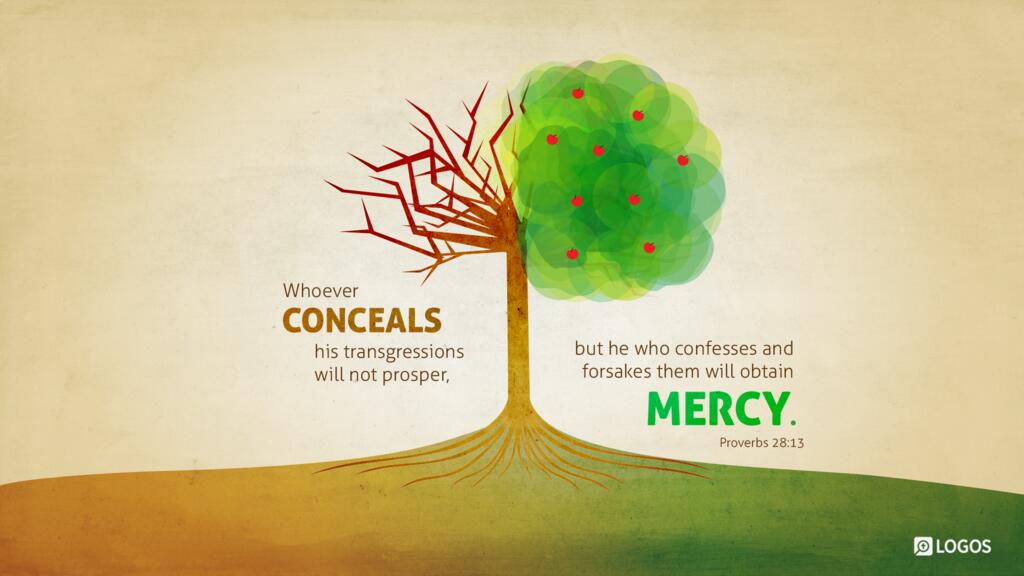
28:13The one who covers37 his transgressions will not prosper,38
but whoever confesses them and forsakes them will find mercy.39
Footnotes
- 37 The Hebrew participles provide the subject matter in this contrast. On the one hand is the person who covers over (מְכַסֶּה, mékhasseh) his sins. This means refusing to acknowledge them in confession, and perhaps rationalizing them away. On the other hand there is the one who both “confesses” (מוֹדֶה, modeh) and “forsakes” (עֹזֵב, ’ozev) the sin. To “confess” sins means to acknowledge them, to say the same thing about them that God does.
- 38 The verse contrasts the consequences of each. The person who refuses to confess will not prosper. This is an understatement (a figure of speech known as tapeinosis); the opposite is the truth, that eventually such a person will be undone and ruined. On the other hand, the penitent will find mercy. This expression is a metonymy of cause for the effect—although “mercy” is mentioned, what mercy provides is intended, i.e., forgiveness. In other passages the verb “conceal” is used of God’s forgiveness—he covers over the iniquity (Ps 32:1). Whoever acknowledges sin, God will cover it; whoever covers it, God will lay it open.
- 39 This verse is unique in the book of Proverbs; it captures the theology of forgiveness (e.g., Pss 32 and 51). Every part of the passage is essential to the point: Confession of sins as opposed to concealing them, coupled with a turning away from them, results in mercy.
The NET Bible First Edition, Copyright 1996-2005 by Biblical Studies Press
In other versions
ESVEnglish Standard Version
Whoever conceals his transgressions will not prosper,
but he who confesses and forsakes them will obtain mercy.
Copyright 2001 Crossway Bibles
NIVNew International Version (2011)
Whoever conceals their sins does not prosper,
but the one who confesses and renounces them finds mercy.
Copyright 1973, 1978, 1984, 2011 Biblica, Inc.
CSBChristian Standard Bible
The one who conceals his sins
will not prosper,
but whoever confesses and renounces them
will find mercy.
Copyright 2017 Holman Bible Publishers
NLTNew Living Translation
People who conceal their sins will not prosper,
but if they confess and turn from them, they will receive mercy.
Holy Bible, New Living Translation, copyright © 1996, 2004, 2015 by Tyndale House Foundation. Used by permission of Tyndale House Publishers. All rights reserved.
LEBThe Lexham English Bible
He who conceals his transgression will not prosper,
but he who confesses and forsakes will obtain mercy.
Copyright 2012 Lexham Press
KJV 1900King James Version
He that covereth his sins shall not prosper:
But whoso confesseth and forsaketh them shall have mercy.
Public Domain