Proverbs 13:20–23
The NET BibleOther versions
English
- NET The NET Bible
- DARBY 1890 Darby Bible
- ASV American Standard Version
- AV 1873 The Cambridge Paragraph Bible of the Authorized English Version
- CSB Christian Standard Bible
- D-R Douay-Rheims Bible
- ESV English Standard Version
- GW GOD’S WORD Translation
- GNB Good News Translation
- HCSB The Holman Christian Standard Bible
- KJV 1900 King James Version
- LSB Legacy Standard Bible
- LEB The Lexham English Bible
- MSG The Message: The Bible in Contemporary Language
- NASB95 New American Standard Bible (1995)
- NCV New Century Version
- NIrV New International Reader’s Version (1998)
- NIV New International Version (2011)
- NKJV The New King James Version
- NLT New Living Translation
- NRSVue New Revised Standard Version: Updated Edition
- RSV The Revised Standard Version
- RSVCE The Revised Standard Version, Catholic Edition
- YLT Young’s Literal Translation
Arabic
Czech
French
German
Hebrew
Hungarian
Italian
Korean
Latin
Portuguese
Russian
Simplified Chinese
Spanish
Traditional Chinese
13:20The one who associates71 with the wise grows wise,
but a companion of fools suffers harm.72
13:21Calamity73 pursues sinners,
but prosperity rewards the righteous.74
13:22A benevolent75 person leaves an inheritance76 for his grandchildren,77
but the wealth of a sinner is stored up for the righteous.78
13:23There is abundant food in the field79 of the poor,
but it is swept away by injustice.80
Footnotes
- 71 Heb “walks.” When used with the preposition אֶת (’et, “with”), the verb הָלַךְ (halakh, “to walk”) means “to associate with” someone ( 234 הָלַךְ II.3.b; e.g., Mic 6:8; Job 34:8). The active participle of הָלַךְ (“to walk”) stresses continual, durative action. One should stay in close association with the wise, and move in the same direction they do.
- 72 The verb form יֵרוֹעַ (yeroa’) is the Niphal imperfect of רָעַע (ra’a’), meaning “to suffer hurt.” Several have attempted to parallel the repetition in the wordplay of the first colon. A. Guillaume has “he who associates with fools will be left a fool” (“A Note on the Roots רִיע, יָרַע, and רָעַע in Hebrew,” 15 [1964]: 294). translated the thus: “Fool he ends that fool befriends” (cited by D. Kidner, Proverbs [], ).
- 73 Heb “evil.” The term רָעָה (ra’ah, “evil”) here functions in a metonymical sense meaning “calamity.” “Good” is the general idea of good fortune or prosperity; the opposite, “evil,” is likewise “misfortune” (cf. , , ) or calamity.
- 74 This statement deals with recompense in absolute terms. It is this principle, without allowing for any of the exceptions that Proverbs itself acknowledges, that Job’s friends applied (incorrectly) to his suffering.
- 75 Heb “good.”
- 76 In ancient Israel the idea of leaving an inheritance was a sign of God’s blessing; blessings extended to the righteous and not the sinners.
- 77 Heb “the children of children.”
- 78 In the ultimate justice of God, the wealth of the wicked goes to the righteous after death (e.g., Ps 49:10, 17).
- 79 Heb “fallow ground” (so ). The word נִיר (nir) means “the tillable [or untilled; or fallow] ground.” 644 says this line could be rendered: “abundant food [yields] the fallow ground of poor men” (i.e., with the Lord’s blessing).
- 80 The reads “there is what is swept away because [there is] no justice” (וְיֵשׁ נִסְפֶּה בְּלֹא מִשְׁפָּט, véyesh nispeh bélo’ mishpat). The reads “the great enjoy wealth many years, but some men perish little by little.” The reads “those who have no habitation waste wealth many years, and some waste it completely.” reads “the great man devours the land of the poor, and some men are taken away unjustly.” The has “there is much food in the fresh land of the fathers, and for others it is collected without judgment.” C. H. Toy says that the text is corrupt (Proverbs [], ). Nevertheless, the makes sense: The ground could produce enough food for people if there were no injustice in the land. Poverty is unnecessary as long as there is justice and not injustice.
The NET Bible First Edition, Copyright 1996-2005 by Biblical Studies Press
In other versions
ESVEnglish Standard Version
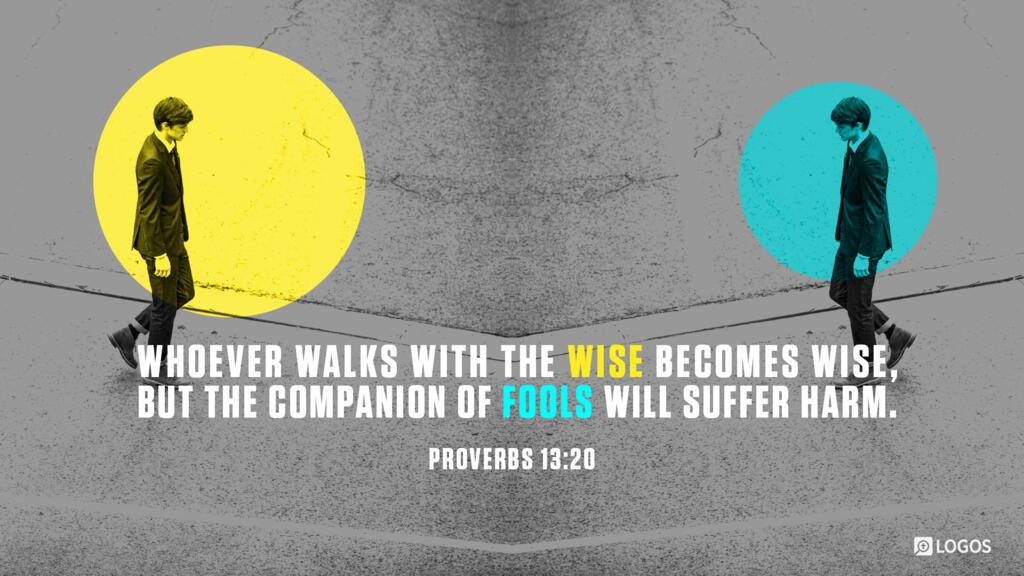
Whoever walks with the wise becomes wise,
but the companion of fools will suffer harm.
Disaster pursues sinners,
but the righteous are rewarded with good.
A good man leaves an inheritance to his children’s children,
but the sinner’s wealth is laid up for the righteous.
The fallow ground of the poor would yield much food,
but it is swept away through injustice.
Copyright 2001 Crossway Bibles
NIVNew International Version (2011)
Walk with the wise and become wise,
for a companion of fools suffers harm.
Trouble pursues the sinner,
but the righteous are rewarded with good things.
A good person leaves an inheritance for their children’s children,
but a sinner’s wealth is stored up for the righteous.
An unplowed field produces food for the poor,
but injustice sweeps it away.
Copyright 1973, 1978, 1984, 2011 Biblica, Inc.
CSBChristian Standard Bible
The one who walks with the wise will become wise,
but a companion of fools will suffer harm.
Disaster pursues sinners,
but good rewards the righteous.
A good man leaves an inheritance to his grandchildren,
but the sinner’s wealth is stored up for the righteous.
The uncultivated field of the poor yields abundant food,
but without justice, it is swept away.
Copyright 2017 Holman Bible Publishers
NLTNew Living Translation
Walk with the wise and become wise;
associate with fools and get in trouble.
Trouble chases sinners,
while blessings reward the righteous.
Good people leave an inheritance to their grandchildren,
but the sinner’s wealth passes to the godly.
A poor person’s farm may produce much food,
but injustice sweeps it all away.
Holy Bible, New Living Translation, copyright © 1996, 2004, 2015 by Tyndale House Foundation. Used by permission of Tyndale House Publishers. All rights reserved.
LEBThe Lexham English Bible
Walk with the wise and be wise,
but as for the companion of fools, he will suffer harm.
Misfortune will pursue sinners,
but the righteous will be rewarded with prosperity.
He who is good will leave an inheritance to his grandchildren,
and stored up for the righteous is the wealth of a sinner.
There is much food in the field of the poor,
but it is swept away by injustice.
Copyright 2012 Lexham Press
KJV 1900King James Version
He that walketh with wise men shall be wise:
But a companion of fools shall be destroyed.
Evil pursueth sinners:
But to the righteous good shall be repayed.
A good man leaveth an inheritance to his children’s children:
And the wealth of the sinner is laid up for the just.
Much food is in the tillage of the poor:
But there is that is destroyed for want of judgment.
Public Domain