Matthew 16:13–28
The NET BibleOther versions
English
- NET The NET Bible
- DARBY 1890 Darby Bible
- ASV American Standard Version
- AV 1873 The Cambridge Paragraph Bible of the Authorized English Version
- CSB Christian Standard Bible
- D-R Douay-Rheims Bible
- ESV English Standard Version
- GW GOD’S WORD Translation
- GNB Good News Translation
- HCSB The Holman Christian Standard Bible
- KJV 1900 King James Version
- LSB Legacy Standard Bible
- LEB The Lexham English Bible
- MSG The Message: The Bible in Contemporary Language
- NASB95 New American Standard Bible (1995)
- NCV New Century Version
- NIrV New International Reader’s Version (1998)
- NIV New International Version (2011)
- NKJV The New King James Version
- NLT New Living Translation
- NRSVue New Revised Standard Version: Updated Edition
- RSV The Revised Standard Version
- RSVCE The Revised Standard Version, Catholic Edition
- YLT Young’s Literal Translation
Arabic
Czech
French
German
Greek
Hungarian
Italian
Korean
Latin
Portuguese
Russian
Simplified Chinese
Spanish
Traditional Chinese
Peter’s Confession
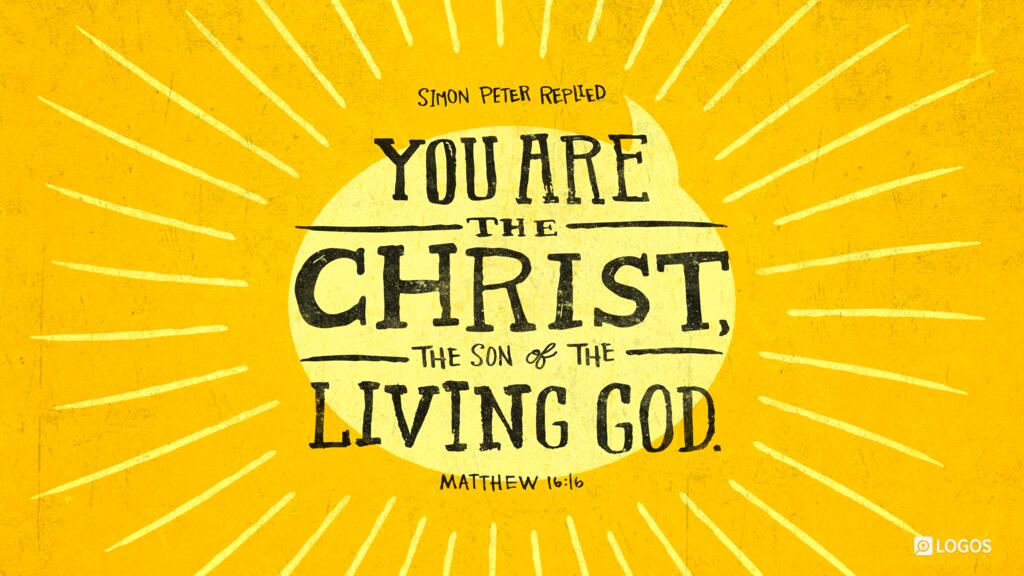
16:13When15 Jesus came to the area of Caesarea Philippi,16 he asked his disciples,17 “Who do people say that the Son of Man is?” 16:14They answered, “Some say John the Baptist, others Elijah,18 and others Jeremiah or one of the prophets.” 16:15He said to them, “But who do you say that I am?” 16:16Simon Peter answered,19 “You are the Christ,20 the Son of the living God.” 16:17And Jesus answered him,21 “You are blessed, Simon son of Jonah, because flesh and blood22 did not reveal this to you, but my Father in heaven! 16:18And I tell you that you are Peter, and on this rock I will build my church, and the gates of Hades23 will not overpower it. 16:19I will give you the keys of the kingdom of heaven. Whatever you bind on earth will have been bound in heaven, and whatever you release on earth will have been released in heaven.” 16:20Then he instructed his disciples not to tell anyone that he was the Christ.24
First Prediction of Jesus’ Death and Resurrection
16:21From that time on25 Jesus began to show his disciples that he must go to Jerusalem26 and suffer27 many things at the hands of the elders, chief priests, and experts in the law,28 and be killed, and on the third day be raised. 16:22So Peter took him aside and began to rebuke him:29 “God forbid,30 Lord! This must not happen to you!” 16:23But he turned and said to Peter, “Get behind me, Satan! You are a stumbling block to me, because you are not setting your mind on God’s interests, but on man’s.”3116:24Then Jesus said to his disciples, “If anyone wants to become my follower,32 he must deny33 himself, take up his cross,34 and follow me. 16:25For whoever wants to save his life35 will lose it,36 but whoever loses his life for my sake will find it. 16:26For what does it benefit a person37 if he gains the whole world but forfeits his life? Or what can a person give in exchange for his life? 16:27For the Son of Man will come with his angels in the glory of his Father, and then he will reward each person according to what he has done.3816:28I tell you the truth,39 there are some standing here who will not40 experience41 death before they see the Son of Man coming in his kingdom.”42
Footnotes
- 15 Here δέ (de) has not been translated.
- 16 For location see ; .
- 17 Grk “he asked his disciples, saying.” The participle λέγων (legōn) is redundant and has been left untranslated.
- 18 The appearance of Elijah would mean that the end time had come. According to 2 Kgs 2:11, Elijah was still alive. In Mal 4:5 it is said that Elijah would be the precursor of Messiah.
- 19 Grk “And answering, Simon Peter said.”
- 20 Or “Messiah”; both “Christ” (Greek) and “Messiah” (Hebrew and Aramaic) mean “one who has been anointed.” See the note on Christ in .
- 21 Grk “answering, Jesus said to him.” The participle ἀποκριθείς (apokritheis) is redundant, but the syntax of this phrase has been modified for clarity.
- 22 The expression “flesh and blood” could refer to “any human being” (so , ; cf. “man”), but it could also refer to Peter himself (i.e., his own intuition; cf. “You didn’t discover this on your own”). Because of the ambiguity of the referent, the phrase “flesh and blood” has been retained in the translation.
- 23 Or “and the power of death” (taking the reference to the gates of Hades as a metonymy). In the OT, Hades was known as Sheol. It is the place where the unrighteous will reside (Matt 11:23; Luke 16:23; Rev 20:13–14). Some translations render this by its modern equivalent, “hell”; others see it as a reference to the power of death.
- 24 Most (א2 C W 𝔐 lat bo) have “Jesus, the Christ” (Ἰησοῦς ὁ Χριστός, Iēsous ho Christos) here, while D has “Christ Jesus” (ὁ Χριστὸς Ἰησοῦς). On the one hand, this is a much harder reading than the mere Χριστός, because the name Jesus was already well known for the disciples’ master—both to them and to others. Whether he was the Messiah is the real focus of the passage. But this is surely too hard a reading: There are no other texts in which the Lord tells his disciples not to disclose his personal name. Further, it is plainly a motivated reading in that scribes had the proclivity to add Ἰησοῦς to χριστός or to κύριος (kurios, “Lord”), regardless of whether such was appropriate to the context. In this instance it clearly is not, and it only reveals that scribes sometimes, if not often, did not think about the larger interpretive consequences of their alterations to the text. Further, the shorter reading is well supported by א* B L Δ Θ f1, 13 565 700 1424 al it sa. Or “Messiah”; both “Christ” (Greek) and “Messiah” (Hebrew and Aramaic) mean “one who has been anointed.” See the note on Christ in .
- 25 Grk “From then.”
- 26 For location see ; ; ; ; ; ; ; ; .
- 27 The necessity that the Son of Man suffer is the particular point that needed emphasis since for many 1st century Jews the Messiah was a glorious and powerful figure, not a suffering one.
- 28 Or “and scribes.” See the note on the phrase “experts in the law” in .
- 29 Grk “began to rebuke him, saying.” The participle λέγων (legōn) is redundant in English and has not been translated.
- 30 Grk “Merciful to you.” A highly elliptical expression: “May God be merciful to you in sparing you from having to undergo [some experience]” (L&N 88.78). A contemporary English equivalent is “God forbid!”
- 31 Grk “people.”
- 32 Grk “to come after me.”
- 33 This translation better expresses the force of the Greek third person imperative than the traditional “let him deny,” which could be understood as merely permissive.
- 34 To bear the cross means to accept the rejection of the world for turning to Jesus and following him. Discipleship involves a death that is like a crucifixion; see Gal 6:14.
- 35 Or “soul” (throughout vv. 25–26).
- 36 The point of the saying whoever wants to save his life will lose it is that if one comes to Jesus then rejection by many will certainly follow. If self-protection is a key motivation, then one will not respond to Jesus and will not be saved. One who is willing to risk rejection will respond and find true life.
- 37 Grk “a man,” but ἄνθρωπος (anthrōpos) is used in a generic sense here to refer to both men and women.
- 38 An allusion to Pss 28:4; 62:12; cf. Prov 24:12.
- 39 Grk “Truly (ἀμήν, amēn), I say to you.”
- 40 The Greek negative here (οὐ μή, ou mē) is the strongest possible.
- 41 Grk “will not taste.” Here the Greek verb does not mean “sample a small amount” (as a typical English reader might infer from the word “taste”), but “experience something cognitively or emotionally; come to know something” (cf. γεύομαι 2).
- 42 Several suggestions have been made as to the referent for the phrase the Son of Man coming in his kingdom: (1) the transfiguration itself, which immediately follows in the narrative; (2) Jesus’ resurrection and ascension; (3) the coming of the Spirit; (4) Christ’s role in the Church; (5) the destruction of Jerusalem; (6) Jesus’ second coming and the establishment of the kingdom. The reference to six days later in 17:1 seems to indicate that Matthew had the transfiguration in mind insofar as it was a substantial prefiguring of the consummation of the kingdom (although this interpretation is not without its problems). As such, the transfiguration would be a tremendous confirmation to the disciples that even though Jesus had just finished speaking of his death (in vv. 21–23), he was nonetheless the promised Messiah and things were proceeding according to God’s plan.
The NET Bible First Edition, Copyright 1996-2005 by Biblical Studies Press