Matthew 11:1–6
The NET BibleOther versions
English
- NET The NET Bible
- DARBY 1890 Darby Bible
- ASV American Standard Version
- AV 1873 The Cambridge Paragraph Bible of the Authorized English Version
- CSB Christian Standard Bible
- D-R Douay-Rheims Bible
- ESV English Standard Version
- GW GOD’S WORD Translation
- GNB Good News Translation
- HCSB The Holman Christian Standard Bible
- KJV 1900 King James Version
- LSB Legacy Standard Bible
- LEB The Lexham English Bible
- MSG The Message: The Bible in Contemporary Language
- NASB95 New American Standard Bible (1995)
- NCV New Century Version
- NIrV New International Reader’s Version (1998)
- NIV New International Version (2011)
- NKJV The New King James Version
- NLT New Living Translation
- NRSVue New Revised Standard Version: Updated Edition
- RSV The Revised Standard Version
- RSVCE The Revised Standard Version, Catholic Edition
- YLT Young’s Literal Translation
Arabic
Czech
French
German
Greek
Hungarian
Italian
Korean
Latin
Portuguese
Russian
Simplified Chinese
Spanish
Traditional Chinese
11:1When1 Jesus had finished instructing his twelve disciples, he went on from there to teach and preach in their towns.
Jesus and John the Baptist
11:2Now when John2 heard in prison about the deeds Christ3 had done, he sent his disciples to ask a question:411:3“Are you the one who is to come,5 or should we look for another?” 11:4Jesus answered them,6 “Go tell John what you hear and see:711:5The blind see, the8 lame walk, lepers are cleansed, the deaf hear, the dead are raised, and the poor have good news proclaimed to them. 11:6Blessed is anyone9 who takes no offense at me.”
Footnotes
- 1 Grk “And it happened when.” The introductory phrase καὶ ἐγένετο (kai egeneto, “it happened that”) is redundant in contemporary English and has not been translated.
- 2 John refers to John the Baptist.
- 3 The Western codex D and a few other (0233 1424 al) read “Jesus” here instead of “Christ.” This is not likely to be original because it is not found in the earliest and most important , nor in the rest of the tradition. Or “Messiah”; both “Christ” (Greek) and “Messiah” (Hebrew and Aramaic) mean “one who has been anointed.” See the note on Christ in .
- 4 Instead of “by his disciples” (see the below for the reading of the Greek), the majority of later (C3 L f1 𝔐 lat bo) have “two of his disciples.” The difference in Greek, however, is only two letters: διὰ τῶν μαθητῶν αὐτοῦ vs. δύο τῶν μαθητῶν αὐτοῦ (dia tōn mathētōn autou vs. duo tōn mathētōn autou). Although an accidental alteration could account for either of these readings, it is more likely that δύο is an assimilation to the parallel in Luke 7:18. Further, διά is read by a good number of early and excellent witnesses (א B C* D P W Z Δ Θ 0233 f13 33 sa), and thus should be considered original. Grk “sending by his disciples he said to him.” The words “a question” are not in the Greek text, but are implied.
- 5 Aspects of Jesus’ ministry may have led John to question whether Jesus was the promised stronger and greater one who is to come that he had preached about in Matt 3:1–12.
- 6 Grk “And answering, Jesus said to them.” This construction is somewhat redundant in English and has been simplified in the translation.
- 7 What you hear and see. The following activities all paraphrase various OT descriptions of the time of promised salvation: Isa 35:5–6; 26:19; 29:18–19; 61:1. Jesus is answering not by acknowledging a title, but by pointing to the nature of his works, thus indicating the nature of the time.
- 8 Grk “and the,” but καί (kai) has not been translated since English normally uses a coordinating conjunction only between the last two elements in a series of three or more. Two other conjunctions are omitted in this series.
- 9 Grk “whoever.”
The NET Bible First Edition, Copyright 1996-2005 by Biblical Studies Press
In other versions
ESVEnglish Standard Version
When Jesus had finished instructing his twelve disciples, he went on from there to teach and preach in their cities.
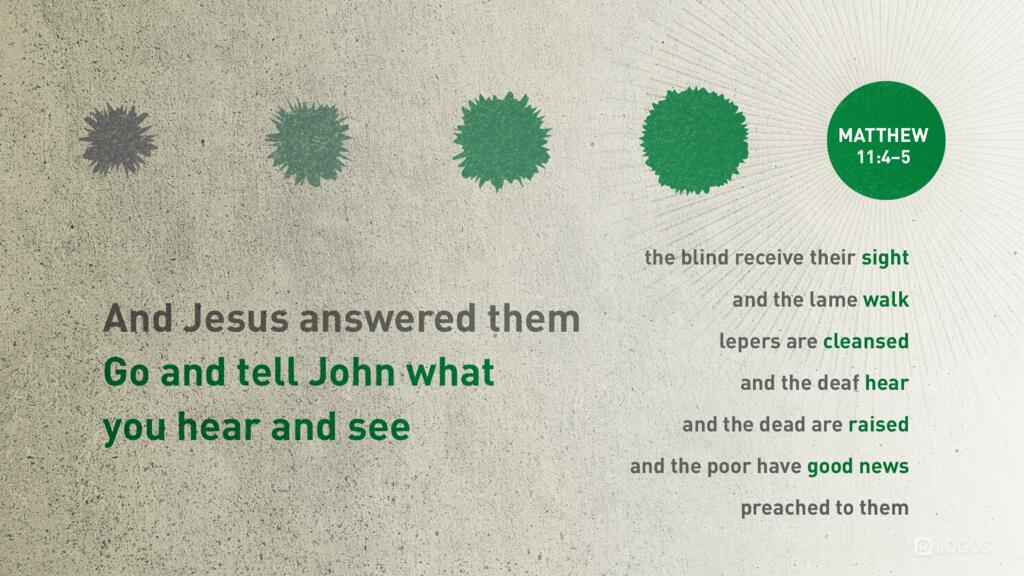
Now when John heard in prison about the deeds of the Christ, he sent word by his disciples and said to him, “Are you the one who is to come, or shall we look for another?” And Jesus answered them, “Go and tell John what you hear and see: the blind receive their sight and the lame walk, lepers are cleansed and the deaf hear, and the dead are raised up, and the poor have good news preached to them. And blessed is the one who is not offended by me.”
Copyright 2001 Crossway Bibles
NIVNew International Version (2011)
After Jesus had finished instructing his twelve disciples, he went on from there to teach and preach in the towns of Galilee.
When John, who was in prison, heard about the deeds of the Messiah, he sent his disciples to ask him, “Are you the one who is to come, or should we expect someone else?”
Jesus replied, “Go back and report to John what you hear and see: The blind receive sight, the lame walk, those who have leprosy are cleansed, the deaf hear, the dead are raised, and the good news is proclaimed to the poor. Blessed is anyone who does not stumble on account of me.”
Copyright 1973, 1978, 1984, 2011 Biblica, Inc.
CSBChristian Standard Bible
When Jesus had finished giving instructions to his twelve disciples, he moved on from there to teach and preach in their towns. Now when John heard in prison what the Christ was doing, he sent a message through his disciples and asked him, “Are you the one who is to come, or should we expect someone else?”
Jesus replied to them, “Go and report to John what you hear and see: The blind receive their sight, the lame walk, those with leprosy are cleansed, the deaf hear, the dead are raised, and the poor are told the good news, and blessed is the one who isn’t offended by me.”
Copyright 2017 Holman Bible Publishers
NLTNew Living Translation
When Jesus had finished giving these instructions to his twelve disciples, he went out to teach and preach in towns throughout the region.
John the Baptist, who was in prison, heard about all the things the Messiah was doing. So he sent his disciples to ask Jesus, “Are you the Messiah we’ve been expecting, or should we keep looking for someone else?”
Jesus told them, “Go back to John and tell him what you have heard and seen—the blind see, the lame walk, those with leprosy are cured, the deaf hear, the dead are raised to life, and the Good News is being preached to the poor.” And he added, “God blesses those who do not fall away because of me.”
Holy Bible, New Living Translation, copyright © 1996, 2004, 2015 by Tyndale House Foundation. Used by permission of Tyndale House Publishers. All rights reserved.
LEBThe Lexham English Bible
And it happened that when Jesus had finished giving orders to his twelve disciples, he went on from there to teach and to preach in their towns. Now when John heard in prison the deeds of Christ, he sent word by his disciples and said to him, “Are you the one who is to come, or should we look for another?” And Jesus answered and said to them, “Go and tell John what you hear and see: the blind receive sight and the lame walk, lepers are cleansed and the deaf hear, and the dead are raised, and the poor have good news announced to them. And whoever is not offended by me is blessed.”
Copyright 2012 Lexham Press
KJV 1900King James Version
And it came to pass, when Jesus had made an end of commanding his twelve disciples, he departed thence to teach and to preach in their cities. Now when John had heard in the prison the works of Christ, he sent two of his disciples, And said unto him, Art thou he that should come, or do we look for another? Jesus answered and said unto them, Go and shew John again those things which ye do hear and see: The blind receive their sight, and the lame walk, the lepers are cleansed, and the deaf hear, the dead are raised up, and the poor have the gospel preached to them. And blessed is he, whosoever shall not be offended in me.
Public Domain