Luke 2:7–8
The NET BibleOther versions
English
- NET The NET Bible
- DARBY 1890 Darby Bible
- ASV American Standard Version
- AV 1873 The Cambridge Paragraph Bible of the Authorized English Version
- CSB Christian Standard Bible
- D-R Douay-Rheims Bible
- ESV English Standard Version
- GW GOD’S WORD Translation
- GNB Good News Translation
- HCSB The Holman Christian Standard Bible
- KJV 1900 King James Version
- LSB Legacy Standard Bible
- LEB The Lexham English Bible
- MSG The Message: The Bible in Contemporary Language
- NASB95 New American Standard Bible (1995)
- NCV New Century Version
- NIrV New International Reader’s Version (1998)
- NIV New International Version (2011)
- NKJV The New King James Version
- NLT New Living Translation
- NRSVue New Revised Standard Version: Updated Edition
- RSV The Revised Standard Version
- RSVCE The Revised Standard Version, Catholic Edition
- YLT Young’s Literal Translation
Arabic
Czech
French
German
Greek
Hungarian
Italian
Korean
Latin
Portuguese
Russian
Simplified Chinese
Spanish
Traditional Chinese
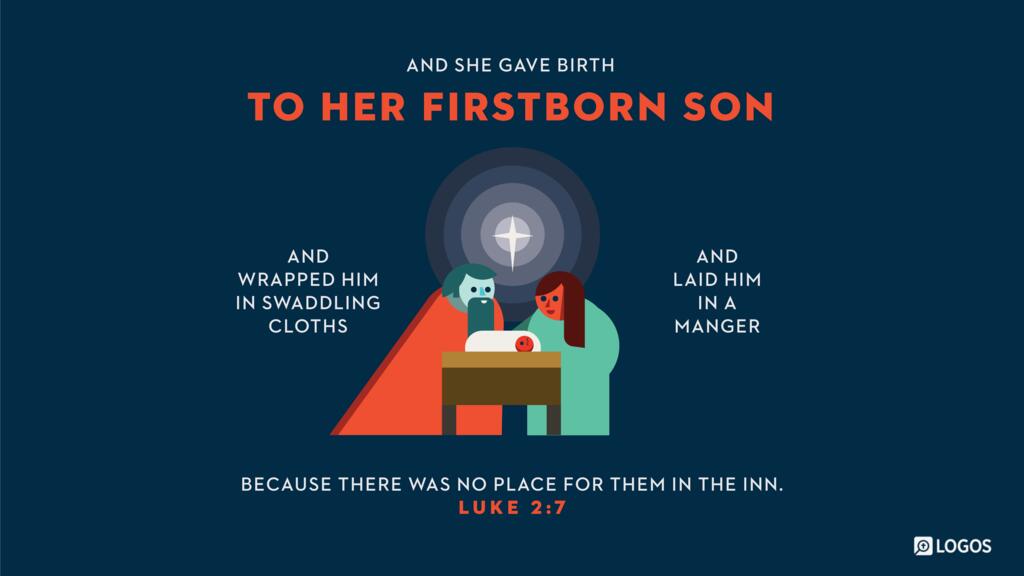
2:7And she gave birth to her firstborn son and wrapped him in strips of cloth20 and laid him in a manger,21 because there was no place for them in the inn.22
The Shepherds’ Visit
2:8Now23 there were shepherds24 nearby25 living out in the field, keeping guard26 over their flock at night.
Footnotes
- 20 The strips of cloth (traditionally, “swaddling cloths”) were strips of linen that would be wrapped around the arms and legs of an infant to keep the limbs protected.
- 21 Or “a feeding trough.”
- 22 The Greek word κατάλυμα is flexible, and usage in the and NT refers to a variety of places for lodging (see ). Most likely Joseph and Mary sought lodging in the public accommodations in the city of Bethlehem (see J. Nolland, Luke [], 1:), which would have been crude shelters for people and animals. However, it has been suggested by various scholars that Joseph and Mary were staying with relatives in Bethlehem (e.g., C. S. Keener, The IVP Bible Background Commentary: New Testament, 194; B. Witherington, “Birth of Jesus,” , ); if that were so the term would refer to the guest room in the relatives’ house, which would have been filled beyond capacity with all the other relatives who had to journey to Bethlehem for the census. There was no place for them in the inn. There is no drama in how this is told. There is no search for a variety of places to stay or a heartless innkeeper. (Such items are later, nonbiblical embellishments.) Bethlehem was not large and there was simply no other place to stay. The humble surroundings of the birth are ironic in view of the birth’s significance.
- 23 Here καί (kai) has been translated as “now” to indicate the transition to a new topic.
- 24 Some argue that shepherds were among the culturally despised, but the evidence for this view of shepherds is late, coming from 5th century Jewish materials. December 25 as the celebrated date of Jesus’ birth arose around the time of Constantine ( a.d. 306–337), though it is mentioned in material from Hippolytus (a.d. 165–235). Some think that the reason for celebration on this date was that it coincided with the pagan Roman festival of Saturnalia, and Christians could celebrate their own festival at this time without fear of persecution. On the basis of the statement that the shepherds were living out in the field, keeping guard over their flock at night it is often suggested that Jesus’ birth took place in early spring, since it was only at lambing time that shepherds stood guard over their flocks in the field. This is not absolutely certain, however.
- 25 Grk “in that region.”
- 26 Grk “living in the field (see ἀγραυλέω) and guarding their flock.”
The NET Bible First Edition, Copyright 1996-2005 by Biblical Studies Press
In other versions
ESVEnglish Standard Version
And she gave birth to her firstborn son and wrapped him in swaddling cloths and laid him in a manger, because there was no place for them in the inn.
And in the same region there were shepherds out in the field, keeping watch over their flock by night.
Copyright 2001 Crossway Bibles
NIVNew International Version (2011)
and she gave birth to her firstborn, a son. She wrapped him in cloths and placed him in a manger, because there was no guest room available for them.
And there were shepherds living out in the fields nearby, keeping watch over their flocks at night.
Copyright 1973, 1978, 1984, 2011 Biblica, Inc.
CSBChristian Standard Bible
Then she gave birth to her firstborn son, and she wrapped him tightly in cloth and laid him in a manger, because there was no guest room available for them.
In the same region, shepherds were staying out in the fields and keeping watch at night over their flock.
Copyright 2017 Holman Bible Publishers
NLTNew Living Translation
She gave birth to her firstborn son. She wrapped him snugly in strips of cloth and laid him in a manger, because there was no lodging available for them.
That night there were shepherds staying in the fields nearby, guarding their flocks of sheep.
Holy Bible, New Living Translation, copyright © 1996, 2004, 2015 by Tyndale House Foundation. Used by permission of Tyndale House Publishers. All rights reserved.
LEBThe Lexham English Bible
And she gave birth to her firstborn son, and wrapped him in strips of cloth and laid him in a manger, because there was no place for them in the inn.
And there were shepherds in the same region, living out of doors and keeping watch, guarding over their flock by night.
Copyright 2012 Lexham Press
KJV 1900King James Version
And she brought forth her firstborn son, and wrapped him in swaddling clothes, and laid him in a manger; because there was no room for them in the inn. And there were in the same country shepherds abiding in the field, keeping watch over their flock by night.
Public Domain