Luke 17:7–10
The NET BibleOther versions
English
- NET The NET Bible
- DARBY 1890 Darby Bible
- ASV American Standard Version
- AV 1873 The Cambridge Paragraph Bible of the Authorized English Version
- CSB Christian Standard Bible
- D-R Douay-Rheims Bible
- ESV English Standard Version
- GW GOD’S WORD Translation
- GNB Good News Translation
- HCSB The Holman Christian Standard Bible
- KJV 1900 King James Version
- LSB Legacy Standard Bible
- LEB The Lexham English Bible
- MSG The Message: The Bible in Contemporary Language
- NASB95 New American Standard Bible (1995)
- NCV New Century Version
- NIrV New International Reader’s Version (1998)
- NIV New International Version (2011)
- NKJV The New King James Version
- NLT New Living Translation
- NRSVue New Revised Standard Version: Updated Edition
- RSV The Revised Standard Version
- RSVCE The Revised Standard Version, Catholic Edition
- YLT Young’s Literal Translation
Arabic
Czech
French
German
Greek
Hungarian
Italian
Korean
Latin
Portuguese
Russian
Simplified Chinese
Spanish
Traditional Chinese
17:7“Would any one of you say20 to your slave21 who comes in from the field after plowing or shepherding sheep, ‘Come at once and sit down for a meal’?2217:8Won’t23 the master24 instead say to him, ‘Get my dinner ready, and make yourself ready25 to serve me while26 I eat and drink. Then27 you may eat and drink’? 17:9He won’t thank the slave because he did what he was told,28 will he?2917:10So you too, when you have done everything you were commanded to do, should say, ‘We are slaves undeserving of special praise;30 we have only done what was our duty.’ ”31
Footnotes
- 20 Grk “Who among you, having a slave … would say to him.”
- 21 See the note on the word “slave” in .
- 22 Grk “and recline at table,” as 1st century middle eastern meals were not eaten while sitting at a table, but while reclining on one’s side on the floor with the head closest to the low table and the feet farthest away. See ἀναπίπτω 1.
- 23 The question includes a Greek particle, οὐχί (ouchi), that expects a positive reply. The slave is expected to prepare a meal before eating himself.
- 24 Grk “he”; the referent has been specified in the translation for clarity.
- 25 Grk “and gird yourself” (with an apron or towel, in preparation for service).
- 26 ἕως 2.b, “to denote contemporaneousness as long as, while … subjunctive … Lk 17:8.”
- 27 Grk “after these things.”
- 28 Grk “did what was commanded.”
- 29 The Greek construction anticipates a negative reply which is indicated in the translation by the ‘tag’ at the end, “will he?” Thanks are not required.
- 30 Some translations describe the slaves as “worthless” () or “unworthy” (, ) but that is not Jesus’ point. These disciples have not done anything deserving special commendation or praise (L&N 33.361), but only what would normally be expected of a slave in such a situation (thus the translation “we have only done what was our duty”).
- 31 Or “we have only done what we were supposed to do.”
The NET Bible First Edition, Copyright 1996-2005 by Biblical Studies Press
In other versions
ESVEnglish Standard Version
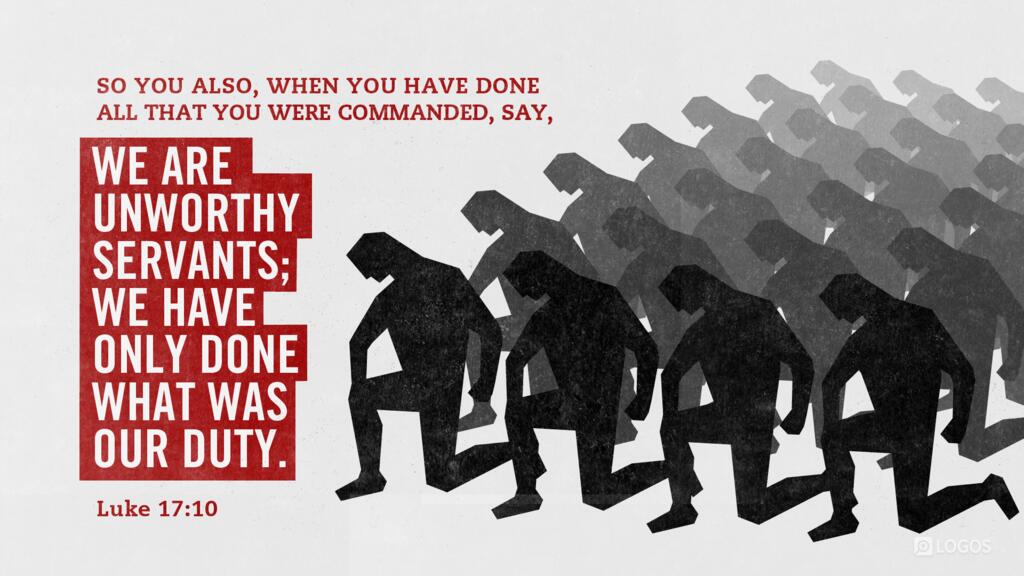
“Will any one of you who has a servant plowing or keeping sheep say to him when he has come in from the field, ‘Come at once and recline at table’? Will he not rather say to him, ‘Prepare supper for me, and dress properly, and serve me while I eat and drink, and afterward you will eat and drink’? Does he thank the servant because he did what was commanded? So you also, when you have done all that you were commanded, say, ‘We are unworthy servants; we have only done what was our duty.’ ”
Copyright 2001 Crossway Bibles
NIVNew International Version (2011)
“Suppose one of you has a servant plowing or looking after the sheep. Will he say to the servant when he comes in from the field, ‘Come along now and sit down to eat’? Won’t he rather say, ‘Prepare my supper, get yourself ready and wait on me while I eat and drink; after that you may eat and drink’? Will he thank the servant because he did what he was told to do? So you also, when you have done everything you were told to do, should say, ‘We are unworthy servants; we have only done our duty.’ ”
Copyright 1973, 1978, 1984, 2011 Biblica, Inc.
CSBChristian Standard Bible
“Which one of you having a servant tending sheep or plowing will say to him when he comes in from the field, ‘Come at once and sit down to eat’? Instead, will he not tell him, ‘Prepare something for me to eat, get ready, and serve me while I eat and drink; later you can eat and drink’? Does he thank that servant because he did what was commanded? In the same way, when you have done all that you were commanded, you should say, ‘We are unworthy servants; we’ve only done our duty.’ ”
Copyright 2017 Holman Bible Publishers
NLTNew Living Translation
“When a servant comes in from plowing or taking care of sheep, does his master say, ‘Come in and eat with me’? No, he says, ‘Prepare my meal, put on your apron, and serve me while I eat. Then you can eat later.’ And does the master thank the servant for doing what he was told to do? Of course not. In the same way, when you obey me you should say, ‘We are unworthy servants who have simply done our duty.’ ”
Holy Bible, New Living Translation, copyright © 1996, 2004, 2015 by Tyndale House Foundation. Used by permission of Tyndale House Publishers. All rights reserved.
LEBThe Lexham English Bible
“And which of you who has a slave plowing or shepherding sheep who comes in from the field will say to him, ‘Come here at once and recline at the table’? Will he not rather say to him, ‘Prepare something that I may eat, and dress yourself to serve me while I eat and drink, and after these things you will eat and drink.’ He will not be grateful to the slave because he did what was ordered, will he? Thus you also, when you have done all the things you were ordered to do, say, ‘We are unworthy slaves; we have done what we were obligated to do.’ ”
Copyright 2012 Lexham Press
KJV 1900King James Version
But which of you, having a servant plowing or feeding cattle, will say unto him by and by, when he is come from the field, Go and sit down to meat? And will not rather say unto him, Make ready wherewith I may sup, and gird thyself, and serve me, till I have eaten and drunken; and afterward thou shalt eat and drink? Doth he thank that servant because he did the things that were commanded him? I trow not. So likewise ye, when ye shall have done all those things which are commanded you, say, We are unprofitable servants: we have done that which was our duty to do.
Public Domain