Luke 15:11–32
The NET BibleOther versions
English
- NET The NET Bible
- DARBY 1890 Darby Bible
- ASV American Standard Version
- AV 1873 The Cambridge Paragraph Bible of the Authorized English Version
- CSB Christian Standard Bible
- D-R Douay-Rheims Bible
- ESV English Standard Version
- GW GOD’S WORD Translation
- GNB Good News Translation
- HCSB The Holman Christian Standard Bible
- KJV 1900 King James Version
- LSB Legacy Standard Bible
- LEB The Lexham English Bible
- MSG The Message: The Bible in Contemporary Language
- NASB95 New American Standard Bible (1995)
- NCV New Century Version
- NIrV New International Reader’s Version (1998)
- NIV New International Version (2011)
- NKJV The New King James Version
- NLT New Living Translation
- NRSVue New Revised Standard Version: Updated Edition
- RSV The Revised Standard Version
- RSVCE The Revised Standard Version, Catholic Edition
- YLT Young’s Literal Translation
Arabic
Czech
French
German
Greek
Hungarian
Italian
Korean
Latin
Portuguese
Russian
Simplified Chinese
Spanish
Traditional Chinese
The Parable of the Compassionate Father
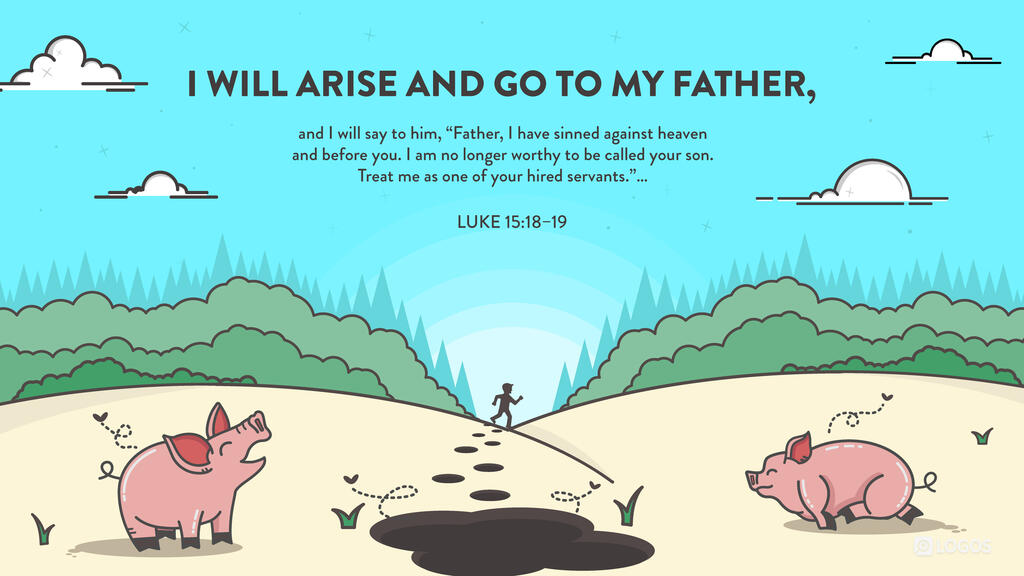
15:11Then33 Jesus34 said, “A man had two sons. 15:12The35 younger of them said to his36 father, ‘Father, give me the share of the estate37 that will belong38 to me.’ So39 he divided his40 assets between them.4115:13After42 a few days,43 the younger son gathered together all he had and left on a journey to a distant country, and there he squandered44 his wealth45 with a wild lifestyle. 15:14Then46 after he had spent everything, a severe famine took place in that country, and he began to be in need. 15:15So he went and worked for47 one of the citizens of that country, who48 sent him to his fields to feed pigs.4915:16He50 was longing to eat51 the carob pods52 the pigs were eating, but53 no one gave him anything. 15:17But when he came to his senses54 he said, ‘How many of my father’s hired workers have food55 enough to spare, but here I am dying from hunger! 15:18I will get up and go to my father and say to him, “Father, I have sinned56 against heaven57 and against58 you. 15:19I am no longer worthy to be called your son; treat me59 like one of your hired workers.” ’ 15:20So60 he got up and went to his father. But while he was still a long way from home61 his father saw him, and his heart went out to him;62 he ran and hugged63 his son64 and kissed him. 15:21Then65 his son said to him, ‘Father, I have sinned against heaven66 and against you; I am no longer worthy to be called your son.’6715:22But the father said to his slaves,68 ‘Hurry! Bring the best robe,69 and put it on him! Put a ring on his finger70 and sandals71 on his feet! 15:23Bring72 the fattened calf73 and kill it! Let us eat74 and celebrate, 15:24because this son of mine was dead, and is alive again—he was lost and is found!’75 So76 they began to celebrate.
15:25“Now his older son was in the field. As77 he came and approached the house, he heard music78 and dancing. 15:26So79 he called one of the slaves80 and asked what was happening. 15:27The slave replied,81 ‘Your brother has returned, and your father has killed the fattened calf82 because he got his son83 back safe and sound.’ 15:28But the older son84 became angry85 and refused86 to go in. His father came out and appealed to him, 15:29but he answered87 his father, ‘Look! These many years I have worked like a slave88 for you, and I never disobeyed your commands. Yet89 you never gave me even a goat90 so that I could celebrate with my friends! 15:30But when this son of yours91 came back, who has devoured92 your assets with prostitutes,93 you killed the fattened calf94 for him!’ 15:31Then95 the father96 said to him, ‘Son, you are always with me, and everything that belongs to me is yours. 15:32It was appropriate97 to celebrate and be glad, for your brother98 was dead, and is alive; he was lost and is found.’ ”99
Footnotes
- 33 Here δέ (de) has been translated as “then” to indicate the implied sequence of events within the narrative.
- 34 Grk “he”; the referent (Jesus) has been specified in the translation for clarity.
- 35 Grk “And the.” Here καί (kai) has not been translated because of differences between Greek and English style.
- 36 Grk “the”; in context the article is used as a possessive pronoun ( ).
- 37 L&N 57.19 notes that in nonbiblical contexts in which the word οὐσία (ousia) occurs, it refers to considerable possessions or wealth, thus “estate.”
- 38 L&N 57.3, “to belong to or come to belong to, with the possible implication of by right or by inheritance.”
- 39 Here δέ (de) has been translated as “so” to indicate the father’s response to the younger son’s request.
- 40 Grk “the”; in context the article is used as a possessive pronoun ( ).
- 41 He divided his assets between them. There was advice against doing this in the OT Apocrypha (Sir 33:20). The younger son would get half of what the older son received (Deut 21:17).
- 42 Grk “And after.” Here καί (kai) has not been translated because of differences between Greek and English style.
- 43 Grk “after not many days.”
- 44 Or “wasted.” This verb is graphic; it means to scatter (L&N 57.151).
- 45 Or “estate” (the same word has been translated “estate” in v. 12).
- 46 Here δέ (de) has been translated as “then” to indicate the sequence of events in the parable. Greek style often begins sentences or clauses with “and,” but English style generally does not.
- 47 Grk “joined himself to” (in this case an idiom for beginning to work for someone).
- 48 Grk “and he.” Here the conjunction καί (kai) and the personal pronoun have been translated by a relative pronoun to improve the English style.
- 49 To a Jew, being sent to the field to feed pigs would be an insult, since pigs were considered unclean animals (Lev 11:7).
- 50 Grk “And he.” Here καί (kai) has not been translated because of differences between Greek and English style.
- 51 Or “would gladly have eaten”; Grk “was longing to be filled with.”
- 52 This term refers to the edible pods from a carob tree ( κεράτιον). They were bean-like in nature and were commonly used for fattening pigs, although they were also used for food by poor people (L&N 3.46).
- 53 Here καί (kai) has been translated as “but” to indicate the contrast present in this context.
- 54 Grk “came to himself” (an idiom).
- 55 Grk “bread,” but used figuratively for food of any kind (L&N 5.1).
- 56 In the confession “I have sinned” there is a recognition of wrong that pictures the penitent coming home and “being found.”
- 57 The phrase against heaven is a circumlocution for God.
- 58 According to ἐνωπιον 4.a, “in relation to ἁμαρτάνειν ἐ. τινος sin against someone Lk 15:18, 21 (cf. Jdth 5:17; 1 Km 7:6; 20:1).”
- 59 Or “make me.” Here is a sign of total humility.
- 60 Here καί (kai) has been translated as “so” to indicate the result of the son’s decision to return home. Greek style often begins sentences or clauses with “and,” but English style generally does not.
- 61 Grk “a long way off from [home].” The word “home” is implied (L&N 85.16).
- 62 Or “felt great affection for him,” “felt great pity for him.” The major figure of the parable, the forgiving father, represents God the Father and his compassionate response. God is ready with open arms to welcome the sinner who comes back to him.
- 63 Grk “he fell on his neck,” an idiom for showing special affection for someone by throwing one’s arms around them. The picture is of the father hanging on the son’s neck in welcome.
- 64 Grk “him”; the referent (the son) has been specified in the translation for clarity.
- 65 Here δέ (de) has been translated as “then” to indicate the implied sequence of events within the narrative.
- 66 The phrase against heaven is a circumlocution for God. 1st century Judaism tended to minimize use of the divine name out of reverence.
- 67 The younger son launches into his confession just as he had planned. See vv. 18–19.
- 68 See the note on the word “slave” in .
- 69 With the instructions Hurry! Bring the best robe, there is a total acceptance of the younger son back into the home.
- 70 Grk “hand”; but χείρ (cheir) can refer to either the whole hand or any relevant part of it (L&N 8.30).
- 71 The need for sandals underlines the younger son’s previous destitution, because he was barefoot.
- 72 Grk “And bring.” Here καί (kai) has not been translated because of differences between Greek and English style. Because of the length and complexity of the Greek sentence, a new sentence was started here in the translation.
- 73 Or “the prize calf” (L&N 65.8). See also L&N 44.2, “grain-fattened.” Such a calf was usually reserved for religious celebrations.
- 74 The participle φαγόντες (phagontes) has been translated as a finite verb due to requirements of contemporary English style.
- 75 This statement links the parable to the theme of 15:6, 9.
- 76 Here καί (kai) has been translated as “so” to indicate the result of the father’s remarks in the preceding verses.
- 77 Grk “And as.” Here καί (kai) has not been translated because of differences between Greek and English style.
- 78 This would have been primarily instrumental music, but might include singing as well.
- 79 Here καί (kai) has been translated as “so” to indicate the result of the older son hearing the noise of the celebration in progress.
- 80 The Greek term here, παῖς (pais), describes a slave, possibly a household servant regarded with some affection (L&N 87.77).
- 81 Grk “And he said to him.” Here δέ (de) has not been translated. The rest of the phrase has been simplified to “the slave replied,” with the referent (the slave) specified in the translation for clarity.
- 82 See note on the phrase “fattened calf” in v. .
- 83 Grk “him”; the referent (the younger son) has been specified in the translation for clarity.
- 84 Grk “he”; the referent (the older son, v. 25) has been specified in the translation for clarity.
- 85 The aorist verb ὠργίσθη (ōrgisthē) has been translated as an ingressive aorist, reflecting entry into a state or condition.
- 86 Ironically the attitude of the older son has left him outside and without joy.
- 87 Grk “but answering, he said.” This is somewhat redundant in contemporary English and has been simplified to “but he answered.”
- 88 Or simply, “have served,” but in the emotional context of the older son’s outburst the translation given is closer to the point.
- 89 Here καί (kai) has been translated as “yet” to bring out the contrast indicated by the context.
- 90 You never gave me even a goat. The older son’s complaint was that the generous treatment of the younger son was not fair: “I can’t get even a little celebration with a basic food staple like a goat!”
- 91 Note the younger son is not “my brother” but this son of yours (an expression with a distinctly pejorative nuance).
- 92 This is another graphic description. The younger son’s consumption had been like a glutton. He had both figuratively and literally devoured the assets which were given to him.
- 93 The charge concerning the prostitutes is unproven, but essentially the older brother accuses the father of committing an injustice by rewarding his younger son’s unrighteous behavior.
- 94 See note on the phrase “fattened calf” in v. .
- 95 Here καί (kai) has been translated as “then” to indicate the implied sequence of events in the parable.
- 96 Grk “he”; the referent (the father) has been specified in the translation for clarity.
- 97 Or “necessary.”
- 98 By referring to him as your brother, the father reminded the older brother that the younger brother was part of the family.
- 99 The theme he was lost and is found is repeated from v. 24. The conclusion is open-ended. The reader is left to ponder with the older son (who pictures the scribes and Pharisees) what the response will be. The parable does not reveal the ultimate response of the older brother. Jesus argued that sinners should be pursued and received back warmly when they returned.
The NET Bible First Edition, Copyright 1996-2005 by Biblical Studies Press