Luke 1:30–35
The NET BibleOther versions
English
- NET The NET Bible
- DARBY 1890 Darby Bible
- ASV American Standard Version
- AV 1873 The Cambridge Paragraph Bible of the Authorized English Version
- CSB Christian Standard Bible
- D-R Douay-Rheims Bible
- ESV English Standard Version
- GW GOD’S WORD Translation
- GNB Good News Translation
- HCSB The Holman Christian Standard Bible
- KJV 1900 King James Version
- LSB Legacy Standard Bible
- LEB The Lexham English Bible
- MSG The Message: The Bible in Contemporary Language
- NASB95 New American Standard Bible (1995)
- NCV New Century Version
- NIrV New International Reader’s Version (1998)
- NIV New International Version (2011)
- NKJV The New King James Version
- NLT New Living Translation
- NRSVue New Revised Standard Version: Updated Edition
- RSV The Revised Standard Version
- RSVCE The Revised Standard Version, Catholic Edition
- YLT Young’s Literal Translation
Arabic
Czech
French
German
Greek
Hungarian
Italian
Korean
Latin
Portuguese
Russian
Simplified Chinese
Spanish
Traditional Chinese
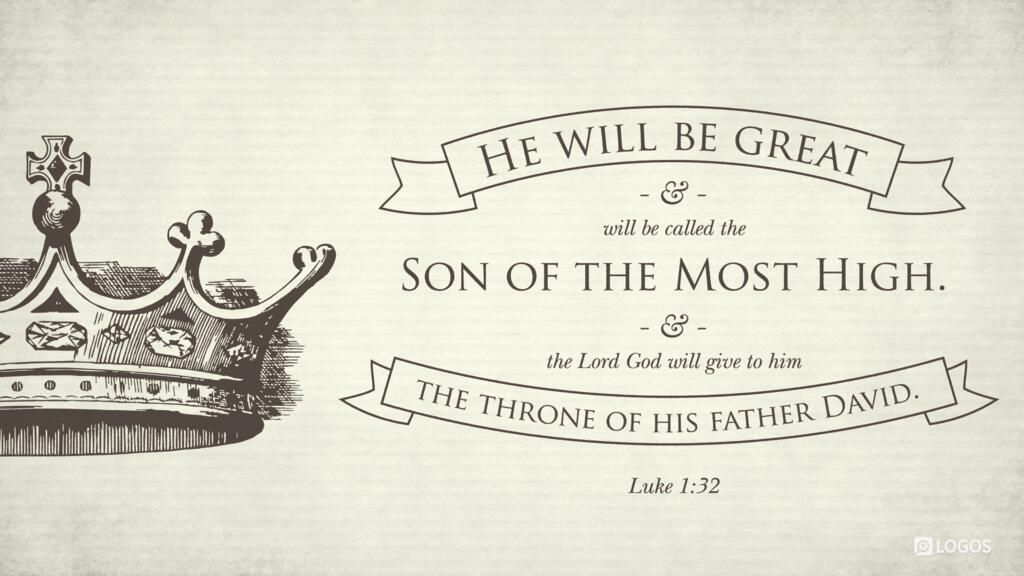
1:30So96 the angel said to her, “Do not be afraid,97 Mary, for you have found favor98 with God! 1:31Listen:99 You will become pregnant100 and give birth to101 a son, and you will name him102 Jesus.1031:32He104 will be great,105 and will be called the Son of the Most High,106 and the Lord God will give him the throne of his father107 David. 1:33He108 will reign over the house of Jacob109 forever, and his kingdom will never end.” 1:34Mary110 said to the angel, “How will this be, since I have not had sexual relations with111 a man?” 1:35The angel replied,112 “The Holy Spirit will come upon you, and the power of the Most High will overshadow113 you. Therefore the child114 to be born115 will be holy;116 he will be called the Son of God.
Footnotes
- 96 Here καί (kai) has been translated as “so” to indicate that Gabriel’s statement is a response to Mary’s perplexity over the greeting.
- 97 Do not be afraid. See 1:13 for a similar statement to Zechariah.
- 98 Or “grace.” The expression found favor is a Semitism, common in the OT (Gen 6:8; 18:3; 43:14; 2 Sam 15:25). God has chosen to act on this person’s behalf.
- 99 Grk “And behold.”
- 100 Grk “you will conceive in your womb.”
- 101 Or “and bear.”
- 102 Grk “you will call his name.”
- 103 See v. 13 for a similar construction. You will name him Jesus. This verse reflects the birth announcement of a major figure; see 1:13; Gen 16:7; Judg 13:5; Isa 7:14. The Greek form of the name Iēsous, which was translated into Latin as Jesus, is the same as the Hebrew Yeshua (Joshua), which means “Yahweh saves” (Yahweh is typically rendered as “Lord” in the OT). It was a fairly common name among Jews in 1st century Palestine, as references to a number of people by this name in the and Josephus indicate.
- 104 Grk “this one.”
- 105 Compare the description of Jesus as great here with 1:15, “great before the Lord.” Jesus is greater than John, since he is Messiah compared to a prophet. Great is stated absolutely without qualification to make the point.
- 106 The expression Most High is a way to refer to God without naming him. Such avoiding of direct reference to God was common in 1st century Judaism out of reverence for the divine name.
- 107 Or “ancestor.”
- 108 Grk “And he.” Here καί (kai) has not been translated because of differences between Greek and English style. A new sentence is begun here in the translation because of the length of the sentence in Greek.
- 109 Or “over Israel.” The expression house of Jacob refers to Israel. This points to the Messiah’s relationship to the people of Israel.
- 110 Grk “And Mary.” Here καί (kai) has not been translated because of differences between Greek and English style.
- 111 Grk “have not known.” The expression in the Greek text is a euphemism for sexual relations. Mary seems to have sensed that the declaration had an element of immediacy to it that excluded Joseph. Many modern translations render this phrase “since I am a virgin,” but the Greek word for virgin is not used in the text, and the euphemistic expression is really more explicit, referring specifically to sexual relations.
- 112 Grk “And the angel said to her.” Here καί (kai) has not been translated because of differences between Greek and English style. The pronoun αὐτῇ (autē, “to her”) has not been included in the translation since it is redundant in contemporary English.
- 113 The phrase will overshadow is a reference to God’s glorious presence at work (Exod 40:34–35; Ps 91:4).
- 114 Or “the one born holy will be called the Son of God.” The wording of this phrase depends on whether the adjective is a predicate adjective, as in the text, or is an adjective modifying the participle serving as the subject. The absence of an article with the adjective speaks for a predicate position. Other less appealing options supply a verb for “holy”; thus “the one who is born will be holy”; or argue that both “holy” and “Son of God” are predicates, so “The one who is born will be called holy, the Son of God.”
- 115 A few (C* Θ f1 33 ) add “by you” here. This looks like a scribal addition to bring symmetry to the first three clauses of the angel’s message (note the second person pronoun in the previous two clauses), and is too poorly supported to be seriously considered as authentic.
- 116 Or “Therefore the holy child to be born will be called the Son of God.” There are two ways to understand the Greek phrase τὸ γεννώμενον ἅγιον (to gennōmenon hagion) here. First, τὸ γεννώμενον could be considered a substantival participle with ἅγιον as an adjective in the second predicate position, thus making a complete sentence; this interpretation is reflected in the translation above. Second, τὸ ἅγιον could be considered a substantival adjective with γεννώμενον acting as an adjectival participle, thus making the phrase the subject of the verb κληθήσεται (klēthēsetai); this interpretation is reflected in the alternative reading. Treating the participle γεννώμενον as adjectival is a bit unnatural for the very reason that it forces one to understand ἅγιον as substantival; this introduces a new idea in the text with ἅγιον when an already new topic is being introduced with γεννώμενον. Semantically this would overload the new subject introduced at this point. For this reason the first interpretation is preferred.
The NET Bible First Edition, Copyright 1996-2005 by Biblical Studies Press
In other versions
ESVEnglish Standard Version
And the angel said to her, “Do not be afraid, Mary, for you have found favor with God. And behold, you will conceive in your womb and bear a son, and you shall call his name Jesus. He will be great and will be called the Son of the Most High. And the Lord God will give to him the throne of his father David, and he will reign over the house of Jacob forever, and of his kingdom there will be no end.”
And Mary said to the angel, “How will this be, since I am a virgin?”
And the angel answered her, “The Holy Spirit will come upon you, and the power of the Most High will overshadow you; therefore the child to be born will be called holy—the Son of God.
Copyright 2001 Crossway Bibles
NIVNew International Version (2011)
But the angel said to her, “Do not be afraid, Mary; you have found favor with God. You will conceive and give birth to a son, and you are to call him Jesus. He will be great and will be called the Son of the Most High. The Lord God will give him the throne of his father David, and he will reign over Jacob’s descendants forever; his kingdom will never end.”
“How will this be,” Mary asked the angel, “since I am a virgin?”
The angel answered, “The Holy Spirit will come on you, and the power of the Most High will overshadow you. So the holy one to be born will be called the Son of God.
Copyright 1973, 1978, 1984, 2011 Biblica, Inc.
CSBChristian Standard Bible
Then the angel told her, “Do not be afraid, Mary, for you have found favor with God. Now listen: You will conceive and give birth to a son, and you will name him Jesus. He will be great and will be called the Son of the Most High, and the Lord God will give him the throne of his father David. He will reign over the house of Jacob forever, and his kingdom will have no end.”
Mary asked the angel, “How can this be, since I have not had sexual relations with a man?”
The angel replied to her, “The Holy Spirit will come upon you, and the power of the Most High will overshadow you. Therefore, the holy one to be born will be called the Son of God.
Copyright 2017 Holman Bible Publishers
NLTNew Living Translation
“Don’t be afraid, Mary,” the angel told her, “for you have found favor with God! You will conceive and give birth to a son, and you will name him Jesus. He will be very great and will be called the Son of the Most High. The Lord God will give him the throne of his ancestor David. And he will reign over Israel forever; his Kingdom will never end!”
Mary asked the angel, “But how can this happen? I am a virgin.”
The angel replied, “The Holy Spirit will come upon you, and the power of the Most High will overshadow you. So the baby to be born will be holy, and he will be called the Son of God.
Holy Bible, New Living Translation, copyright © 1996, 2004, 2015 by Tyndale House Foundation. Used by permission of Tyndale House Publishers. All rights reserved.
LEBThe Lexham English Bible
And the angel said to her,
“Do not be afraid, Mary, for you have found favor with God.
And behold, you will conceive in the womb and will give birth to a son,
and you will call his name Jesus.
This one will be great, and he will be called the Son of the Most High,
and the Lord God will give him the throne of his father David.
And he will reign over the house of Jacob forever,
and of his kingdom there will be no end.
And Mary said to the angel, “How will this be, since I have not had sexual relations with a man?” And the angel answered and said to her,
“The Holy Spirit will come upon you,
and the power of the Most High will overshadow you.
Therefore also the one to be born will be called holy, the Son of God.
Copyright 2012 Lexham Press
KJV 1900King James Version
And the angel said unto her, Fear not, Mary: for thou hast found favour with God. And, behold, thou shalt conceive in thy womb, and bring forth a son, and shalt call his name JESUS. He shall be great, and shall be called the Son of the Highest: and the Lord God shall give unto him the throne of his father David: And he shall reign over the house of Jacob for ever; and of his kingdom there shall be no end. Then said Mary unto the angel, How shall this be, seeing I know not a man? And the angel answered and said unto her, The Holy Ghost shall come upon thee, and the power of the Highest shall overshadow thee: therefore also that holy thing which shall be born of thee shall be called the Son of God.
Public Domain