Lamentations 3:22–29
The NET BibleOther versions
English
- NET The NET Bible
- DARBY 1890 Darby Bible
- ASV American Standard Version
- AV 1873 The Cambridge Paragraph Bible of the Authorized English Version
- CSB Christian Standard Bible
- D-R Douay-Rheims Bible
- ESV English Standard Version
- GW GOD’S WORD Translation
- GNB Good News Translation
- HCSB The Holman Christian Standard Bible
- KJV 1900 King James Version
- LSB Legacy Standard Bible
- LEB The Lexham English Bible
- MSG The Message: The Bible in Contemporary Language
- NASB95 New American Standard Bible (1995)
- NCV New Century Version
- NIrV New International Reader’s Version (1998)
- NIV New International Version (2011)
- NKJV The New King James Version
- NLT New Living Translation
- NRSVue New Revised Standard Version: Updated Edition
- RSV The Revised Standard Version
- RSVCE The Revised Standard Version, Catholic Edition
- YLT Young’s Literal Translation
Arabic
Czech
French
German
Hebrew
Hungarian
Italian
Korean
Latin
Portuguese
Russian
Simplified Chinese
Spanish
Traditional Chinese
ח (Khet)
3:22The Lord’s loyal kindness52 never ceases;53
his compassions54 never end.
3:23They are fresh55 every morning;
your faithfulness is abundant!56
3:24“My portion is the Lord,” I have said to myself,57
so I will put my hope in him.
ט (Tet)
3:25The Lord is good to those who trust58 in him,
to the one59 who seeks him.
3:26It is good to wait patiently60
for deliverance from the Lord.61
3:27It is good for a man62
to bear63 the yoke64 while he is young.65
י (Yod)
3:28Let a person66 sit alone in silence,
when the Lord67 is disciplining him.68
3:29Let him bury his face in the dust;69
perhaps there is hope.
Footnotes
- 52 It is difficult to capture the nuances of the Hebrew word חֶסֶד (khesed). When used of the Lord it is often connected to his covenant loyalty. This is the only occasion when the plural form of חֶסֶד (khesed) precedes the plural form of רַחֲמִים (rakhamim, “mercy, compassion”). The plural forms, as with this one, tend to be in late texts. The plural may indicate several concrete expressions of God’s kindnesses or may indicate the abstract concept of his kindness.
- 53 The reads תָמְנוּ (tamnu) “indeed we are [not] cut off,” Qal perfect 1st person common plural from תָּמַם (tamam, “be finished”): “[Because of] the kindnesses of the Lord, we are not cut off.” However, the ancient versions (, , Aramaic ) and many medieval Hebrew preserve the alternate reading תָּמּוּ (tammu), Qal perfect 3rd person common plural from תָּמַם (tamam, “to be finished”): “The kindnesses of the Lord never cease.” The external evidence favors the alternate reading. The internal evidence supports this as well, as the parallel B-line suggests: “his compassions never come to an end.” Several English versions follow the : “It is of the Lord’s mercies that we are not consumed” (, ), “Because of the Lord’s great love we are not consumed” (). Other English versions follow the alternate textual tradition: “The steadfast love of the Lord never ceases” (, ), “The Lord’s lovingkindnesses indeed never cease” (), “The kindness of the Lord has not ended” () and “The Lord’s unfailing love still continues” ().
- 54 The plural form of רַחֲמִים (rakhamim) may denote the abstract concept of mercy, several concrete expressions of mercy, or the plural of intensity: “great compassion.” See §7.4.3a.
- 55 Heb “they are new.”
- 56 The adjective רַב (rav) has a broad range of meanings: (1) quantitative: “much, numerous, many (with plurals), abundant, enough, exceedingly” and (2) less often in a qualitative sense: “great” (a) of space and location, (b) “strong” as opposed to “weak” and (c) “major.” The traditional translation, “great is thy faithfulness,” is less likely than the quantitative sense: “your faithfulness is abundant” [or, “plentiful”]. is on target in its translation: “Ample is your grace!”
- 57 Heb “My soul said …” The term נַפְשִׁי (nafshi, “my soul”) is a synecdoche of part (= my soul) for the whole person (= I).
- 58 Heb “wait for him”
- 59 Heb “to the soul …” The term נֶפֶשׁ (nefesh, “soul”) is a synecdoche of part (= “the soul who seeks him”) for the whole person (= “the person who seeks him”).
- 60 Heb “waiting and silently.” The two adjectives וְיָחִיל וְדוּמָם (véyakhil védumam, “waiting and silently”) form a hendiadys: The first functions verbally and the second functions adverbially: “to wait silently.” The adjective דוּמָם (dumam, “silently”) also functions as a metonymy of association, standing for patience or rest ( ). This metonymical nuance is captured well in less literal English versions: “wait in patience” () and “wait patiently” (, ). The more literal English versions do not express the metonymy as well: “quietly wait” (, , ), “waits silently” (), “wait quietly” (, , ).
- 61 Heb “deliverance of the Lord.” In the genitive-construct, the genitive יהוה (YHWH, “the Lord”) denotes source, that is, he is the source of the deliverance: “deliverance from the Lord.”
- 62 See note at on the Hebrew term for “man” here.
- 63 Heb “that he bear.”
- 64 Jeremiah is referring to the painful humiliation of subjugation to the Babylonians, particularly to the exile of the populace of Jerusalem. The Babylonians and Assyrians frequently used the phrase “bear the yoke” as a metaphor: their subjects were made as subservient to them as yoked oxen were to their masters. Because the Babylonian exile would last for seventy years, only those who were in their youth when Jerusalem fell would have any hope of living until the return of the remnant. For the middle-aged and elderly, the yoke of exile would be insufferable; but those who bore this “yoke” in their youth would have hope.
- 65 Heb “in his youth.” The preposition ב (bet) functions in a temporal sense: “when.”
- 66 Heb “him.” The speaking voice in this chapter continues to be that of the גֶּבֶר (gever, “man”). The image of female Jerusalem in chs. 1–2 was fluid, being able to refer to the city or its inhabitants, both female and male. So too the “defeated soldier” or “everyman” (see note at on “man”) is fluid and can represent any member of the Jewish community, male and female. This line especially has a proverbial character which can be extended to any person, hence the translation. But masculine pronouns are otherwise maintained reflecting the Hebrew grammatical system and the speaking voice of the poem.
- 67 Heb “he”; the referent (the Lord) has been specified in the translation for clarity.
- 68 Heb “has laid it on him.” The verb נָטַל (natal) is used 4 times in Biblical Hebrew; the related noun refers to heaviness or a burden. The entry of 642 is outdated while נטל is acceptable for the Qal. See D. R. Hillers, Lamentations (), . Hillers’ suggestion of a stative meaning for the Qal is followed here, though based on 2 Sam 24:12 “impose” is also possible.
- 69 Heb “Let him put his mouth in the dust.”
The NET Bible First Edition, Copyright 1996-2005 by Biblical Studies Press
In other versions
ESVEnglish Standard Version
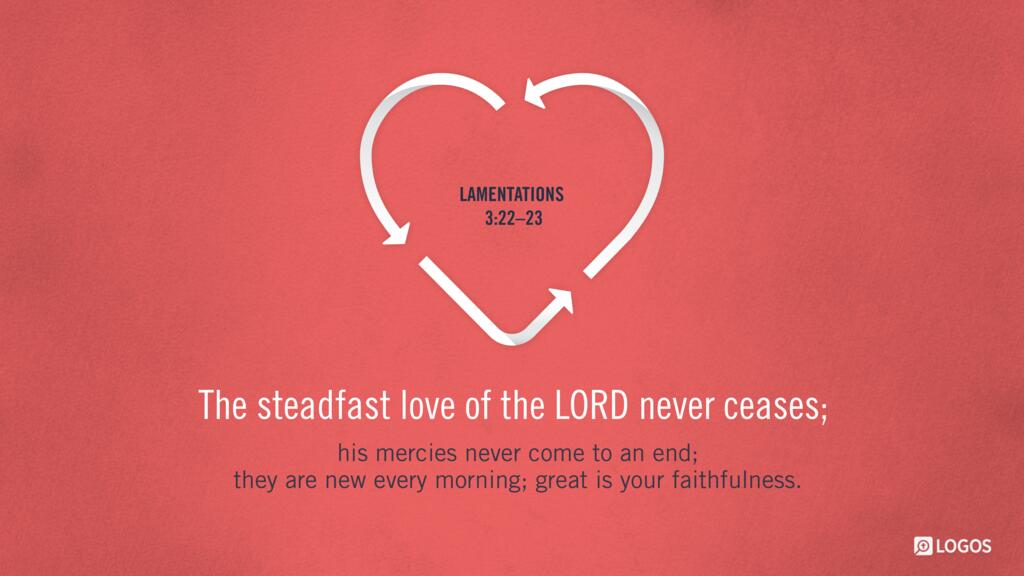
The steadfast love of the Lord never ceases;
his mercies never come to an end;
they are new every morning;
great is your faithfulness.
“The Lord is my portion,” says my soul,
“therefore I will hope in him.”
The Lord is good to those who wait for him,
to the soul who seeks him.
It is good that one should wait quietly
for the salvation of the Lord.
It is good for a man that he bear
the yoke in his youth.
Let him sit alone in silence
when it is laid on him;
let him put his mouth in the dust—
there may yet be hope;
Copyright 2001 Crossway Bibles
NIVNew International Version (2011)
Because of the Lord’s great love we are not consumed,
for his compassions never fail.
They are new every morning;
great is your faithfulness.
I say to myself, “The Lord is my portion;
therefore I will wait for him.”
The Lord is good to those whose hope is in him,
to the one who seeks him;
it is good to wait quietly
for the salvation of the Lord.
It is good for a man to bear the yoke
while he is young.
Let him sit alone in silence,
for the Lord has laid it on him.
Let him bury his face in the dust—
there may yet be hope.
Copyright 1973, 1978, 1984, 2011 Biblica, Inc.
CSBChristian Standard Bible
Because of the Lord’s faithful love
we do not perish,
for his mercies never end.
They are new every morning;
great is your faithfulness!
I say, “The Lord is my portion,
therefore I will put my hope in him.”
The Lord is good to those who wait for him,
to the person who seeks him.
It is good to wait quietly
for salvation from the Lord.
It is good for a man to bear the yoke
while he is still young.
Let him sit alone and be silent,
for God has disciplined him.
Let him put his mouth in the dust —
perhaps there is still hope.
Copyright 2017 Holman Bible Publishers
NLTNew Living Translation
The faithful love of the Lord never ends!
His mercies never cease.
Great is his faithfulness;
his mercies begin afresh each morning.
I say to myself, “The Lord is my inheritance;
therefore, I will hope in him!”
The Lord is good to those who depend on him,
to those who search for him.
So it is good to wait quietly
for salvation from the Lord.
And it is good for people to submit at an early age
to the yoke of his discipline:
Let them sit alone in silence
beneath the Lord’s demands.
Let them lie face down in the dust,
for there may be hope at last.
Holy Bible, New Living Translation, copyright © 1996, 2004, 2015 by Tyndale House Foundation. Used by permission of Tyndale House Publishers. All rights reserved.
LEBThe Lexham English Bible
The loyal love of Yahweh does not cease;
his compassions do not come to an end.
They are new in the morning,
great is your faithfulness.
“Yahweh is my portion,”
says my soul,
“Thus I will hope on him.”
Yahweh is good to those who wait on him,
to the person that seeks him.
It is good to wait in silence
for the salvation of Yahweh.
It is good for a man who carries
the yoke of his childhood.
Let him sit alone and be silent
when he has laid it on him.
Let him put his mouth in the dust;
perhaps there is hope.
Copyright 2012 Lexham Press
KJV 1900King James Version
It is of the Lord’s mercies that we are not consumed, because his compassions fail not.
They are new every morning: great is thy faithfulness.
The Lord is my portion, saith my soul; therefore will I hope in him.
The Lord is good unto them that wait for him, to the soul that seeketh him.
It is good that a man should both hope and quietly wait for the salvation of the Lord.
It is good for a man that he bear the yoke in his youth.
He sitteth alone and keepeth silence, because he hath borne it upon him.
He putteth his mouth in the dust; if so be there may be hope.
Public Domain