Joshua 6:12–20
The NET BibleOther versions
English
- NET The NET Bible
- DARBY 1890 Darby Bible
- ASV American Standard Version
- AV 1873 The Cambridge Paragraph Bible of the Authorized English Version
- CSB Christian Standard Bible
- D-R Douay-Rheims Bible
- ESV English Standard Version
- GW GOD’S WORD Translation
- GNB Good News Translation
- HCSB The Holman Christian Standard Bible
- KJV 1900 King James Version
- LSB Legacy Standard Bible
- LEB The Lexham English Bible
- MSG The Message: The Bible in Contemporary Language
- NASB95 New American Standard Bible (1995)
- NCV New Century Version
- NIrV New International Reader’s Version (1998)
- NIV New International Version (2011)
- NKJV The New King James Version
- NLT New Living Translation
- NRSVue New Revised Standard Version: Updated Edition
- RSV The Revised Standard Version
- RSVCE The Revised Standard Version, Catholic Edition
- YLT Young’s Literal Translation
Arabic
Czech
French
German
Hebrew
Hungarian
Italian
Korean
Latin
Portuguese
Russian
Simplified Chinese
Spanish
Traditional Chinese
6:12Bright and early the next morning Joshua had the priests pick up the ark of the Lord.22 6:13The seven priests carrying the seven rams’ horns before the ark of the Lord marched along blowing their horns. Armed troops marched ahead of them, while the rear guard followed along behind the ark of the Lord blowing rams’ horns. 6:14They marched around the city one time on the second day, then returned to the camp. They did this six days in all.
6:15On the seventh day they were up at the crack of dawn23 and marched around the city as before—only this time they marched around it seven times.24 6:16The seventh time around, the priests blew the rams’ horns and Joshua told the army,25 “Give the battle cry,26 for the Lord is handing the city over to you!27 6:17The city and all that is in it must be set apart for the Lord,28 except for Rahab the prostitute and all who are with her in her house, because she hid the spies29 we sent. 6:18But be careful when you are setting apart the riches for the Lord. If you take any of it, you will make the Israelite camp subject to annihilation and cause a disaster.30 6:19All the silver and gold, as well as bronze and iron items, belong to the Lord.31 They must go into the Lord’s treasury.”
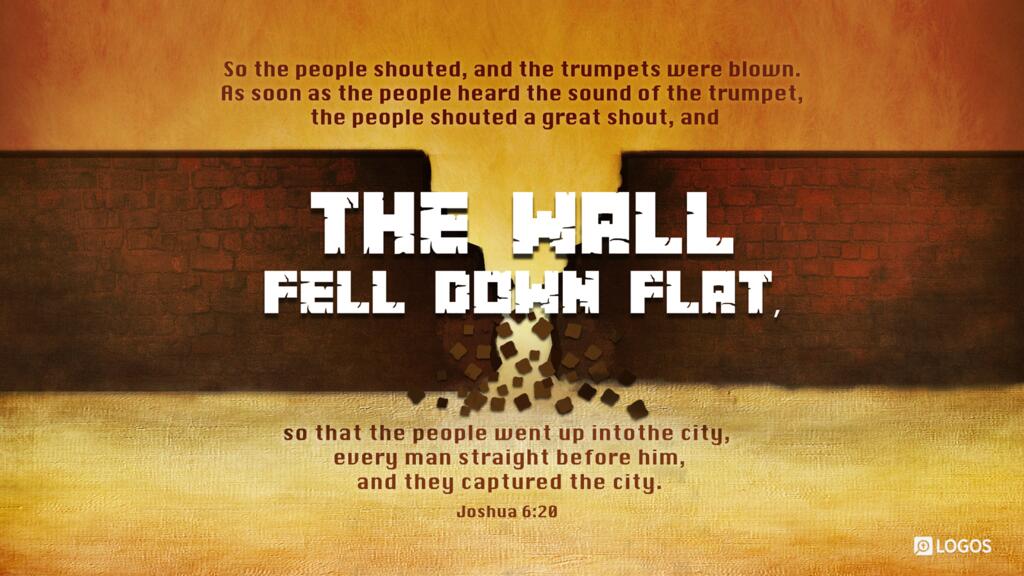
6:20The rams’ horns sounded32 and when the army33 heard the signal,34 they gave a loud battle cry.35 The wall collapsed36 and the warriors charged straight ahead into the city and captured it.37
Footnotes
- 22 Heb “Joshua rose early in the morning and the priests picked up the ark of the Lord.”
- 23 Heb “On the seventh day they rose early, when the dawn ascended.”
- 24 Heb “and they went around the city according to this manner seven times, only on that day they went around the city seven times.”
- 25 Heb “the people.”
- 26 Or “the shout.”
- 27 Heb “for the Lord has given to you the city.” The verbal form is a perfect, probably indicating certitude here.
- 28 Or “dedicated to the Lord.” To make the city set apart for the Lord would involve annihilating all the people and animals and placing its riches in the Lord’s treasury (vv. 19, 21, 24).
- 29 Heb “messengers.”
- 30 Heb “Only you keep [away] from what is set apart [to the Lord] so that you might not, as you are setting [it] apart, take some of what is set apart [to the Lord] and make the camp of Israel set apart [to destruction by the Lord] and bring trouble on it.”
- 31 Heb “it is holy to the Lord.”
- 32 Heb “and the people shouted and they blew the rams’ horns.” The initial statement (“and the people shouted”) seems premature, since the verse goes on to explain that the battle cry followed the blowing of the horns. The statement has probably been accidentally duplicated from what follows. It is omitted in the .
- 33 Heb “the people.”
- 34 Heb “the sound of the horn.”
- 35 Heb “they shouted with a loud shout.”
- 36 Heb “fell in its place.”
- 37 Heb “and the people went up into the city, each one straight ahead, and they captured the city.”
The NET Bible First Edition, Copyright 1996-2005 by Biblical Studies Press