Joshua 23:1–24:33
The NET BibleOther versions
English
- NET The NET Bible
- DARBY 1890 Darby Bible
- ASV American Standard Version
- AV 1873 The Cambridge Paragraph Bible of the Authorized English Version
- CSB Christian Standard Bible
- D-R Douay-Rheims Bible
- ESV English Standard Version
- GW GOD’S WORD Translation
- GNB Good News Translation
- HCSB The Holman Christian Standard Bible
- KJV 1900 King James Version
- LSB Legacy Standard Bible
- LEB The Lexham English Bible
- MSG The Message: The Bible in Contemporary Language
- NASB95 New American Standard Bible (1995)
- NCV New Century Version
- NIrV New International Reader’s Version (1998)
- NIV New International Version (2011)
- NKJV The New King James Version
- NLT New Living Translation
- NRSVue New Revised Standard Version: Updated Edition
- RSV The Revised Standard Version
- RSVCE The Revised Standard Version, Catholic Edition
- YLT Young’s Literal Translation
Arabic
Czech
French
German
Hebrew
Hungarian
Italian
Korean
Latin
Portuguese
Russian
Simplified Chinese
Spanish
Traditional Chinese
Joshua Challenges Israel to be Faithful
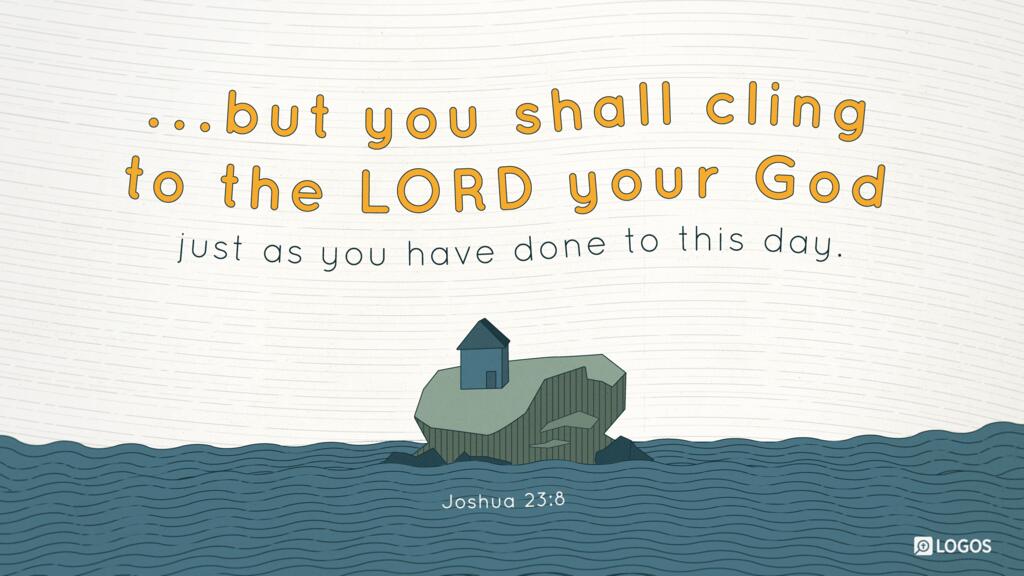
23:1A long time1 passed after the Lord made Israel secure from all their enemies,2 and Joshua was very old.323:2So Joshua summoned all Israel, including the elders, rulers, judges, and leaders, and told them: “I am very old. 23:3You saw everything the Lord your God did to all these nations on your behalf, for the Lord your God fights for you.423:4See, I have parceled out to your tribes these remaining nations,5 from the Jordan to the Mediterranean Sea6 in the west, including all the nations I defeated.723:5The Lord your God will drive them out from before you and remove them,8 so you can occupy9 their land as the Lord your God promised10 you. 23:6Be very strong! Carefully obey11 all that is written in the law scroll of Moses so you won’t swerve from it to the right or the left, 23:7or associate with these nations that remain near12 you. You must not invoke or make solemn declarations by the names of their gods!13 You must not worship14 or bow down to them! 23:8But you must be loyal to15 the Lord your God, as you have been16 to this very day.
23:9“The Lord drove out from before you great and mighty nations; no one has been able to resist you17 to this very day. 23:10One of you makes a thousand run away,18 for the Lord your God fights for you19 as he promised you he would.2023:11Watch yourselves carefully! Love the Lord your God!2123:12But if you ever turn away and make alliances with22 these nations that remain near you,23 and intermarry with them and establish friendly relations with them,2423:13know for certain that the Lord our God will no longer drive out these nations from before you. They will trap and ensnare you;25 they will be a whip that tears26 your sides and thorns that blind27 your eyes until you disappear28 from this good land the Lord your God gave you.
23:14“Look, today I am about to die.29 You know with all your heart and being30 that not even one of all the faithful promises the Lord your God made to you is left unfulfilled; every one was realized—not one promise is unfulfilled!3123:15But in the same way every faithful promise the Lord your God made to you has been realized,32 it is just as certain, if you disobey, that the Lord will bring on you every judgment33 until he destroys you from this good land which the Lord your God gave you. 23:16If you violate the covenantal laws of the Lord your God which he commanded you to keep,34 and follow, worship, and bow down to other gods,35 the Lord will be very angry with you and you will disappear36 quickly from the good land which he gave to you.”
Israel Renews its Commitment to the Lord
24:1Joshua assembled all the Israelite tribes at Shechem. He summoned Israel’s elders, rulers, judges, and leaders, and they appeared before God. 24:2Joshua told all the people, “Here is what the Lord God of Israel says: ‘In the distant past your ancestors1 lived beyond the Euphrates River,2 including Terah the father of Abraham and Nahor. They worshiped3 other gods, 24:3but I took your father Abraham from beyond the Euphrates4 and brought him into5 the entire land of Canaan. I made his descendants numerous; I gave him Isaac, 24:4and to Isaac I gave Jacob and Esau. To Esau I assigned Mount Seir,6 while Jacob and his sons went down to Egypt. 24:5I sent Moses and Aaron, and I struck Egypt down when I intervened in their land.7 Then I brought you out. 24:6When I brought your fathers out of Egypt, you arrived at the sea. The Egyptians chased your fathers with chariots and horsemen to the Red Sea. 24:7Your fathers8 cried out for help to the Lord; he made the area between you and the Egyptians dark,9 and then drowned them in the sea.10 You witnessed with your very own eyes11 what I did in Egypt. You lived in the wilderness for a long time.1224:8Then I brought you to the land of the Amorites who lived east of the Jordan. They fought with you, but I handed them over to you; you conquered13 their land and I destroyed them from before you. 24:9Balak son of Zippor, king of Moab, launched an attack14 against Israel. He summoned15 Balaam son of Beor to call down judgment16 on you. 24:10I refused to respond to Balaam; he kept17 prophesying good things about18 you, and I rescued you from his power.1924:11You crossed the Jordan and came to Jericho.20 The leaders21 of Jericho, as well as the Amorites, Perizzites, Canaanites, Hittites, Girgashites, Hivites, and Jebusites, fought with you, but I handed them over to you. 24:12I sent terror22 ahead of you to drive out before you the two23 Amorite kings. I gave you the victory; it was not by your swords or bows.2424:13I gave you a land in25 which you had not worked hard; you took up residence in cities you did not build and you are eating the produce of26 vineyards and olive groves you did not plant.’
24:14Now27 obey28 the Lord and worship29 him with integrity and loyalty. Put aside the gods your ancestors30 worshiped31 beyond the Euphrates32 and in Egypt and worship33 the Lord. 24:15If you have no desire34 to worship35 the Lord, choose today whom you will worship,36 whether it be the gods whom your ancestors37 worshiped38 beyond the Euphrates,39 or the gods of the Amorites in whose land you are living. But I and my family40 will worship41 the Lord!”
24:16The people responded, “Far be it from us to abandon the Lord so we can42 worship43 other gods! 24:17For the Lord our God took us and our fathers out of slavery44 in the land of Egypt45 and performed these awesome miracles46 before our very eyes. He continually protected us as we traveled and when we passed through nations.4724:18The Lord drove out from before us all the nations, including the Amorites who lived in the land. So we too will worship48 the Lord, for he is our God!”
24:19Joshua warned49 the people, “You will not keep worshiping50 the Lord, for51 he is a holy God.52 He is a jealous God who will not forgive53 your rebellion or your sins. 24:20If54 you abandon the Lord and worship55 foreign gods, he will turn against you;56 he will bring disaster on you and destroy you,57 though he once treated you well.”58
24:21The people said to Joshua, “No! We really will59 worship60 the Lord!” 24:22Joshua said to the people, “Do you agree to be witnesses against yourselves that you have chosen to worship the Lord?”61 They replied, “We are witnesses!”6224:23Joshua said,63 “Now put aside the foreign gods that are among you and submit to64 the Lord God of Israel.”
24:24The people said to Joshua, “We will worship65 the Lord our God and obey him.”66
24:25That day Joshua drew up an agreement67 for the people, and he established rules and regulations68 for them in Shechem. 24:26Joshua wrote these words in the Law Scroll of God. He then took a large stone and set it up there under the oak tree near the Lord’s shrine. 24:27Joshua said to all the people, “Look, this stone will be a witness against you, for it has heard everything the Lord said to us.69 It will be a witness against you if70 you deny your God.” 24:28When Joshua dismissed the people, they went to their allotted portions of land.71
An Era Ends
24:29After all this72 Joshua son of Nun, the Lord’s servant, died at the age of one hundred ten. 24:30They buried him in his allotted territory73 in Timnath Serah in the hill country of Ephraim, north of Mount Gaash. 24:31Israel worshiped74 the Lord throughout Joshua’s lifetime and as long as the elderly men who outlived him remained alive.75 These men had experienced firsthand everything the Lord had done for Israel.76
24:32The bones of Joseph, which the Israelites had brought up from Egypt, were buried at Shechem in the part of the field that Jacob bought from the sons of Hamor, the father of Shechem, for one hundred pieces of money.77 So it became the inheritance of the tribe of Joseph.78
24:33Eleazar son of Aaron died, and they buried him in Gibeah in the hill country of Ephraim, where his son Phinehas had been assigned land.79
Footnotes
- 1 Heb “many days.”
- 2 Heb “the Lord had given rest to Israel from their enemies all around.”
- 3 Heb “was old, coming into the days.” This expression, referring to advancing in years, also occurs in the following verse.
- 4 Heb “for the Lord your God, he [is] the one who fights for you.”
- 5 Heb “I have assigned by lots to you these remaining nations as an inheritance for your tribes.”
- 6 Heb “the Great Sea,” the typical designation for the Mediterranean Sea.
- 7 Heb “from the Jordan and all the nations which I cut off and the Great Sea [at] the place where the sun sets.” The relationship of the second half of the verse, which mentions nations already conquered, to the first half, which speaks of “remaining nations,” is difficult to understand.
- 8 The Hebrew text reads, “from before you.” This has not been included in the translation because it is redundant in English.
- 9 Or “take possession of.”
- 10 Heb “said to.”
- 11 Heb “Be strong so you can be careful to do.”
- 12 Heb “with.”
- 13 Heb “and in the name of their gods you must not invoke and you must not make solemn declarations.” The words “and you must not make solemn declarations” are omitted in the and may represent a later scribal addition to elucidate the immediately preceding command. The Hiphil of שָׁבַע (shava’) without an object occurs only here and in Josh 6:26.
- 14 Or “serve.”
- 15 Heb “hug.”
- 16 Heb “done.”
- 17 Heb “not a man has stood before you.”
- 18 Or “chases a thousand.”
- 19 Heb “for the Lord your God, he [is] the one who fights for you.”
- 20 Heb “as he said to you.”
- 21 Heb “Watch carefully yourselves so as to love the Lord your God.”
- 22 Heb “and hug.”
- 23 Heb “the remnant of the these nations, these nations that are with you.”
- 24 Heb “and go into them, and they into you.”
- 25 Heb “be a trap and a snare to you.”
- 26 Heb “in.”
- 27 Heb “thorns in your eyes.”
- 28 Or “perish.”
- 29 Heb “go the way of all the earth.”
- 30 Or “soul.”
- 31 Heb “one word from all these words which the Lord your God spoke to you has not fallen, the whole has come to pass for you, one word from it has not fallen.”
- 32 Heb “and it will be as every good word which the Lord your God spoke to you has come to pass.”
- 33 Heb “so the Lord will bring every injurious [or “evil”] word [or “thing”] upon you.”
- 34 Heb “when you violate the covenant of the Lord your God which he commanded you.”
- 35 Heb “and you walk and serve other gods and bow down to them.”
- 36 Or “perish.”
- 1 Heb “your fathers.”
- 2 Heb “the river,” referring to the Euphrates. This has been specified in the translation for clarity.
- 3 Or “served.”
- 4 Heb “the river,” referring to the Euphrates. This has been specified in the translation for clarity.
- 5 Or “through.”
- 6 Heb “I gave to Esau Mount Seir to possess it.”
- 7 Heb “by that which I did in its midst.”
- 8 Heb “they”; the referent (the fathers) has been specified in the translation for clarity (see the previous verse).
- 9 Or “put darkness between you and the Egyptians.”
- 10 Heb “and he brought over them the sea and covered them.”
- 11 Heb “your eyes saw.”
- 12 Heb “many days.”
- 13 Or “took possession of.”
- 14 Heb “arose and fought.”
- 15 Heb “sent and called.”
- 16 Or “to curse.”
- 17 The infinitive absolute follows the finite verb in the Hebrew text and indicates continuation or repetition of the action. Balaam pronounced several oracles of blessing over Israel (see Num 23–24).
- 18 Heb “blessing.” Balaam’s “blessings” were actually prophecies of how God would prosper Israel.
- 19 Heb “hand.”
- 20 For location see ; ; ; ; ; .
- 21 Or perhaps, “citizens.”
- 22 Traditionally, “the hornet” (so , , , , ) but the precise meaning of the Hebrew word is uncertain (cf. “panic”).
- 23 The has “twelve,” apparently understanding this as a reference to Amorite kings west of the Jordan (see Josh 5:1, rather than the trans-Jordanian Amorite kings Sihon and Og (see Josh 2:10; 9:10).
- 24 Heb “and it drove them out from before you, the two kings of the Amorites, not by your sword and not by your bow.” The words “I gave you the victory” are supplied for clarification.
- 25 Or perhaps, “for.”
- 26 The words “the produce of” are supplied for clarification.
- 27 Joshua quotes the Lord’s words in vv. 2b–13 (note that the Lord speaks in the first person in these verses); in vv. 14–15 Joshua himself exhorts the people (note the third person references to the Lord).
- 28 Heb “fear.”
- 29 Or “and serve.”
- 30 Heb “your fathers.”
- 31 Or “served.”
- 32 Heb “the river,” referring to the Euphrates. This has been specified in the translation for clarity; see v. 3.
- 33 Or “and serve.”
- 34 Heb “if it is bad in your eyes.”
- 35 Or “to serve.”
- 36 Or “will serve.”
- 37 Heb “your fathers.”
- 38 Or “served.”
- 39 Heb “the river,” referring to the Euphrates. This has been specified in the translation for clarity; see v. 3.
- 40 Heb “house.”
- 41 Or “will serve.”
- 42 Heb “to.”
- 43 Or “can serve.”
- 44 Heb “of the house of slavery.”
- 45 Heb “for the Lord our God, he is the one who brought up us and our fathers from the land of Egypt, from the house of slaves.”
- 46 Or “great signs.”
- 47 Heb “and he guarded us in all the way in which we walked and among all the peoples through whose midst we passed.”
- 48 Or “will serve.”
- 49 Heb “said to.”
- 50 Heb “you are not able to serve.”
- 51 For an excellent discussion of Joshua’s logical argument here, see T. C. Butler, Joshua (), .
- 52 In the Hebrew text both the divine name (אֱלֹהִים, ’elohim) and the adjective (קְדֹשִׁים, qédoshim, “holy”) are plural. Normally the divine name, when referring to the one true God, takes singular modifiers, but this is a rare exception where the adjective agrees grammatically with the honorific plural noun. See §124.i and .
- 53 Heb “lift up” or “take away.” This assertion obviously needs qualification, for the OT elsewhere affirms that God does forgive. Joshua is referring to the persistent national rebellion against the Mosaic covenant that eventually cause God to decree unconditionally the nation’s exile.
- 54 Or “when.”
- 55 Or “and serve.”
- 56 The words “against you” are added for clarification.
- 57 Heb “bring you to an end.”
- 58 Heb “after he did good for you.”
- 59 The translation assumes that כִּי (ki) is emphatic. Another option is to take it as explanatory, “No, for we will.…”
- 60 Or “will serve.”
- 61 Heb “You are witnesses against yourselves that you have chosen for yourselves the Lord to serve him.”
- 62 Like witnesses in a court of law, Israel’s solemn vow to worship the Lord will testify against them in the divine court if the nation ever violates its commitment.
- 63 The words “Joshua said” are supplied for clarification.
- 64 Heb “bend your heart toward.” The term לֵבָב (levav, “heart”) probably here refers to the people’s volition or will.
- 65 Or “will serve.”
- 66 Heb “and listen to his voice.”
- 67 Heb “cut a covenant.”
- 68 Heb “a statute and a judgment.”
- 69 Heb “all the words of the Lord which he spoke with us.”
- 70 Or “lest,” “so that you might not.”
- 71 Heb “And Joshua sent the people away, each to his inheritance.”
- 72 Heb “after these things.”
- 73 Heb “in the territory of his inheritance.”
- 74 Or “served.”
- 75 Heb “all the days of Joshua and all the days of the elders who outlived him.”
- 76 Heb “who knew all the work of the Lord which he had done for Israel.”
- 77 Heb “one hundred qesitahs.” The Hebrew word קְשִׂיטָה (qesitah) is generally understood to refer to a unit of money, but the value and/or weight is unknown. The word occurs only here and in Gen 33:19 and Job 42:11.
- 78 Heb “and they became for the sons of Joseph an inheritance.” One might think “bones” is the subject of the verb “they became,” but the verb is masculine, while “bones” is feminine. The translation follows the emendation suggested in the note, which appeals to the and for support. The emended reading understands “the part (of the field)” as the subject of the verb “became.” The emended verb is feminine singular; this agrees with “the part” (of the field), which is feminine in Hebrew.
- 79 Heb “in Gibeah of Phinehas, his son, which had been given to him in the hill country of Ephraim.”
The NET Bible First Edition, Copyright 1996-2005 by Biblical Studies Press