John 9:1–3
The NET BibleOther versions
English
- NET The NET Bible
- DARBY 1890 Darby Bible
- ASV American Standard Version
- AV 1873 The Cambridge Paragraph Bible of the Authorized English Version
- CSB Christian Standard Bible
- D-R Douay-Rheims Bible
- ESV English Standard Version
- GW GOD’S WORD Translation
- GNB Good News Translation
- HCSB The Holman Christian Standard Bible
- KJV 1900 King James Version
- LSB Legacy Standard Bible
- LEB The Lexham English Bible
- MSG The Message: The Bible in Contemporary Language
- NASB95 New American Standard Bible (1995)
- NCV New Century Version
- NIrV New International Reader’s Version (1998)
- NIV New International Version (2011)
- NKJV The New King James Version
- NLT New Living Translation
- NRSVue New Revised Standard Version: Updated Edition
- RSV The Revised Standard Version
- RSVCE The Revised Standard Version, Catholic Edition
- YLT Young’s Literal Translation
Arabic
Czech
French
German
Greek
Hungarian
Italian
Korean
Latin
Portuguese
Russian
Simplified Chinese
Spanish
Traditional Chinese
Healing a Man Born Blind
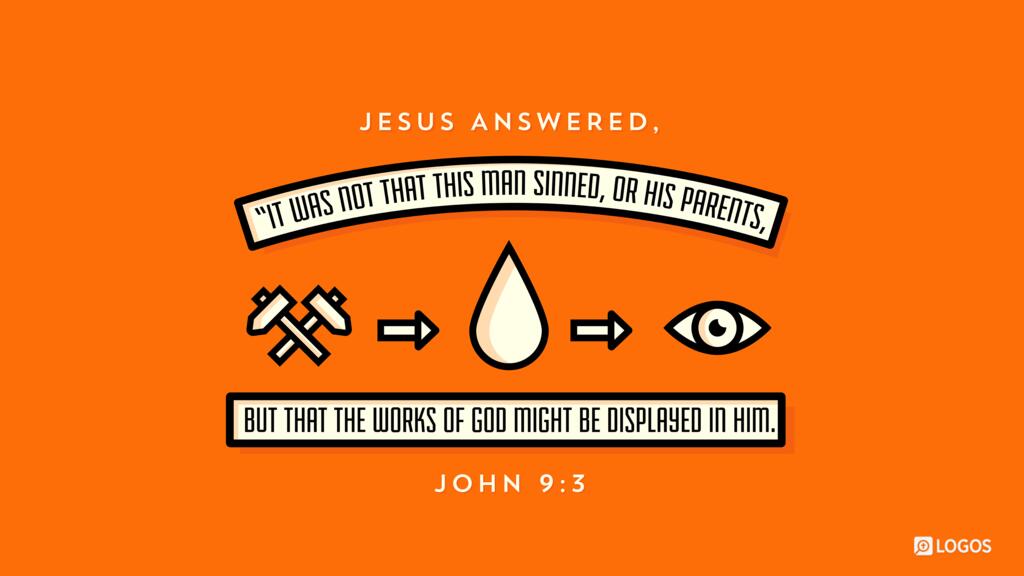
9:1Now as Jesus was passing by,1 he saw a man who had been blind from birth. 9:2His disciples asked him,2 “Rabbi, who committed the sin that caused him to be born blind, this man3 or his parents?”49:3Jesus answered, “Neither this man5 nor his parents sinned, but he was born blind so that6 the acts7 of God may be revealed8 through what happens to him.9
Footnotes
- 1 Or “going along.” The opening words of chap. 9, καὶ παράγων (kai paragōn), convey only the vaguest indication of the circumstances. Since there is no break with chap. 8, Jesus is presumably still in Jerusalem, and presumably not still in the temple area. The events of chap. 9 fall somewhere between the feast of Tabernacles (John 7:2) and the feast of the Dedication (John 10:22). But in the author’s narrative the connection exists—the incident recorded in chap. 9 (along with the ensuing debates with the Pharisees) serves as a real-life illustration of the claim Jesus made in 8:12, I am the light of the world. This is in fact the probable theological motivation behind the juxtaposition of these two incidents in the narrative. The second serves as an illustration of the first, and as a concrete example of the victory of light over darkness. One other thing which should be pointed out about the miracle recorded in chap. 9 is its messianic significance. In the OT it is God himself who is associated with the giving of sight to the blind (Exod 4:11, Ps 146:8). In a number of passages in Isa (29:18, 35:5, 42:7) it is considered to be a messianic activity.
- 2 Grk “asked him, saying.”
- 3 Grk “this one.”
- 4 Grk “in order that he should be born blind.” The disciples assumed that sin (regardless of who committed it) was the cause of the man’s blindness. This was a common belief in Judaism; the rabbis used Ezek 18:20 to prove there was no death without sin, and Ps 89:33 to prove there was no punishment without guilt (the Babylonian Talmud, Shabbat 55a, although later than the NT, illustrates this). Thus in this case the sin must have been on the part of the man’s parents, or during his own prenatal existence. Song Rabbah 1:41 (another later rabbinic work) stated that when a pregnant woman worshiped in a heathen temple the unborn child also committed idolatry. This is only one example of how, in rabbinic Jewish thought, an unborn child was capable of sinning.
- 5 Grk “this one.”
- 6 Grk “but so that.” There is an ellipsis that must be supplied: “but [he was born blind] so that” or “but [it happened to him] so that.”
- 7 Or “deeds”; Grk “works.”
- 8 Or “manifested,” “brought to light.”
- 9 Grk “in him.”
The NET Bible First Edition, Copyright 1996-2005 by Biblical Studies Press
In other versions
ESVEnglish Standard Version
As he passed by, he saw a man blind from birth. And his disciples asked him, “Rabbi, who sinned, this man or his parents, that he was born blind?” Jesus answered, “It was not that this man sinned, or his parents, but that the works of God might be displayed in him.
Copyright 2001 Crossway Bibles
NIVNew International Version (2011)
As he went along, he saw a man blind from birth. His disciples asked him, “Rabbi, who sinned, this man or his parents, that he was born blind?”
“Neither this man nor his parents sinned,” said Jesus, “but this happened so that the works of God might be displayed in him.
Copyright 1973, 1978, 1984, 2011 Biblica, Inc.
CSBChristian Standard Bible
As he was passing by, he saw a man blind from birth. His disciples asked him, “Rabbi, who sinned, this man or his parents, that he was born blind?”
“Neither this man nor his parents sinned,” Jesus answered. “This came about so that God’s works might be displayed in him.
Copyright 2017 Holman Bible Publishers
NLTNew Living Translation
As Jesus was walking along, he saw a man who had been blind from birth. “Rabbi,” his disciples asked him, “why was this man born blind? Was it because of his own sins or his parents’ sins?”
“It was not because of his sins or his parents’ sins,” Jesus answered. “This happened so the power of God could be seen in him.
Holy Bible, New Living Translation, copyright © 1996, 2004, 2015 by Tyndale House Foundation. Used by permission of Tyndale House Publishers. All rights reserved.
LEBThe Lexham English Bible
And as he went away, he saw a man blind from birth. And his disciples asked him, saying, “Rabbi, who sinned, this man or his parents, that he should be born blind?” Jesus replied, “Neither this man sinned nor his parents, but it happened so that the works of God could be revealed in him.
Copyright 2012 Lexham Press
KJV 1900King James Version
And as Jesus passed by, he saw a man which was blind from his birth. And his disciples asked him, saying, Master, who did sin, this man, or his parents, that he was born blind? Jesus answered, Neither hath this man sinned, nor his parents: but that the works of God should be made manifest in him.
Public Domain