John 11:25–27
The NET BibleOther versions
English
- NET The NET Bible
- DARBY 1890 Darby Bible
- ASV American Standard Version
- AV 1873 The Cambridge Paragraph Bible of the Authorized English Version
- CSB Christian Standard Bible
- D-R Douay-Rheims Bible
- ESV English Standard Version
- GW GOD’S WORD Translation
- GNB Good News Translation
- HCSB The Holman Christian Standard Bible
- KJV 1900 King James Version
- LSB Legacy Standard Bible
- LEB The Lexham English Bible
- MSG The Message: The Bible in Contemporary Language
- NASB95 New American Standard Bible (1995)
- NCV New Century Version
- NIrV New International Reader’s Version (1998)
- NIV New International Version (2011)
- NKJV The New King James Version
- NLT New Living Translation
- NRSVue New Revised Standard Version: Updated Edition
- RSV The Revised Standard Version
- RSVCE The Revised Standard Version, Catholic Edition
- YLT Young’s Literal Translation
Arabic
Czech
French
German
Greek
Hungarian
Italian
Korean
Latin
Portuguese
Russian
Simplified Chinese
Spanish
Traditional Chinese
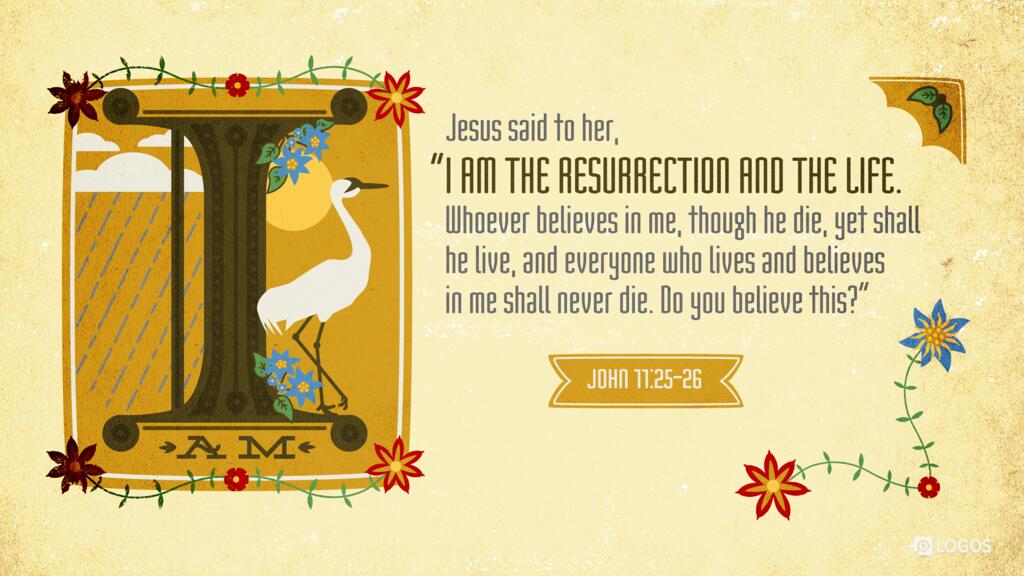
11:25Jesus said to her, “I am the resurrection and the life. The one who believes in me will live49 even if he dies, 11:26and the one who lives and believes in me will never die.50 Do you believe this?” 11:27She replied,51 “Yes, Lord, I believe52 that you are the Christ,53 the Son of God who comes into the world.”54
Footnotes
- 49 That is, will come to life.
- 50 Grk “will never die forever.”
- 51 Grk “She said to him.”
- 52 The perfect tense in Greek is often used to emphasize the results or present state of a past action. Such is the case here. To emphasize this nuance the perfect tense verb πεπίστευκα (pepisteuka) has been translated as a present tense. This is in keeping with the present context, where Jesus asks of her present state of belief in v. 26, and the theology of the Gospel as a whole, which emphasizes the continuing effects and present reality of faith. For discussion on this use of the perfect tense, see and B. M. Fanning, Verbal Aspect, 291–97.
- 53 Or “the Messiah” (Both Greek “Christ” and Hebrew and Aramaic “Messiah” mean “one who has been anointed”). See the note on Christ in .
- 54 Or “the Son of God, the one who comes into the world.”
The NET Bible First Edition, Copyright 1996-2005 by Biblical Studies Press
In other versions
ESVEnglish Standard Version
Jesus said to her, “I am the resurrection and the life. Whoever believes in me, though he die, yet shall he live, and everyone who lives and believes in me shall never die. Do you believe this?” She said to him, “Yes, Lord; I believe that you are the Christ, the Son of God, who is coming into the world.”
Copyright 2001 Crossway Bibles
NIVNew International Version (2011)
Jesus said to her, “I am the resurrection and the life. The one who believes in me will live, even though they die; and whoever lives by believing in me will never die. Do you believe this?”
“Yes, Lord,” she replied, “I believe that you are the Messiah, the Son of God, who is to come into the world.”
Copyright 1973, 1978, 1984, 2011 Biblica, Inc.
CSBChristian Standard Bible
Jesus said to her, “I am the resurrection and the life. The one who believes in me, even if he dies, will live. Everyone who lives and believes in me will never die. Do you believe this?”
“Yes, Lord,” she told him, “I believe you are the Messiah, the Son of God, who comes into the world.”
Copyright 2017 Holman Bible Publishers
NLTNew Living Translation
Jesus told her, “I am the resurrection and the life. Anyone who believes in me will live, even after dying. Everyone who lives in me and believes in me will never ever die. Do you believe this, Martha?”
“Yes, Lord,” she told him. “I have always believed you are the Messiah, the Son of God, the one who has come into the world from God.”
Holy Bible, New Living Translation, copyright © 1996, 2004, 2015 by Tyndale House Foundation. Used by permission of Tyndale House Publishers. All rights reserved.
LEBThe Lexham English Bible
Jesus said to her, “I am the resurrection and the life. The one who believes in me, even if he dies, will live, and everyone who lives and believes in me will never die forever. Do you believe this?” She said to him, “Yes, Lord, I have believed that you are the Christ, the Son of God, who comes into the world.”
Copyright 2012 Lexham Press
KJV 1900King James Version
Jesus said unto her, I am the resurrection, and the life: he that believeth in me, though he were dead, yet shall he live: And whosoever liveth and believeth in me shall never die. Believest thou this? She saith unto him, Yea, Lord: I believe that thou art the Christ, the Son of God, which should come into the world.
Public Domain