John 10:2–5
The NET BibleOther versions
English
- NET The NET Bible
- DARBY 1890 Darby Bible
- ASV American Standard Version
- AV 1873 The Cambridge Paragraph Bible of the Authorized English Version
- CSB Christian Standard Bible
- D-R Douay-Rheims Bible
- ESV English Standard Version
- GW GOD’S WORD Translation
- GNB Good News Translation
- HCSB The Holman Christian Standard Bible
- KJV 1900 King James Version
- LSB Legacy Standard Bible
- LEB The Lexham English Bible
- MSG The Message: The Bible in Contemporary Language
- NASB95 New American Standard Bible (1995)
- NCV New Century Version
- NIrV New International Reader’s Version (1998)
- NIV New International Version (2011)
- NKJV The New King James Version
- NLT New Living Translation
- NRSVue New Revised Standard Version: Updated Edition
- RSV The Revised Standard Version
- RSVCE The Revised Standard Version, Catholic Edition
- YLT Young’s Literal Translation
Arabic
Czech
French
German
Greek
Hungarian
Italian
Korean
Latin
Portuguese
Russian
Simplified Chinese
Spanish
Traditional Chinese
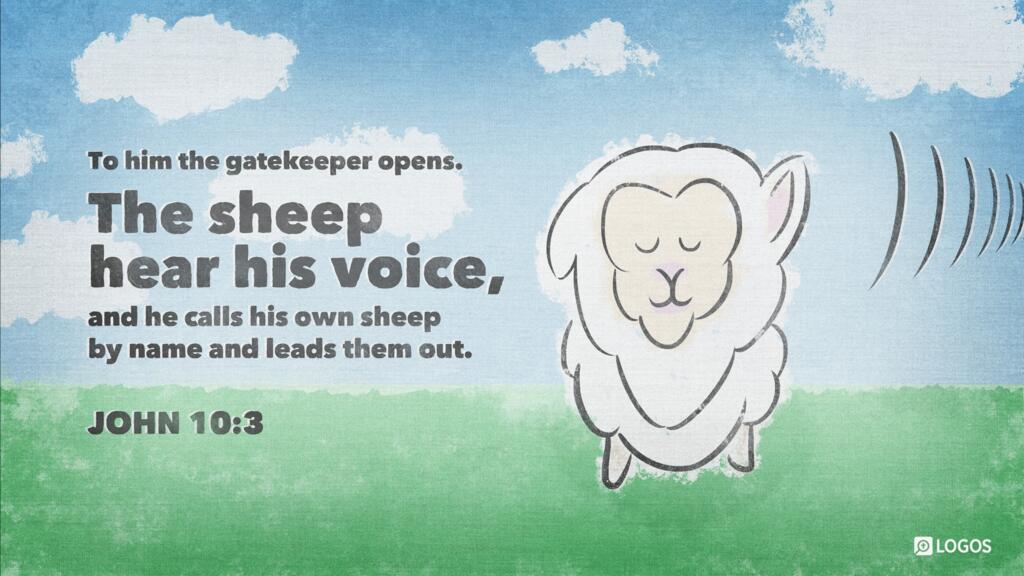
10:2The one who enters by the door is the shepherd of the sheep. 10:3The doorkeeper4 opens the door5 for him,6 and the sheep hear his voice. He7 calls his own sheep by name and leads them out.810:4When he has brought all his own sheep9 out, he goes ahead of them, and the sheep follow him because they recognize10 his voice. 10:5They will never follow a stranger,11 but will run away from him, because they do not recognize12 the stranger’s voice.”13
Footnotes
- 4 Or “porter” (British English). There have been many attempts to identify who the doorkeeper represents, none of which are convincing. More likely there are some details in this parable that are included for the sake of the story, necessary as parts of the overall picture but without symbolic significance.
- 5 The words “the door” are not in the Greek text but are implied. Direct objects in Greek were often omitted when clear from the context.
- 6 Grk “For this one.”
- 7 Grk “And he.” Because of the difference between Greek style, which often begins sentences or clauses with “and,” and English style, which generally does not, καί (kai) has not been translated here.
- 8 He calls his own sheep by name and leads them out. Some interpreters have suggested that there was more than one flock in the fold, and there would be a process of separation where each shepherd called out his own flock. This may also be suggested by the mention of a doorkeeper in v. 3 since only the larger sheepfolds would have such a guard. But the Gospel of John never mentions a distinction among the sheep in this fold; in fact (10:16) there are other sheep which are to be brought in, but they are to be one flock and one shepherd.
- 9 The word “sheep” is not in the Greek text, but is implied.
- 10 Grk “because they know.”
- 11 Or “someone whom they do not know.”
- 12 Grk “know.”
- 13 Or “the voice of someone they do not know.”
The NET Bible First Edition, Copyright 1996-2005 by Biblical Studies Press
In other versions
ESVEnglish Standard Version
But he who enters by the door is the shepherd of the sheep. To him the gatekeeper opens. The sheep hear his voice, and he calls his own sheep by name and leads them out. When he has brought out all his own, he goes before them, and the sheep follow him, for they know his voice. A stranger they will not follow, but they will flee from him, for they do not know the voice of strangers.”
Copyright 2001 Crossway Bibles
NIVNew International Version (2011)
The one who enters by the gate is the shepherd of the sheep. The gatekeeper opens the gate for him, and the sheep listen to his voice. He calls his own sheep by name and leads them out. When he has brought out all his own, he goes on ahead of them, and his sheep follow him because they know his voice. But they will never follow a stranger; in fact, they will run away from him because they do not recognize a stranger’s voice.”
Copyright 1973, 1978, 1984, 2011 Biblica, Inc.
CSBChristian Standard Bible
The one who enters by the gate is the shepherd of the sheep. The gatekeeper opens it for him, and the sheep hear his voice. He calls his own sheep by name and leads them out. When he has brought all his own outside, he goes ahead of them. The sheep follow him because they know his voice. They will never follow a stranger; instead they will run away from him, because they don’t know the voice of strangers.”
Copyright 2017 Holman Bible Publishers
NLTNew Living Translation
But the one who enters through the gate is the shepherd of the sheep. The gatekeeper opens the gate for him, and the sheep recognize his voice and come to him. He calls his own sheep by name and leads them out. After he has gathered his own flock, he walks ahead of them, and they follow him because they know his voice. They won’t follow a stranger; they will run from him because they don’t know his voice.”
Holy Bible, New Living Translation, copyright © 1996, 2004, 2015 by Tyndale House Foundation. Used by permission of Tyndale House Publishers. All rights reserved.
LEBThe Lexham English Bible
But the one who enters through the door is the shepherd of the sheep. For this one the doorkeeper opens, and the sheep hear his voice, and he calls his own sheep by name and leads them out. Whenever he sends out all his own, he goes before them, and the sheep follow him because they know his voice. And they will never follow a stranger, but will flee from him, because they do not know the voice of strangers.”
Copyright 2012 Lexham Press
KJV 1900King James Version
But he that entereth in by the door is the shepherd of the sheep. To him the porter openeth; and the sheep hear his voice: and he calleth his own sheep by name, and leadeth them out. And when he putteth forth his own sheep, he goeth before them, and the sheep follow him: for they know his voice. And a stranger will they not follow, but will flee from him: for they know not the voice of strangers.
Public Domain