Jeremiah 31:33–36
The NET BibleOther versions
English
- NET The NET Bible
- DARBY 1890 Darby Bible
- ASV American Standard Version
- AV 1873 The Cambridge Paragraph Bible of the Authorized English Version
- CSB Christian Standard Bible
- D-R Douay-Rheims Bible
- ESV English Standard Version
- GW GOD’S WORD Translation
- GNB Good News Translation
- HCSB The Holman Christian Standard Bible
- KJV 1900 King James Version
- LSB Legacy Standard Bible
- LEB The Lexham English Bible
- MSG The Message: The Bible in Contemporary Language
- NASB95 New American Standard Bible (1995)
- NCV New Century Version
- NIrV New International Reader’s Version (1998)
- NIV New International Version (2011)
- NKJV The New King James Version
- NLT New Living Translation
- NRSVue New Revised Standard Version: Updated Edition
- RSV The Revised Standard Version
- RSVCE The Revised Standard Version, Catholic Edition
- YLT Young’s Literal Translation
Arabic
Czech
French
German
Hebrew
Hungarian
Italian
Korean
Latin
Portuguese
Russian
Simplified Chinese
Spanish
Traditional Chinese
31:33“But I will make a new covenant with the whole nation of Israel74 after I plant them back in the land,”75 says the Lord.76 “I will77 put my law within them78 and write it on their hearts and minds.79 I will be their God and they will be my people.80
31:34“People will no longer need to teach their neighbors and relatives to know me.81 For all of them, from the least important to the most important, will know me,”82 says the Lord. “For83 I will forgive their sin and will no longer call to mind the wrong they have done.”
The Lord Guarantees Israel’s Continuance
31:35The Lord has made a promise to Israel.
He promises it as the one who fixed the sun to give light by day
and the moon and stars to give light by night.
He promises it as the one who stirs up the sea so that its waves roll.
He promises it as the one who is known as the Lord who rules over all.84
31:36The Lord affirms,85 “The descendants of Israel will not
cease forever to be a nation in my sight.
That could only happen if the fixed ordering of the heavenly lights
were to cease to operate before me.”86
Footnotes
- 74 Heb “with the house of Israel.” All commentators agree that the term here refers to both the whole nation which was divided into the house of Israel and the house of Judah in v. 30.
- 75 Heb “after those days.” Commentators are generally agreed that this refers to the return from exile and the repopulation of the land referred to in vv. 27–28 and not to something subsequent to the time mentioned in v. 30. This is the sequencing that is also presupposed in other new covenant passages such as Deut 30:1–6; Ezek 11:17–20; 36:24–28.
- 76 Heb “Oracle of the Lord.”
- 77 Heb “ ‘But this is the covenant that I will make with the house of Israel after these days:’ says the Lord, ‘I will.…’ ” The sentence has been reworded and restructured to avoid the awkwardness of the original style.
- 78 Heb “in their inward parts.” The Hebrew word here refers to the seat of the thoughts, emotions, and decisions (Jer 9:8 [9:7 ]). It is essentially synonymous with “heart” in Hebrew psychological terms.
- 79 The words “and minds” is not in the text but is supplied in the translation to bring the English psychology more into line with the Hebrew where the “heart” is the center both of knowing/thinking/reflecting and deciding/willing. Two contexts are relevant for understanding this statement. First is the context of the first or old covenant which was characterized by a law written on stone tablets (e.g., Exod 32:15–16; 34:1, 28; Deut 4:13; 5:22; 9:10) or in a “book” or “scroll” (Deut 31:9–13) which could be lost (cf. 2 Kgs 22:8), forgotten (Hos 4:6), ignored (Jer 6:19; Amos 4:2), or altered (Jer 8:8). Second is the context of the repeated fault that Jeremiah has found with their stubborn (3:17; 7:24; 9:14; 11:8; 13:10; 16:12; 18:12; 23:17), uncircumcised (4:4; 9:26), and desperately wicked hearts (4:4; 17:9). Radical changes were necessary to get the people to obey the law from the heart and not just pay superficial or lip service to it (3:10; 12:2). Deut 30:1–6; Ezek 11:17–20; 36:24–28 speak of these radical changes. The Lord will remove the “foreskin” of their heart and give them a circumcised heart, or take away their “stony” heart and give them a new heart. With this heart they will be able to obey his laws, statutes, ordinances, and commands (Deut 30:8; Ezek 11:20; 36:27). The new covenant does not entail a new law; it is the same law that Jeremiah has repeatedly accused them of rejecting or ignoring (6:19; 9:13; 16:11; 26:4; 44:10). What does change is their inner commitment to keep it. Jeremiah has already referred to this in Jer 24:7 and will refer to it again in Jer 32:39.
- 80 Compare Jer 24:7; 30:22; 31:1 and see the study note on .
- 81 Heb “teach …, saying, ‘Know the Lord.’ ” The indirect quote has been chosen for stylistic reasons, i.e., to better parallel the following line. As mentioned in the translator’s note on (9:2 ) “knowing” God in covenant contexts like this involves more than just an awareness of who he is (9:23 [9:22 ]). It involves an acknowledgment of his sovereignty and whole hearted commitment to obedience to him. This is perhaps best seen in the parallelisms in Hos 4:1; 6:6 where “the knowledge of God” is parallel with faithfulness and steadfast love and in the context of Hos 4 refers to obedience to the Lord’s commands.
- 82 This statement should be understood against the background of Jer 8:8–9 where class distinctions were drawn and certain people were considered to have more awareness and responsibility for knowing the law and also Jer 5:1–5 and 9:3–9 where the sinfulness of Israel was seen to be universal across these class distinctions and no trust was to be placed in friends, neighbors, or relatives because all without distinction had cast off God’s yoke (i.e., refused to submit themselves to his authority).
- 83 The Hebrew particle כִּי (ki) that introduces this clause refers to more than just the preceding clause (i.e., that all will know the Lord) but to all of vv. 31–34a (See 474 כִּי 3.c).
- 84 Heb “Yahweh of armies.” See the study note on for this title. In the Hebrew text the verse reads: “Thus says the Lord who provides the sun for light by day, the fixed ordering of the moon and stars for light by night, who stirs up the sea and its waves roar, whose name is Yahweh of armies, ‘…’ ” The hymnic introduction to the quote which does not begin until v. 36 has been broken down to avoid a long awkward sentence in English. The word “said” has been translated “made a promise” to reflect the nature of the content in vv. 36–37. The first two lines of the Hebrew poetry are a case of complex or supplementary ellipsis where the complete idea of “providing/establishing the fixed laws” is divided between the two lines (cf. E. W. Bullinger, Figures of Speech, ). The necessity for recombining the ellipsis is obvious from reference to the fixed ordering in the next verse. (Some commentators prefer to delete the word as an erroneous glossing of the word in the following line (see, e.g., J. Bright, Jeremiah [], 277, n. y).
- 85 Heb “Oracle of the Lord.”
- 86 Heb “ ‘If these fixed orderings were to fail to be present before me,’ oracle of the Lord, ‘then the seed of Israel could cease from being a nation before me forever (or more literally, “all the days”).’ ” The sentence has been broken up to conform more to modern style. The connection has been maintained by reversing the order of condition and consequence and still retaining the condition in the second clause. For the meaning of “cease to operate” for the verb מוּשׁ (mush) compare the usage in Isa 54:10; Ps 55:11 (55:12 ); Prov 17:13 where what is usually applied to persons or things is applied to abstract things like this (see II מוּשׁ Qal for general usage).
The NET Bible First Edition, Copyright 1996-2005 by Biblical Studies Press
In other versions
ESVEnglish Standard Version
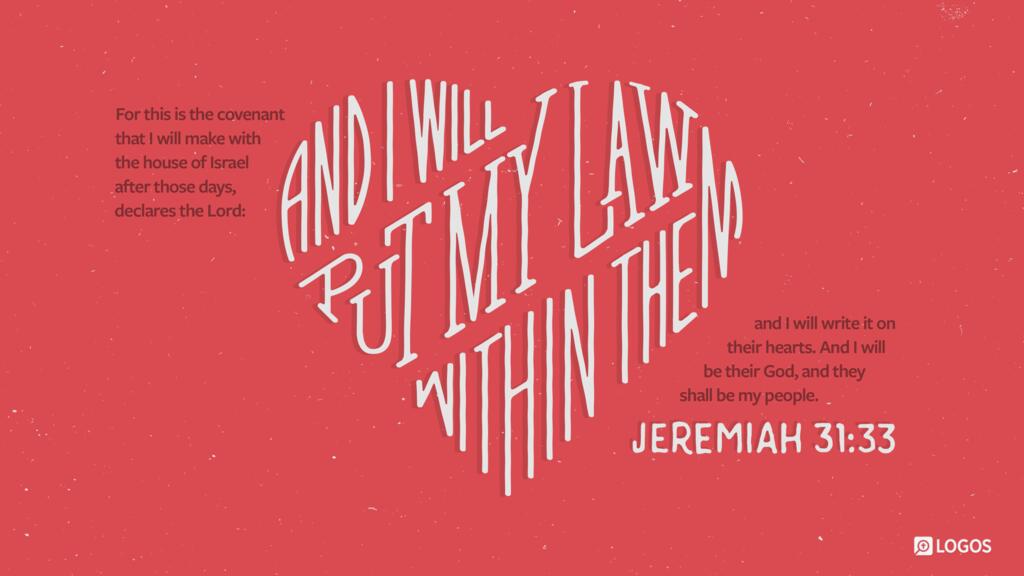
For this is the covenant that I will make with the house of Israel after those days, declares the Lord: I will put my law within them, and I will write it on their hearts. And I will be their God, and they shall be my people. And no longer shall each one teach his neighbor and each his brother, saying, ‘Know the Lord,’ for they shall all know me, from the least of them to the greatest, declares the Lord. For I will forgive their iniquity, and I will remember their sin no more.”
Thus says the Lord,
who gives the sun for light by day
and the fixed order of the moon and the stars for light by night,
who stirs up the sea so that its waves roar—
the Lord of hosts is his name:
“If this fixed order departs
from before me, declares the Lord,
then shall the offspring of Israel cease
from being a nation before me forever.”
Copyright 2001 Crossway Bibles
NIVNew International Version (2011)
“This is the covenant I will make with the people of Israel
after that time,” declares the Lord.
“I will put my law in their minds
and write it on their hearts.
I will be their God,
and they will be my people.
No longer will they teach their neighbor,
or say to one another, ‘Know the Lord,’
because they will all know me,
from the least of them to the greatest,”
declares the Lord.
“For I will forgive their wickedness
and will remember their sins no more.”
This is what the Lord says,
he who appoints the sun
to shine by day,
who decrees the moon and stars
to shine by night,
who stirs up the sea
so that its waves roar—
the Lord Almighty is his name:
“Only if these decrees vanish from my sight,”
declares the Lord,
“will Israel ever cease
being a nation before me.”
Copyright 1973, 1978, 1984, 2011 Biblica, Inc.
CSBChristian Standard Bible
“Instead, this is the covenant I will make with the house of Israel after those days”—the Lord’s declaration. “I will put my teaching within them and write it on their hearts. I will be their God, and they will be my people. No longer will one teach his neighbor or his brother, saying, ‘Know the Lord,’ for they will all know me, from the least to the greatest of them” —this is the Lord’s declaration. “For I will forgive their iniquity and never again remember their sin.
“This is what the Lord says:
The one who gives the sun for light by day,
the fixed order of moon and stars for light by night,
who stirs up the sea and makes its waves roar —
the Lord of Armies is his name:
If this fixed order departs from before me—
this is the Lord’s declaration—
only then will Israel’s descendants cease
to be a nation before me forever.
Copyright 2017 Holman Bible Publishers
NLTNew Living Translation
“But this is the new covenant I will make with the people of Israel after those days,” says the Lord. “I will put my instructions deep within them, and I will write them on their hearts. I will be their God, and they will be my people. And they will not need to teach their neighbors, nor will they need to teach their relatives, saying, ‘You should know the Lord.’ For everyone, from the least to the greatest, will know me already,” says the Lord. “And I will forgive their wickedness, and I will never again remember their sins.”
It is the Lord who provides the sun to light the day
and the moon and stars to light the night,
and who stirs the sea into roaring waves.
His name is the Lord of Heaven’s Armies,
and this is what he says:
“I am as likely to reject my people Israel
as I am to abolish the laws of nature!”
Holy Bible, New Living Translation, copyright © 1996, 2004, 2015 by Tyndale House Foundation. Used by permission of Tyndale House Publishers. All rights reserved.
LEBThe Lexham English Bible
“But this is the covenant that I will make with the house of Israel after those days,” declares Yahweh: “I will put my law in their inward parts and on their hearts I will write it, and I will be to them God, and they themselves will be to me people. And they will no longer teach each one his neighbor, or each one his brother, saying, ‘Know Yahweh,’ for all of them will know me, from their smallest and up to their greatest,” declares Yahweh, “for I will forgive their iniquity and their sin I will no longer remember.”
Thus says Yahweh, who gives the sun for light by day, the regulations of the moon and the stars for light by night, who stirs up the sea and its waves roar—Yahweh of hosts is his name. “If these rules would cease from before me,” declares Yahweh, “also the offspring of Israel would cease from being a nation before me forever.”
Copyright 2012 Lexham Press
KJV 1900King James Version
But this shall be the covenant that I will make with the house of Israel;
After those days, saith the Lord,
I will put my law in their inward parts,
And write it in their hearts;
And will be their God,
And they shall be my people.
And they shall teach no more every man his neighbour, and every man his brother, saying,
Know the Lord:
For they shall all know me,
From the least of them unto the greatest of them, saith the Lord:
For I will forgive their iniquity,
And I will remember their sin no more.
Thus saith the Lord, which giveth the sun for a light by day,
And the ordinances of the moon and of the stars for a light by night,
Which divideth the sea when the waves thereof roar;
The Lord of hosts is his name:
If those ordinances depart from before me, saith the Lord,
Then the seed of Israel also shall cease
From being a nation before me for ever.
Public Domain