Isaiah 53:4–6
The NET BibleOther versions
English
- NET The NET Bible
- DARBY 1890 Darby Bible
- ASV American Standard Version
- AV 1873 The Cambridge Paragraph Bible of the Authorized English Version
- CSB Christian Standard Bible
- D-R Douay-Rheims Bible
- ESV English Standard Version
- GW GOD’S WORD Translation
- GNB Good News Translation
- HCSB The Holman Christian Standard Bible
- KJV 1900 King James Version
- LSB Legacy Standard Bible
- LEB The Lexham English Bible
- MSG The Message: The Bible in Contemporary Language
- NASB95 New American Standard Bible (1995)
- NCV New Century Version
- NIrV New International Reader’s Version (1998)
- NIV New International Version (2011)
- NKJV The New King James Version
- NLT New Living Translation
- NRSVue New Revised Standard Version: Updated Edition
- RSV The Revised Standard Version
- RSVCE The Revised Standard Version, Catholic Edition
- YLT Young’s Literal Translation
Arabic
Czech
French
German
Hebrew
Hungarian
Italian
Korean
Latin
Portuguese
Russian
Simplified Chinese
Spanish
Traditional Chinese
53:4But he lifted up our illnesses,
he carried our pain;13
even though we thought he was being punished,
attacked by God, and afflicted for something he had done.14
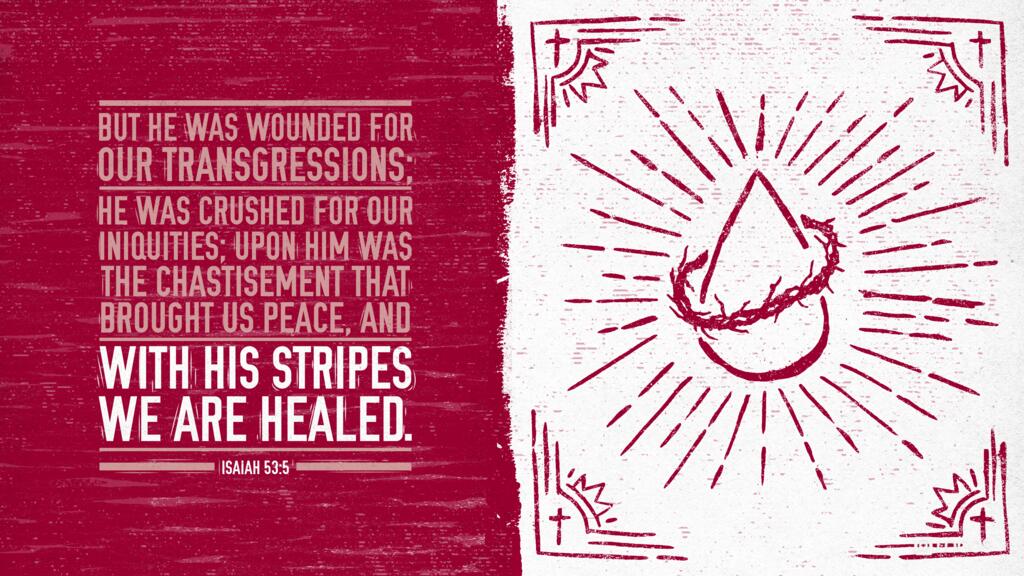
53:5He was wounded because of15 our rebellious deeds,
crushed because of our sins;
he endured punishment that made us well;16
because of his wounds we have been healed.17
53:6All of us had wandered off like sheep;
each of us had strayed off on his own path,
but the Lord caused the sin of all of us to attack him.18
Footnotes
- 13 Illness and pain stand by metonymy (or perhaps as metaphors) for sin and its effects, as vv. 11–12 make clear.
- 14 The words “for something he had done” are supplied in the translation for clarification. The group now realizes he suffered because of his identification with them, not simply because he was a special target of divine anger.
- 15 The preposition מִן (min) has a causal sense (translated “because of”) here and in the following clause.
- 16 Heb “the punishment of our peace [was] on him.” שָׁלוֹם (shalom, “peace”) is here a genitive of result, i.e., “punishment that resulted in our peace.”
- 17 Continuing to utilize the imagery of physical illness, the group acknowledges that the servant’s willingness to carry their illnesses (v. 4) resulted in their being healed. Healing is a metaphor for forgiveness here.
- 18 Elsewhere the Hiphil of פָגַע (paga’) means “to intercede verbally” (Jer 15:11; 36:25) or “to intervene militarily” (Isa 59:16), but neither nuance fits here. Apparently here the Hiphil is the causative of the normal Qal meaning, “encounter, meet, touch.” The Qal sometimes refers to a hostile encounter or attack; when used in this way the object is normally introduced by the preposition -בְּ (bet, see Josh 2:16; Judg 8:21; 15:12, etc.). Here the causative Hiphil has a double object—the Lord makes “sin” attack “him” (note that the object attacked is introduced by the preposition -בְּ. In their sin the group was like sheep who had wandered from God’s path. They were vulnerable to attack; the guilt of their sin was ready to attack and destroy them. But then the servant stepped in and took the full force of the attack.
The NET Bible First Edition, Copyright 1996-2005 by Biblical Studies Press
In other versions
ESVEnglish Standard Version
Surely he has borne our griefs
and carried our sorrows;
yet we esteemed him stricken,
smitten by God, and afflicted.
But he was pierced for our transgressions;
he was crushed for our iniquities;
upon him was the chastisement that brought us peace,
and with his wounds we are healed.
All we like sheep have gone astray;
we have turned—every one—to his own way;
and the Lord has laid on him
the iniquity of us all.
Copyright 2001 Crossway Bibles
NIVNew International Version (2011)
Surely he took up our pain
and bore our suffering,
yet we considered him punished by God,
stricken by him, and afflicted.
But he was pierced for our transgressions,
he was crushed for our iniquities;
the punishment that brought us peace was on him,
and by his wounds we are healed.
We all, like sheep, have gone astray,
each of us has turned to our own way;
and the Lord has laid on him
the iniquity of us all.
Copyright 1973, 1978, 1984, 2011 Biblica, Inc.
CSBChristian Standard Bible
Yet he himself bore our sicknesses,
and he carried our pains;
but we in turn regarded him stricken,
struck down by God, and afflicted.
But he was pierced because of our rebellion,
crushed because of our iniquities;
punishment for our peace was on him,
and we are healed by his wounds.
We all went astray like sheep;
we all have turned to our own way;
and the Lord has punished him
for the iniquity of us all.
Copyright 2017 Holman Bible Publishers
NLTNew Living Translation
Yet it was our weaknesses he carried;
it was our sorrows that weighed him down.
And we thought his troubles were a punishment from God,
a punishment for his own sins!
But he was pierced for our rebellion,
crushed for our sins.
He was beaten so we could be whole.
He was whipped so we could be healed.
All of us, like sheep, have strayed away.
We have left God’s paths to follow our own.
Yet the Lord laid on him
the sins of us all.
Holy Bible, New Living Translation, copyright © 1996, 2004, 2015 by Tyndale House Foundation. Used by permission of Tyndale House Publishers. All rights reserved.
LEBThe Lexham English Bible
However, he was the one who lifted up our sicknesses,
and he carried our pain,
yet we ourselves assumed him stricken,
struck down by God and afflicted.
But he was pierced for our transgressions,
crushed because of our iniquities;
the chastisement for our peace was upon him,
and by his wounds we were healed.
All of us have wandered about like sheep;
we each have turned to his own way;
and Yahweh let fall on him
the iniquity of us all.
Copyright 2012 Lexham Press
KJV 1900King James Version
Surely he hath borne our griefs,
And carried our sorrows:
Yet we did esteem him stricken,
Smitten of God, and afflicted.
But he was wounded for our transgressions,
He was bruised for our iniquities:
The chastisement of our peace was upon him;
And with his stripes we are healed.
All we like sheep have gone astray;
We have turned every one to his own way;
And the Lord hath laid on him the iniquity of us all.
Public Domain