Isaiah 49:5–8
The NET BibleOther versions
English
- NET The NET Bible
- DARBY 1890 Darby Bible
- ASV American Standard Version
- AV 1873 The Cambridge Paragraph Bible of the Authorized English Version
- CSB Christian Standard Bible
- D-R Douay-Rheims Bible
- ESV English Standard Version
- GW GOD’S WORD Translation
- GNB Good News Translation
- HCSB The Holman Christian Standard Bible
- KJV 1900 King James Version
- LSB Legacy Standard Bible
- LEB The Lexham English Bible
- MSG The Message: The Bible in Contemporary Language
- NASB95 New American Standard Bible (1995)
- NCV New Century Version
- NIrV New International Reader’s Version (1998)
- NIV New International Version (2011)
- NKJV The New King James Version
- NLT New Living Translation
- NRSVue New Revised Standard Version: Updated Edition
- RSV The Revised Standard Version
- RSVCE The Revised Standard Version, Catholic Edition
- YLT Young’s Literal Translation
Arabic
Czech
French
German
Hebrew
Hungarian
Italian
Korean
Latin
Portuguese
Russian
Simplified Chinese
Spanish
Traditional Chinese
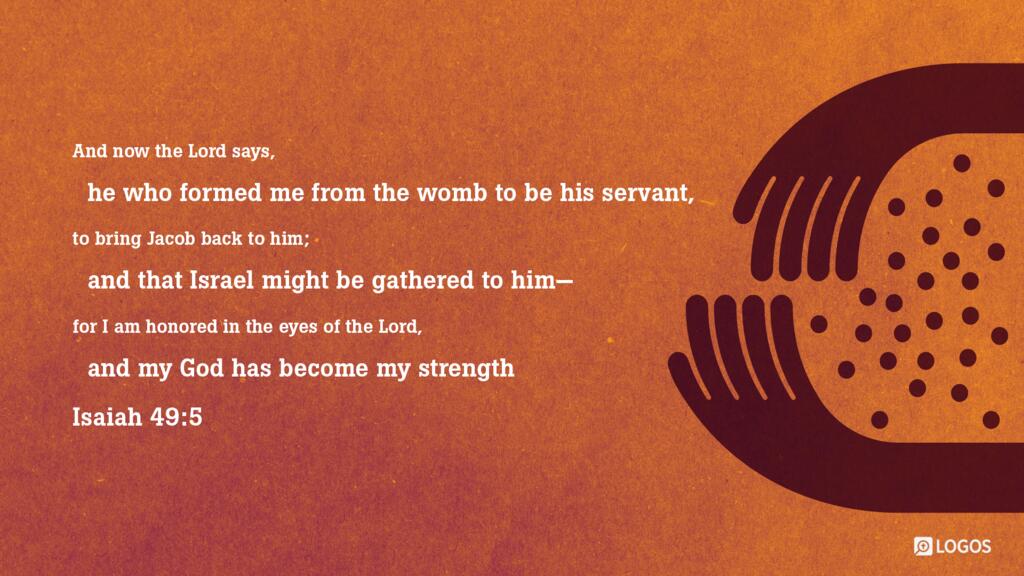
49:5So now the Lord says,
the one who formed me from birth10 to be his servant—
he did this11 to restore Jacob to himself,
so that Israel might be gathered to him;
and I will be honored12 in the Lord’s sight,
for my God is my source of strength13—
49:6he says, “Is it too insignificant a task for you to be my servant,
to reestablish the tribes of Jacob,
and restore the remnant14 of Israel?15
I will make you a light to the nations,16
so you can bring17 my deliverance to the remote regions of the earth.”
49:7This is what the Lord,
the protector18 of Israel, their Holy One,19 says
to the one who is despised20 and rejected21 by nations,22
a servant of rulers:
“Kings will see and rise in respect,23
princes will bow down,
because of the faithful Lord,
the Holy One of Israel who has chosen you.”
49:8This is what the Lord says:
“At the time I decide to show my favor, I will respond to you;
in the day of deliverance I will help you;
I will protect you24 and make you a covenant mediator for people,25
and to reassign the desolate property.
Footnotes
- 10 Heb “from the womb” (so , ).
- 11 The words “he did this” are supplied in the translation for stylistic reasons. In the Hebrew text the infinitive construct of purpose is subordinated to the previous statement.
- 12 The vav (ו) + imperfect is translated here as a result clause; one might interpret it as indicating purpose, “and so I might be honored.”
- 13 Heb “and my God is [perhaps, “having been”] my strength.” The disjunctive structure (vav [ו] + subject + verb) is interpreted here as indicating a causal circumstantial clause.
- 14 Heb “the protected [or “preserved”] ones.”
- 15 The question is purely rhetorical; it does not imply that the servant was dissatisfied with his commission or that he minimized the restoration of Israel.
- 16 See the note at .
- 17 Heb “be” (so , ); “you must take.”
- 18 Heb “redeemer.” See the note at .
- 19 See the note on the phrase “the Holy One of Israel” in .
- 20 The Hebrew text reads literally “to [one who] despises life.” It is preferable to read with the Qumran scroll 1QIsaa לבזוי, which should be vocalized as a passive participle, לִבְזוּי (livzuy, “to the one despised with respect to life” [נֶפֶשׁ is a genitive of specification]). The consonantal sequence וי was probably misread as ה in the tradition. The contextual argument favors the 1QIsaa reading. As J. N. Oswalt (Isaiah [], 2:) points out, the three terse phrases “convey a picture of lowliness, worthlessness, and helplessness.”
- 21 ’s Piel participle (“to the one who rejects”) does not fit contextually. The form should be revocalized as a Pual, “to the one rejected.”
- 22 Parallelism (see “rulers,” “kings,” “princes”) suggests that the singular גּוֹי (goy) be emended to a plural or understood in a collective sense (see 55:5).
- 23 For this sense of קוּם (qum), see Gen 19:1; 23:7; 33:10; Lev 19:32; 1 Sam 20:41; 25:41; 1 Kgs 2:19; Job 29:8.
- 24 The translation assumes the verb is derived from the root נָצָר (natsar, “protect”). Some prefer to derive it from the root יָצָר (yatsar, “form”).
- 25 Heb “a covenant of people.” A person cannot literally be a covenant; בְּרִית (bérit) is probably metonymic here, indicating a covenant mediator. Here עָם (’am, “people”) appears to refer to Israel. See the note at .
- 26 The Hiphil of קוּם (qum, “arise”) is probably used here in the sense of “rebuild.”
- 27 The “land” probably stands by metonymy for the ruins within it.
The NET Bible First Edition, Copyright 1996-2005 by Biblical Studies Press