Hosea 2:14–23
The NET BibleOther versions
English
- NET The NET Bible
- DARBY 1890 Darby Bible
- ASV American Standard Version
- AV 1873 The Cambridge Paragraph Bible of the Authorized English Version
- CSB Christian Standard Bible
- D-R Douay-Rheims Bible
- ESV English Standard Version
- GW GOD’S WORD Translation
- GNB Good News Translation
- HCSB The Holman Christian Standard Bible
- KJV 1900 King James Version
- LSB Legacy Standard Bible
- LEB The Lexham English Bible
- MSG The Message: The Bible in Contemporary Language
- NASB95 New American Standard Bible (1995)
- NCV New Century Version
- NIrV New International Reader’s Version (1998)
- NIV New International Version (2011)
- NKJV The New King James Version
- NLT New Living Translation
- NRSVue New Revised Standard Version: Updated Edition
- RSV The Revised Standard Version
- RSVCE The Revised Standard Version, Catholic Edition
- YLT Young’s Literal Translation
Arabic
Czech
French
German
Hebrew
Hungarian
Italian
Korean
Latin
Portuguese
Russian
Simplified Chinese
Spanish
Traditional Chinese
Future Repentance and Restoration of Israel
2:14However, in the future I will allure her;46
I will lead47 her back into the wilderness,
and speak tenderly to her.
2:15From there I will give back her vineyards to her,
and turn the “Valley of Trouble”48 into an “Opportunity49 for Hope.”
There she will sing as she did when she was young,50
when51 she came up from the land of Egypt.
2:16“At that time,”52 declares the Lord,
“you will call,53 ‘My husband’;54
you will never again call me,55 ‘My master.’56
2:17For57 I will remove the names of the Baal idols58 from your lips,59
so that you will never again utter their names!”60
New Covenant Relationship with Repentant Israel
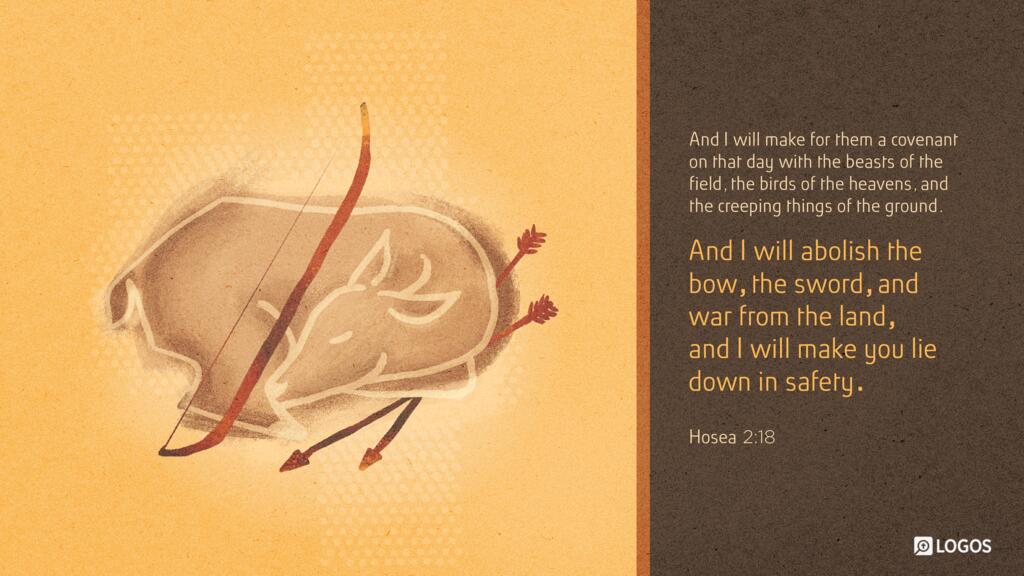
2:18“At that time61 I will make a covenant for them with the wild animals,
the birds of the air, and the creatures that crawl on the ground.
I will abolish62 the warrior’s bow and sword
—that is, every weapon of warfare63—from the land,
and I will allow them to live securely.”64
2:19I will commit myself to you65 forever;
I will commit myself to you in66 righteousness and justice,
in steadfast love and tender compassion.
2:20I will commit myself to you in faithfulness;
then67 you will acknowledge68 the Lord.”69
Agricultural Fertility Restored to the Repentant Nation
2:21“At that time,70 I will willingly respond,”71 declares the Lord.
“I will respond to the sky,
and the sky72 will respond to the ground;
2:22then the ground will respond to the grain, the new wine, and the olive oil;
and they will respond to ‘God Plants’ (Jezreel)!73
2:23Then I will plant her as my own74 in the land.
I will have pity on ‘No Pity’ (Lo-Ruhamah).
I will say to ‘Not My People’ (Lo-Ammi), ‘You are my people!’
Footnotes
- 46 The participle מְפַתֶּיהָ (méfatteha, Piel participle masculine singular + 3rd feminine singular suffix from פָּתָה, patah, “to allure”) following the deictic particle הִנֵּה (hinneh, “Now!”) describes an event that will occur in the immediate or near future.
- 47 Following the future-time referent participle (מְפַתֶּיהָ, méfatteha) there is a string of perfects introduced by vav consecutive that refer to future events.
- 48 Heb “Valley of Achor,” so named because of the unfortunate incident recorded in Josh 7:1–26 (the name is explained in v. 26; the Hebrew term Achor means “disaster” or “trouble”). Cf. , “Trouble Valley.”
- 49 Heb “door” or “doorway”; cf. “gateway.” Unlike the days of Joshua, when Achan’s sin jeopardized Israel’s mission and cast a dark shadow over the nation, Israel’s future return to the land will be marked by renewed hope.
- 50 Heb “as in the days of her youth” (so , , ).
- 51 Heb “as in the day when” (so , ).
- 52 Heb “And in that day”; “In that coming day.”
- 53 The reads תִּקְרְאִי (tiqré’i, “you will call”; Qal imperfect 2nd person feminine singular). The versions (, , ) all reflect an alternate of תִּקְרָא לִי (tiqra’ li, “she will call me”; Qal imperfect 3rd person feminine singular followed by preposition לְ, lamed, + 1st person common singular pronominal suffix). This textual variant undoubtedly arose under the influence of לִי תִּקְרְאִי (tiqré’i li) which follows. Most English versions follow the reading of the (, , , , , , ), but some follow the ancient versions and read the 3rd person (“she”, so , , ).
- 54 There are wordplays on the terms אִישׁ (’ish) and בַּעַל (ba’al) here. The term אִישִׁי (’ishi, “my man, husband”) is a title of affection (Gen 2:23; 3:6, 16) as the counterpart to אִשָּׁה (’ishah, “woman, wife”). The term בַּעְלִי (ba’li, “my lord”) emphasizes the husband’s legal position (Exod 21:3; Deut 22:22; 24:4). The relationship will no longer be conditioned on the outward legal commitment but on a new inward bond of mutual affection and love.
- 55 The reads תִקְרְאִי לִי (tiqré’i li, “you will call me”; Qal imperfect 2nd person feminine singular followed by preposition לְ, lamed, + 1st person common singular pronominal suffix). The versions (, , ) all reflect an alternate of תִקְרְא לִי (tiqré’ li, “she will call me”; Qal imperfect 3rd person feminine singular followed by preposition לְ + 1st person common singular pronominal suffix). This textual variant is related to the preceding textual issue (see preceding note).
- 56 There is a wordplay on the terms בַּעְלִי (ba’li, “my master”) and הַבְּעָלִים (habbé’alim, “the Baals”) which are derived from the root בַּעַל (ba’al, “master; lord”). This wordplay is especially effective because the term בַּעַל can refer to one’s husband and is also the name of the Canaanite storm god Baal. Referring to a spouse the term normally means “husband; master.” It was a common, ordinary, nonpejorative term that was frequently used in an interchangeable manner with אִישׁ (’ish, “husband; man”). Due to its similarity in sound to the abhorrent Canaanite fertility god Baal, the repentant Israelites would be so spiritually sensitive that they would refrain from even uttering this neutral term for fear of recalling their former idolatry. The purpose of the exile is to end Israel’s worship of Baal and to remove syncretism.
- 57 The vav consecutive prefixed to וַהֲסִרֹתִי (vahasiroti) “I will remove” (vav consecutive + Hiphil perfect 1st person common singular) introduces an explanatory clause.
- 58 Heb “the Baals.” The singular term בַּעַל (ba’al) refers to the Canaanite god Baal himself, while the plural form הַבְּעָלִים (habbé’alim) refers to the manifestations of the god (i.e., idols; 127 בָּעַל II.1).
- 59 Heb “from her mouth.” In the translation this is rendered as second person for consistency.
- 60 Heb “they will no longer be mentioned by their name.”
- 61 Heb “And in that day” (so , ).
- 62 Heb “I will break”; “I will destroy”; “I will smash”; “I will remove.”
- 63 Heb “bow and sword and warfare.” The first two terms in the triad וְקֶשֶׁת וְחֶרֶב וּמִלְחָמָה (véqeshet vékherev umilkhamah, literally, “bow and sword and warfare”) are examples of synecdoche of specific (bow and sword) for general (weapons of war, so ). However, they might be examples of metonymy (bow and sword) of association (warfare).
- 64 Heb “and I will cause them to lie down in safety.” The causative nuance (“will make them”) is retained in several English versions (e.g., , , , ).
- 65 Heb “I will betroth you to me” (so ) here and in the following lines. Cf. “I will take you for my wife forever.”
- 66 The preposition בְּ (bet), which is repeated throughout 2:19–20 [21–22], denotes price paid ( 90 בְּ III.3; e.g., Ezek 3:14). The text contains an allusion to the payment of bridal gifts. The Lord will impute the moral character to Israel that will be necessary for a successful covenant relationship (contra 4:1).
- 67 The vav consecutive on the suffix conjugation verb וְיָדַעַתְּ (véyada’at, “then you will know”) introduces a result clause (cf. , ).
- 68 Or “know.” The term יָדַע (yada’, “know, acknowledge”) is often used in covenant contexts. It can refer to the suzerain’s acknowledgment of his covenant obligations to his vassal or to the vassal’s acknowledgment of his covenant obligations to his suzerain. When used in reference to a vassal, the verb “know” is metonymical (cause for effect) for “obey.” See H. Huffmann, “The Treaty Background of Hebrew yādaʿ,” 181 (1966): 31–37.
- 69 The reads יְהוָה (yéhvah, “the Lord”); however, many Hebrew read כִּי אָנִי (ki ’ani, “that it is I”), as also reflected in the Latin (cf. “know who I am”).
- 70 Heb “And in that day”; , “On that day.”
- 71 The verb עָנָה, (’anah) which is used throughout 2:23–24, is related to the root I עָנָה (’anah), “to answer, listen attentively, react willingly” ( 772 1.b; ענה 3.b).
- 72 Heb “and they.” In the Hebrew text the plural pronoun is used because it refers back to the term translated “sky,” which is a dual form in Hebrew. Many English versions (e.g., , , ) use the plural term “heavens” here, which agrees with a plural pronoun (cf. also , “skies”).
- 73 Heb “Jezreel.” The use of the name יִזְרְעֶאל (yizré’e’l, “Jezreel”) creates a powerful three-fold wordplay: (1) The proper name יִזְרְעֶאל (“Jezreel”) is a phonetic wordplay on the similar sounding name יִשְׂרָאֵל (yisra’el, “Israel”): God will answer Israel, that is, Jezreel. (2) The name יִזְרְעֶאל (“Jezreel”) plays on the verb זָרַע (zara’, “to sow, plant”), the immediately following word: וּזְרַעְתִּיהָ (uzéra’tiha, vav + Qal perfect 1st person common singular + 3rd person feminine singular suffix: “I will sow/plant her”). This wordplay creates a popular etymology for יִזְרְעֶאל meaning, “God sows/plants,” which fits well into the agricultural fertility imagery in 2:21–23 [2:23–25]. (3) This positive connotation of יִזְרְעֶאל (“Jezreel”) in 2:21–23[23–25] reverses the negative connotation of יִזְרְעֶאל (“Jezreel”) in 1:4–5 (bloodshed of Jehu in the Jezreel Valley).
- 74 Heb “for myself.”
- 75 The Hebrew text, carrying out the reference to the son born in 1:8–9, uses the third person masculine singular pronoun here; some English translations use third person plural (“they,” so , , , ) in keeping with the immediate context, which refers to reestablished Israel.
- 76 The words “You are” do not appear in the Hebrew text, but are implied. It is necessary to supply the phrase in the translation to prevent the reader from understanding the predicate “my God” as an exclamation (cf. ).
The NET Bible First Edition, Copyright 1996-2005 by Biblical Studies Press