Habakkuk 1:5–11
The NET BibleOther versions
English
- NET The NET Bible
- DARBY 1890 Darby Bible
- ASV American Standard Version
- AV 1873 The Cambridge Paragraph Bible of the Authorized English Version
- CSB Christian Standard Bible
- D-R Douay-Rheims Bible
- ESV English Standard Version
- GW GOD’S WORD Translation
- GNB Good News Translation
- HCSB The Holman Christian Standard Bible
- KJV 1900 King James Version
- LSB Legacy Standard Bible
- LEB The Lexham English Bible
- MSG The Message: The Bible in Contemporary Language
- NASB95 New American Standard Bible (1995)
- NCV New Century Version
- NIrV New International Reader’s Version (1998)
- NIV New International Version (2011)
- NKJV The New King James Version
- NLT New Living Translation
- NRSVue New Revised Standard Version: Updated Edition
- RSV The Revised Standard Version
- RSVCE The Revised Standard Version, Catholic Edition
- YLT Young’s Literal Translation
Arabic
Czech
French
German
Hebrew
Hungarian
Italian
Korean
Latin
Portuguese
Russian
Simplified Chinese
Spanish
Traditional Chinese
The Lord Reveals Some Startling News
1:5“Look at the nations and pay attention!14
You will be shocked and amazed!15
For I will do something in your lifetime16
that you will not believe even though you are forewarned.17
1:6Look, I am about to empower18 the Babylonians,
that ruthless19 and greedy20 nation.
They sweep across the surface21 of the earth,
seizing dwelling places that do not belong to them.
1:7They are frightening and terrifying;
they decide for themselves what is right.22
1:8Their horses are faster than leopards
and more alert23 than wolves in the desert.24
their horses come a great distance;
like a vulture27 they swoop down quickly to devour their prey.28
1:9All of them intend29 to do violence;
every face is determined.30
They take prisoners as easily as one scoops up sand.31
1:10They mock kings
and laugh at rulers.
They laugh at every fortified city;
they build siege ramps32 and capture them.
1:11They sweep by like the wind and pass on.33
But the one who considers himself a god will be held guilty.”34
Footnotes
- 14 Or “look among the nations and observe.” The imperatival forms in v. 5 are plural, indicating that the Lord’s message is for the whole nation, not just the prophet.
- 15 The Hebrew text combines the Hitpael and Qal imperatival forms of the verb תָּמַה (tamah, “be amazed”). A literal translation might read, “Shock yourselves and be shocked!” The repetition of sounds draws attention to the statement. The imperatives here have the force of an emphatic assertion. On this use of the imperative in Hebrew, see §110.c and §34.4c.
- 16 Heb “for a work working in your days.” Following the reading, some supply a first person singular pronoun with the participle פֹּעֵל (po’el). Ellipsis of a first singular pronoun before participles is relatively rare (see §116.s); perhaps an original אֲנֹכִי (’anoki; or אֲנִי, ’aniy) followed the initial כִּי (ki) and was omitted by homoioteleuton.
- 17 Heb “you will not believe when it is told.” In this context the force of כִּי (ki) may be “when,” “if,” or “even though.”
- 18 Heb “raise up” (so , ).
- 19 Heb “bitter.” Other translation options for this word in this context include “fierce” (, ); “savage” (); or “grim.”
- 20 Heb “hasty, quick.” Some translate here “impetuous” (so , , , ) or “rash,” but in this context greed may very well be the idea. The Babylonians move quickly and recklessly ahead in their greedy quest to expand their empire.
- 21 Heb “the open spaces.”
- 22 Heb “from him his justice, even his lifting up, goes out.” In this context שְׂאֵת (sé’et) probably has the nuance “authority.” See R. D. Patterson, Nahum, Habakkuk, Zephaniah (), 150.
- 23 Heb “sharper,” in the sense of “keener” or “more alert.” Some translate “quicker” on the basis of the parallelism with the first line (see חדד).
- 24 Heb “wolves of the evening,” that is, wolves that prowl at night. The present translation assumes an emendation to עֲרָבָה (’aravah, “desert”). On this phrase see also Zeph 3:3.
- 25 Or “horsemen,” “cavalry.”
- 26 The precise nuance of the rare verb פָּוַשׁ (parash) is unclear here. Elsewhere it is used of animals jumping or leaping (see Jer 50:11; Mal 4:2).
- 27 Or “eagle” (so , ). The term can refer to either eagles or vultures, but in this context of gruesome destruction and death “vulture” is preferred.
- 28 Heb “they fly like a vulture/an eagle quickly to devour.” The direct object “their prey” is not included in the Hebrew text but is implied, and has been supplied in the translation for clarity.
- 29 Heb “come.”
- 30 Heb “The totality of their faces is to the east” (or “is forward”). The precise meaning of the Hebrew term מְגַמַּת (megammat) is unclear. For a discussion of options see J. J. M. Roberts, Nahum, Habakkuk, and Zephaniah (), 93. has “a sea of faces rolls on”; “their hordes advance like a desert wind”; “with faces pressing forward.”
- 31 Heb “and he gathers like sand, prisoners.”
- 32 Heb “they heap up dirt.” This is a reference to the piling up of earthen ramps in the process of laying siege to a fortified city.
- 33 The precise meaning of v. 11a is uncertain. The present translation assumes the first line further describes the Babylonian hordes, comparing them to a destructive wind. Another option is to understand רוּחַ (ruakh) as “spirit,” rather than “wind,” and take the form וְאָשֵׁם (vé’ashem) with what precedes (as suggested by the scribal punctuation). Repointing this form as a geminate verb from שָׁמַם (shamam, “be astonished”), one could then translate the line, “The spirit passed on and departed, and I was astonished.” In this case the line would describe the cessation of the divine revelation which began in v. 5. For a detailed defense of this view, see J. J. M. Roberts, Nahum, Habakkuk, and Zephaniah (), 97–100.
- 34 Heb “and guilty is the one whose strength is his god.” This assumes that אָשֵׁם (’ashem) is a predicate adjective meaning “guilty” and that it relates to what follows.
The NET Bible First Edition, Copyright 1996-2005 by Biblical Studies Press
In other versions
ESVEnglish Standard Version
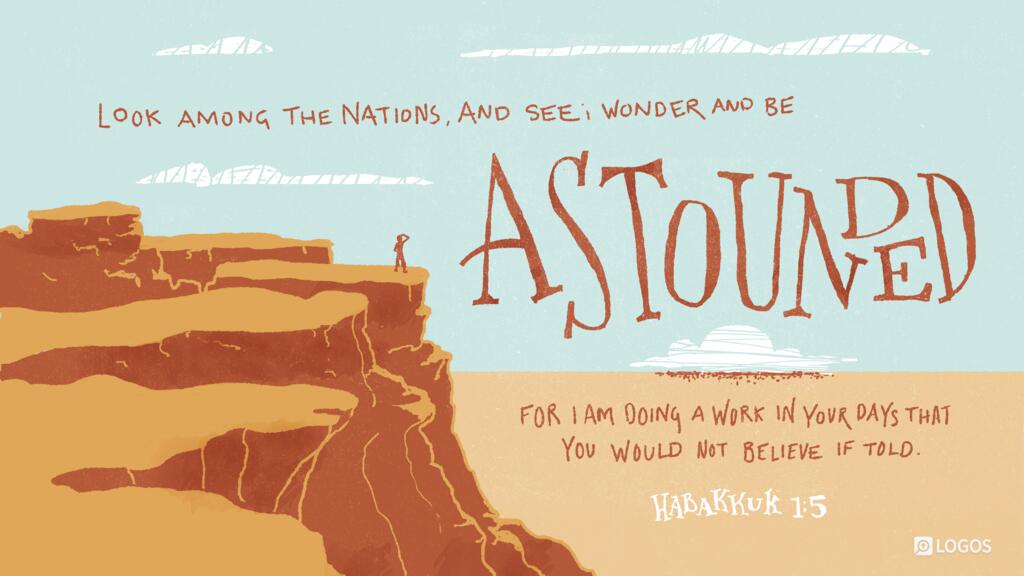
“Look among the nations, and see;
wonder and be astounded.
For I am doing a work in your days
that you would not believe if told.
For behold, I am raising up the Chaldeans,
that bitter and hasty nation,
who march through the breadth of the earth,
to seize dwellings not their own.
They are dreaded and fearsome;
their justice and dignity go forth from themselves.
Their horses are swifter than leopards,
more fierce than the evening wolves;
their horsemen press proudly on.
Their horsemen come from afar;
they fly like an eagle swift to devour.
They all come for violence,
all their faces forward.
They gather captives like sand.
At kings they scoff,
and at rulers they laugh.
They laugh at every fortress,
for they pile up earth and take it.
Then they sweep by like the wind and go on,
guilty men, whose own might is their god!”
Copyright 2001 Crossway Bibles
NIVNew International Version (2011)
“Look at the nations and watch—
and be utterly amazed.
For I am going to do something in your days
that you would not believe,
even if you were told.
I am raising up the Babylonians,
that ruthless and impetuous people,
who sweep across the whole earth
to seize dwellings not their own.
They are a feared and dreaded people;
they are a law to themselves
and promote their own honor.
Their horses are swifter than leopards,
fiercer than wolves at dusk.
Their cavalry gallops headlong;
their horsemen come from afar.
They fly like an eagle swooping to devour;
they all come intent on violence.
Their hordes advance like a desert wind
and gather prisoners like sand.
They mock kings
and scoff at rulers.
They laugh at all fortified cities;
by building earthen ramps they capture them.
Then they sweep past like the wind and go on—
guilty people, whose own strength is their god.”
Copyright 1973, 1978, 1984, 2011 Biblica, Inc.
CSBChristian Standard Bible
Look at the nations and observe—
be utterly astounded!
For I am doing something in your days
that you will not believe
when you hear about it.
Look! I am raising up the Chaldeans,
that bitter, impetuous nation
that marches across the earth’s open spaces
to seize territories not its own.
They are fierce and terrifying;
their views of justice and sovereignty
stem from themselves.
Their horses are swifter than leopards
and more fierce than wolves of the night.
Their horsemen charge ahead;
their horsemen come from distant lands.
They fly like eagles, swooping to devour.
All of them come to do violence;
their faces are set in determination.
They gather prisoners like sand.
They mock kings,
and rulers are a joke to them.
They laugh at every fortress
and build siege ramps to capture it.
Then they sweep by like the wind
and pass through.
They are guilty; their strength is their god.
Copyright 2017 Holman Bible Publishers
NLTNew Living Translation
The Lord replied,
“Look around at the nations;
look and be amazed!
For I am doing something in your own day,
something you wouldn’t believe
even if someone told you about it.
I am raising up the Babylonians,
a cruel and violent people.
They will march across the world
and conquer other lands.
They are notorious for their cruelty
and do whatever they like.
Their horses are swifter than cheetahs
and fiercer than wolves at dusk.
Their charioteers charge from far away.
Like eagles, they swoop down to devour their prey.
“On they come, all bent on violence.
Their hordes advance like a desert wind,
sweeping captives ahead of them like sand.
They scoff at kings and princes
and scorn all their fortresses.
They simply pile ramps of earth
against their walls and capture them!
They sweep past like the wind
and are gone.
But they are deeply guilty,
for their own strength is their god.”
Holy Bible, New Living Translation, copyright © 1996, 2004, 2015 by Tyndale House Foundation. Used by permission of Tyndale House Publishers. All rights reserved.
LEBThe Lexham English Bible
“Look among the nations and see;
be astonished and astounded.
For a work is about to be done in your days
that you will not believe if it is told.
For look! I am raising up the Chaldeans,
the bitter and impetuous nation,
the one who walks through the spacious places of earth
to take possession of dwellings not belonging to it.
They are dreadful and awesome;
their justice and their dignity proceed from themselves.
Their horses are more swift than leopards;
they are more menacing than wolves at dusk.
Their horsemen gallop; their horsemen come from afar;
they fly like an eagle that is swift to devour.
All of them come for violence,
their faces pressing forward.
They gather captives like the sand.
And they themselves scoff at kings
and rulers are a joke to them.
They laugh at every fortification,
and they heap up earth and take it.
Then they sweep like the wind and pass on;
they become guilty, whose might is their god!”
Copyright 2012 Lexham Press
KJV 1900King James Version
Behold ye among the heathen, and regard, and wonder marvellously:
For I will work a work in your days,
Which ye will not believe, though it be told you.
For, lo, I raise up the Chaldeans, that bitter and hasty nation,
Which shall march through the breadth of the land,
To possess the dwellingplaces that are not theirs.
They are terrible and dreadful:
Their judgment and their dignity shall proceed of themselves.
Their horses also are swifter than the leopards,
And are more fierce than the evening wolves:
And their horsemen shall spread themselves,
And their horsemen shall come from far;
They shall fly as the eagle that hasteth to eat.
They shall come all for violence:
Their faces shall sup up as the east wind,
And they shall gather the captivity as the sand.
And they shall scoff at the kings,
And the princes shall be a scorn unto them:
They shall deride every strong hold;
For they shall heap dust, and take it.
Then shall his mind change, and he shall pass over, and offend,
Imputing this his power unto his god.
Public Domain