Genesis 32:25–32
The NET BibleOther versions
English
- NET The NET Bible
- DARBY 1890 Darby Bible
- ASV American Standard Version
- AV 1873 The Cambridge Paragraph Bible of the Authorized English Version
- CSB Christian Standard Bible
- D-R Douay-Rheims Bible
- ESV English Standard Version
- GW GOD’S WORD Translation
- GNB Good News Translation
- HCSB The Holman Christian Standard Bible
- KJV 1900 King James Version
- LSB Legacy Standard Bible
- LEB The Lexham English Bible
- MSG The Message: The Bible in Contemporary Language
- NASB95 New American Standard Bible (1995)
- NCV New Century Version
- NIrV New International Reader’s Version (1998)
- NIV New International Version (2011)
- NKJV The New King James Version
- NLT New Living Translation
- NRSVue New Revised Standard Version: Updated Edition
- RSV The Revised Standard Version
- RSVCE The Revised Standard Version, Catholic Edition
- YLT Young’s Literal Translation
Arabic
Czech
French
German
Hebrew
Hungarian
Italian
Korean
Latin
Portuguese
Russian
Simplified Chinese
Spanish
Traditional Chinese
32:25When the man57 saw that he could not defeat Jacob,58 he struck59 the socket of his hip so the socket of Jacob’s hip was dislocated while he wrestled with him.
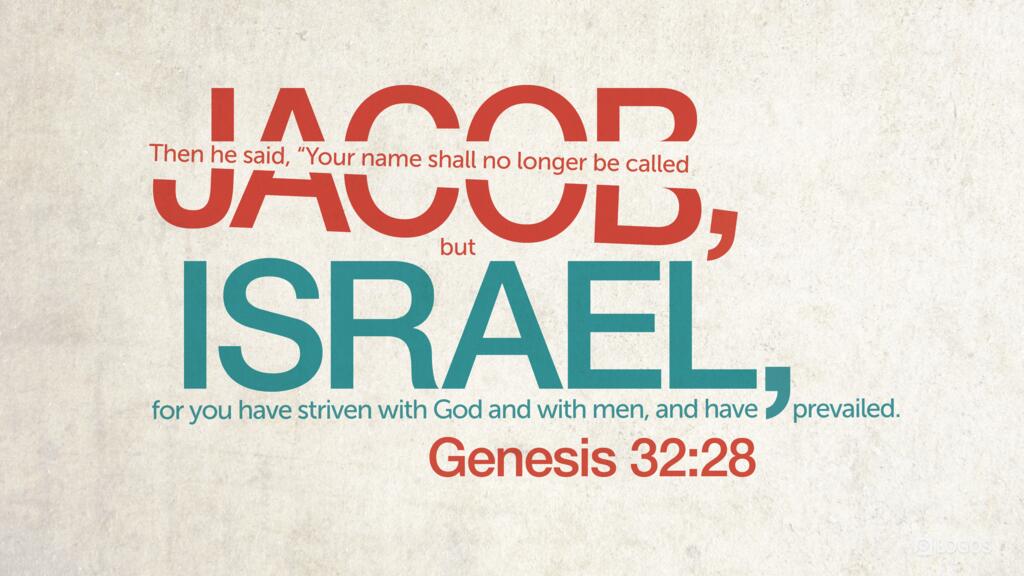
32:26Then the man60 said, “Let me go, for the dawn is breaking.”61 “I will not let you go,” Jacob replied,62 “unless you bless me.”6332:27The man asked him,64 “What is your name?”65 He answered, “Jacob.” 32:28“No longer will your name be Jacob,” the man told him,66 “but Israel,67 because you have fought68 with God and with men and have prevailed.”
32:29Then Jacob asked, “Please tell me your name.”69 “Why70 do you ask my name?” the man replied.71 Then he blessed72 Jacob73 there. 32:30So Jacob named the place Peniel,74 explaining,75 “Certainly76 I have seen God face to face77 and have survived.”78
32:31The sun rose79 over him as he crossed over Penuel,80 but81 he was limping because of his hip. 32:32That is why to this day82 the Israelites do not eat the sinew which is attached to the socket of the hip, because he struck83 the socket of Jacob’s hip near the attached sinew.
Footnotes
- 57 Heb “he”; the referent (the man) has been specified in the translation for clarity.
- 58 Heb “him”; the referent (Jacob) has been specified in the translation for clarity.
- 59 Or “injured”; traditionally “touched.” The Hebrew verb translated “struck” has the primary meanings “to touch; to reach; to strike.” It can, however, carry the connotation “to harm; to molest; to injure.” God’s “touch” cripples Jacob—it would be comparable to a devastating blow.
- 60 Heb “he”; the referent (the man) has been specified in the translation for clarity.
- 61 Heb “dawn has arisen.”
- 62 Heb “and he said, ‘I will not let you go.’ ” The referent of the pronoun “he” (Jacob) has been specified for clarity, and the order of the introductory clause and the direct discourse has been rearranged in the translation for stylistic reasons.
- 63 Jacob wrestled with a man thinking him to be a mere man, and on that basis was equal to the task. But when it had gone on long enough, the night visitor touched Jacob and crippled him. Jacob’s request for a blessing can only mean that he now knew that his opponent was supernatural. Contrary to many allegorical interpretations of the passage that make fighting equivalent to prayer, this passage shows that Jacob stopped fighting, and then asked for a blessing.
- 64 Heb “and he said to him.” The referent of the pronoun “he” (the man who wrestled with Jacob) has been specified in the translation for clarity.
- 65 What is your name? The question is rhetorical, since the Lord obviously knew Jacob’s identity. But since the Lord is going to change Jacob’s name, this question is designed to bring focus Jacob’s attention on all that his name had come to signify.
- 66 Heb “and he said.” The referent of the pronoun “he” (the man who wrestled with Jacob) has been specified for clarity, and the order of the introductory clause and the direct discourse has been rearranged in the translation for stylistic reasons.
- 67 The name Israel is a common construction, using a verb with a theophoric element (אֵל, ’el) that usually indicates the subject of the verb. Here it means “God fights.” This name will replace the name Jacob; it will be both a promise and a call for faith. In essence, the Lord was saying that Jacob would have victory and receive the promises because God would fight for him.
- 68 You have fought. The explanation of the name Israel includes a sound play. In Hebrew the verb translated “you have fought” (שָׂרִיתָ, sarita) sounds like the name “Israel” (יִשְׂרָאֵל, yisra’el), meaning “God fights” (although some interpret the meaning as “he fights [with] God”). The name would evoke the memory of the fight and what it meant. A. Dillmann says that ever after this the name would tell the Israelites that, when Jacob contended successfully with God, he won the battle with man (Genesis, 2:). To be successful with God meant that he had to be crippled in his own self-sufficiency (A. P. Ross, “Jacob at the Jabboq, Israel at Peniel,” 142 [1985]: ).
- 69 Tell me your name. In primitive thought to know the name of a deity or supernatural being would enable one to use it for magical manipulation or power (A. S. Herbert, Genesis 12–50 [], 108). For a thorough structural analysis of the passage discussing the plays on the names and the request of Jacob, see R. Barthes, “The Struggle with the Angel: Textual Analysis of Genesis 32:23–33,” Structural Analysis and Biblical Exegesis (), 21–33.
- 70 The question uses the enclitic pronoun “this” to emphasize the import of the question.
- 71 Heb “and he said, ‘Why is it that you ask my name?’ ” The referent of the pronoun “he” (the man who wrestled with Jacob) has been specified for clarity, and the order of the introductory clause and the direct discourse has been rearranged in the translation for stylistic reasons.
- 72 The verb here means that the Lord endowed Jacob with success; he would be successful in everything he did, including meeting Esau.
- 73 Heb “him”; the referent (Jacob) has been specified in the translation for clarity.
- 74 The name Peniel means “face of God.” Since Jacob saw God face to face here, the name is appropriate.
- 75 The word “explaining” is supplied in the translation for stylistic reasons.
- 76 Or “because.”
- 77 I have seen God face to face. See the note on the name “Peniel” earlier in the verse.
- 78 Heb “and my soul [= life] has been preserved.” I have survived. It was commonly understood that no one could see God and live (Gen 48:16; Exod 19:21, 24:10; and Judg 6:11, 22). On the surface Jacob seems to be saying that he saw God and survived. But the statement may have a double meaning, in light of his prayer for deliverance in v. 11. Jacob recognizes that he has survived his encounter with God and that his safety has now been guaranteed.
- 79 Heb “shone.”
- 80 The name is spelled Penuel here, apparently a variant spelling of Peniel (see v. 30).
- 81 The disjunctive clause draws attention to an important fact: He may have crossed the stream, but he was limping.
- 82 On the use of the expression to this day, see B. S. Childs, “A Study of the Formula ‘Until This Day’,” 82 (1963): 279–92.
- 83 Or “because the socket of Jacob’s hip was struck.” Some translations render this as an impersonal passive. On the translation of the word “struck” see the note on this term in v. .
The NET Bible First Edition, Copyright 1996-2005 by Biblical Studies Press
In other versions
ESVEnglish Standard Version
When the man saw that he did not prevail against Jacob, he touched his hip socket, and Jacob’s hip was put out of joint as he wrestled with him. Then he said, “Let me go, for the day has broken.” But Jacob said, “I will not let you go unless you bless me.” And he said to him, “What is your name?” And he said, “Jacob.” Then he said, “Your name shall no longer be called Jacob, but Israel, for you have striven with God and with men, and have prevailed.” Then Jacob asked him, “Please tell me your name.” But he said, “Why is it that you ask my name?” And there he blessed him. So Jacob called the name of the place Peniel, saying, “For I have seen God face to face, and yet my life has been delivered.” The sun rose upon him as he passed Penuel, limping because of his hip. Therefore to this day the people of Israel do not eat the sinew of the thigh that is on the hip socket, because he touched the socket of Jacob’s hip on the sinew of the thigh.
Copyright 2001 Crossway Bibles
NIVNew International Version (2011)
When the man saw that he could not overpower him, he touched the socket of Jacob’s hip so that his hip was wrenched as he wrestled with the man. Then the man said, “Let me go, for it is daybreak.”
But Jacob replied, “I will not let you go unless you bless me.”
The man asked him, “What is your name?”
“Jacob,” he answered.
Then the man said, “Your name will no longer be Jacob, but Israel, because you have struggled with God and with humans and have overcome.”
Jacob said, “Please tell me your name.”
But he replied, “Why do you ask my name?” Then he blessed him there.
So Jacob called the place Peniel, saying, “It is because I saw God face to face, and yet my life was spared.”
The sun rose above him as he passed Peniel, and he was limping because of his hip. Therefore to this day the Israelites do not eat the tendon attached to the socket of the hip, because the socket of Jacob’s hip was touched near the tendon.
Copyright 1973, 1978, 1984, 2011 Biblica, Inc.
CSBChristian Standard Bible
When the man saw that he could not defeat him, he struck Jacob’s hip socket as they wrestled and dislocated his hip. Then he said to Jacob, “Let me go, for it is daybreak.”
But Jacob said, “I will not let you go unless you bless me.”
“What is your name?” the man asked.
“Jacob,” he replied.
“Your name will no longer be Jacob,” he said. “It will be Israel because you have struggled with God and with men and have prevailed.”
Then Jacob asked him, “Please tell me your name.”
But he answered, “Why do you ask my name?” And he blessed him there.
Jacob then named the place Peniel, “For I have seen God face to face,” he said, “yet my life has been spared.” The sun shone on him as he passed by Penuel—limping because of his hip. That is why, still today, the Israelites don’t eat the thigh muscle that is at the hip socket: because he struck Jacob’s hip socket at the thigh muscle.
Copyright 2017 Holman Bible Publishers
NLTNew Living Translation
When the man saw that he would not win the match, he touched Jacob’s hip and wrenched it out of its socket. Then the man said, “Let me go, for the dawn is breaking!”
But Jacob said, “I will not let you go unless you bless me.”
“What is your name?” the man asked.
He replied, “Jacob.”
“Your name will no longer be Jacob,” the man told him. “From now on you will be called Israel, because you have fought with God and with men and have won.”
“Please tell me your name,” Jacob said.
“Why do you want to know my name?” the man replied. Then he blessed Jacob there.
Jacob named the place Peniel (which means “face of God”), for he said, “I have seen God face to face, yet my life has been spared.” The sun was rising as Jacob left Peniel, and he was limping because of the injury to his hip. (Even today the people of Israel don’t eat the tendon near the hip socket because of what happened that night when the man strained the tendon of Jacob’s hip.)
Holy Bible, New Living Translation, copyright © 1996, 2004, 2015 by Tyndale House Foundation. Used by permission of Tyndale House Publishers. All rights reserved.
LEBThe Lexham English Bible
And when he saw that he could not prevail against him, he struck his hip socket, so that Jacob’s hip socket was sprained as he wrestled with him. Then he said, “Let me go, for dawn is breaking.” But he answered, “I will not let you go unless you bless me.” Then he said to him, “What is your name?” And he said, “Jacob.” And he said, “Your name shall no longer be called Jacob, but Israel, for you have struggled with God and with men and have prevailed.” Then Jacob asked and said, “Please tell me your name.” And he said, “Why do you ask this—for my name?” And he blessed him there. Then Jacob called the name of the place Peniel which means “I have seen God face to face and my life was spared.” Then the sun rose upon him as he passed Penuel, and he was limping because of his hip. Therefore the Israelites do not eat the sinew of the sciatic nerve that is upon the socket of the hip unto this day, because he struck the socket of the thigh of Jacob at the sinew of the sciatic nerve.
Copyright 2012 Lexham Press
KJV 1900King James Version
And when he saw that he prevailed not against him, he touched the hollow of his thigh; and the hollow of Jacob’s thigh was out of joint, as he wrestled with him. And he said, Let me go, for the day breaketh. And he said, I will not let thee go, except thou bless me. And he said unto him, What is thy name? And he said, Jacob. And he said, Thy name shall be called no more Jacob, but Israel: for as a prince hast thou power with God and with men, and hast prevailed. And Jacob asked him, and said, Tell me, I pray thee, thy name. And he said, Wherefore is it that thou dost ask after my name? And he blessed him there. And Jacob called the name of the place Peniel: for I have seen God face to face, and my life is preserved. And as he passed over Penuel the sun rose upon him, and he halted upon his thigh. Therefore the children of Israel eat not of the sinew which shrank, which is upon the hollow of the thigh, unto this day: because he touched the hollow of Jacob’s thigh in the sinew that shrank.
Public Domain