Genesis 3:17–19
The NET BibleOther versions
English
- NET The NET Bible
- DARBY 1890 Darby Bible
- ASV American Standard Version
- AV 1873 The Cambridge Paragraph Bible of the Authorized English Version
- CSB Christian Standard Bible
- D-R Douay-Rheims Bible
- ESV English Standard Version
- GW GOD’S WORD Translation
- GNB Good News Translation
- HCSB The Holman Christian Standard Bible
- KJV 1900 King James Version
- LSB Legacy Standard Bible
- LEB The Lexham English Bible
- MSG The Message: The Bible in Contemporary Language
- NASB95 New American Standard Bible (1995)
- NCV New Century Version
- NIrV New International Reader’s Version (1998)
- NIV New International Version (2011)
- NKJV The New King James Version
- NLT New Living Translation
- NRSVue New Revised Standard Version: Updated Edition
- RSV The Revised Standard Version
- RSVCE The Revised Standard Version, Catholic Edition
- YLT Young’s Literal Translation
Arabic
Czech
French
German
Hebrew
Hungarian
Italian
Korean
Latin
Portuguese
Russian
Simplified Chinese
Spanish
Traditional Chinese
3:17But to Adam50 he said,
“Because you obeyed51 your wife
and ate from the tree about which I commanded you,
‘You must not eat from it,’
cursed is the ground52 thanks to you;53
in painful toil you will eat54 of it all the days of your life.
3:18It will produce thorns and thistles for you,
but you will eat the grain55 of the field.
3:19By the sweat of your brow56 you will eat food
until you return to the ground,57
for out of it you were taken;
for you are dust, and to dust you will return.”58
Footnotes
- 50 Since there is no article on the word, the personal name is used, rather than the generic “the man” (cf. ).
- 51 The idiom “listen to the voice of” often means “obey.” The man “obeyed” his wife and in the process disobeyed God.
- 52 For the ground to be cursed means that it will no longer yield its bounty as the blessing from God had promised. The whole creation, Paul writes in Rom 8:22, is still groaning under this curse, waiting for the day of redemption.
- 53 The Hebrew phrase בַּעֲבוּרֶךָ (ba’avurekha) is more literally translated “on your account” or “because of you.” The idiomatic “thanks to you” in the translation tries to capture the point of this expression.
- 54 In painful toil you will eat. The theme of eating is prominent throughout Gen 3. The prohibition was against eating from the tree of knowledge. The sin was in eating. The interrogation concerned the eating from the tree of knowledge. The serpent is condemned to eat the dust of the ground. The curse focuses on eating in a “measure for measure” justice. Because the man and the woman sinned by eating the forbidden fruit, God will forbid the ground to cooperate, and so it will be through painful toil that they will eat.
- 55 The Hebrew term עֵשֶׂב (’esev), when referring to human food, excludes grass (eaten by cattle) and woody plants like vines.
- 56 The expression “the sweat of your brow” is a metonymy, the sweat being the result of painful toil in the fields.
- 57 Until you return to the ground. The theme of humankind’s mortality is critical here in view of the temptation to be like God. Man will labor painfully to provide food, obviously not enjoying the bounty that creation promised. In place of the abundance of the orchard’s fruit trees, thorns and thistles will grow. Man will have to work the soil so that it will produce the grain to make bread. This will continue until he returns to the soil from which he was taken (recalling the creation in 2:7 with the wordplay on Adam and ground). In spite of the dreams of immortality and divinity, man is but dust (2:7), and will return to dust. So much for his pride.
- 58 In general, the themes of the curse oracles are important in the NT teaching that Jesus became the cursed one hanging on the tree. In his suffering and death, all the motifs are drawn together: the tree, the sweat, the thorns, and the dust of death (see Ps 22:15). Jesus experienced it all, to have victory over it through the resurrection.
The NET Bible First Edition, Copyright 1996-2005 by Biblical Studies Press
In other versions
ESVEnglish Standard Version
And to Adam he said,
“Because you have listened to the voice of your wife
and have eaten of the tree
of which I commanded you,
‘You shall not eat of it,’
cursed is the ground because of you;
in pain you shall eat of it all the days of your life;
thorns and thistles it shall bring forth for you;
and you shall eat the plants of the field.
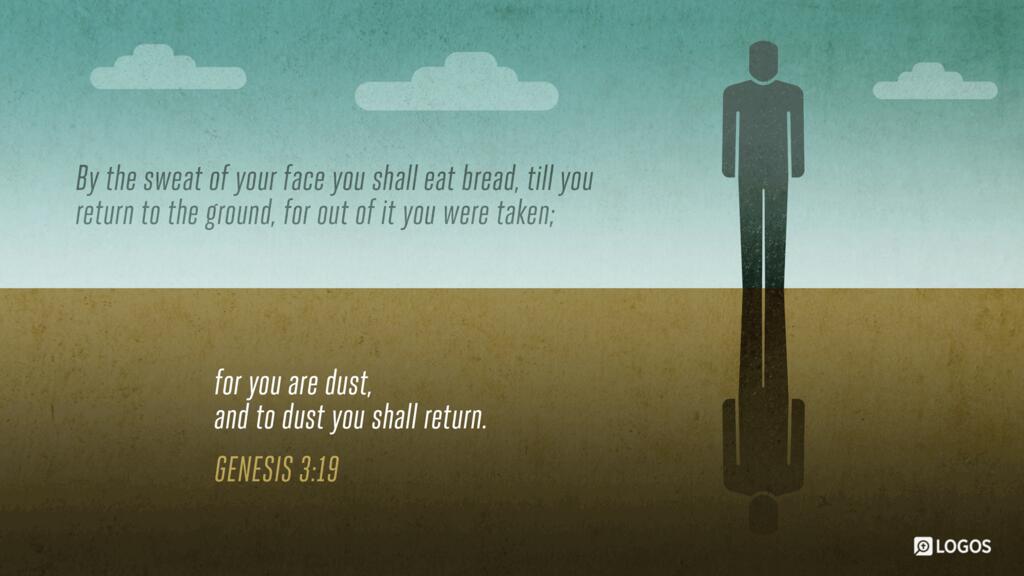
By the sweat of your face
you shall eat bread,
till you return to the ground,
for out of it you were taken;
for you are dust,
and to dust you shall return.”
Copyright 2001 Crossway Bibles
NIVNew International Version (2011)
To Adam he said, “Because you listened to your wife and ate fruit from the tree about which I commanded you, ‘You must not eat from it,’
“Cursed is the ground because of you;
through painful toil you will eat food from it
all the days of your life.
It will produce thorns and thistles for you,
and you will eat the plants of the field.
By the sweat of your brow
you will eat your food
until you return to the ground,
since from it you were taken;
for dust you are
and to dust you will return.”
Copyright 1973, 1978, 1984, 2011 Biblica, Inc.
CSBChristian Standard Bible
And he said to the man, “Because you listened to your wife and ate from the tree about which I commanded you, ‘Do not eat from it’:
The ground is cursed because of you.
You will eat from it by means of painful labor
all the days of your life.
It will produce thorns and thistles for you,
and you will eat the plants of the field.
You will eat bread by the sweat of your brow
until you return to the ground,
since you were taken from it.
For you are dust,
and you will return to dust.”
Copyright 2017 Holman Bible Publishers
NLTNew Living Translation
And to the man he said,
“Since you listened to your wife and ate from the tree
whose fruit I commanded you not to eat,
the ground is cursed because of you.
All your life you will struggle to scratch a living from it.
It will grow thorns and thistles for you,
though you will eat of its grains.
By the sweat of your brow
will you have food to eat
until you return to the ground
from which you were made.
For you were made from dust,
and to dust you will return.”
Holy Bible, New Living Translation, copyright © 1996, 2004, 2015 by Tyndale House Foundation. Used by permission of Tyndale House Publishers. All rights reserved.
LEBThe Lexham English Bible
And to Adam he said, “Because you listened to the voice of your wife and you ate from the tree from which I forbade you to eat,
the ground shall be cursed on your account.
In pain you shall eat from it
all the days of your life.
And thorns and thistles shall sprout for you,
and you shall eat the plants of the field.
By the sweat of your brow
you shall eat bread,
until your return to the ground.
For from it you were taken;
for you are dust,
and to dust you shall return.”
Copyright 2012 Lexham Press
KJV 1900King James Version
And unto Adam he said, Because thou hast hearkened unto the voice of thy wife, and hast eaten of the tree, of which I commanded thee, saying, Thou shalt not eat of it: cursed is the ground for thy sake; in sorrow shalt thou eat of it all the days of thy life; Thorns also and thistles shall it bring forth to thee; and thou shalt eat the herb of the field; In the sweat of thy face shalt thou eat bread, till thou return unto the ground; for out of it wast thou taken: for dust thou art, and unto dust shalt thou return.
Public Domain