Genesis 2:23–25
The NET BibleOther versions
English
- NET The NET Bible
- DARBY 1890 Darby Bible
- ASV American Standard Version
- AV 1873 The Cambridge Paragraph Bible of the Authorized English Version
- CSB Christian Standard Bible
- D-R Douay-Rheims Bible
- ESV English Standard Version
- GW GOD’S WORD Translation
- GNB Good News Translation
- HCSB The Holman Christian Standard Bible
- KJV 1900 King James Version
- LSB Legacy Standard Bible
- LEB The Lexham English Bible
- MSG The Message: The Bible in Contemporary Language
- NASB95 New American Standard Bible (1995)
- NCV New Century Version
- NIrV New International Reader’s Version (1998)
- NIV New International Version (2011)
- NKJV The New King James Version
- NLT New Living Translation
- NRSVue New Revised Standard Version: Updated Edition
- RSV The Revised Standard Version
- RSVCE The Revised Standard Version, Catholic Edition
- YLT Young’s Literal Translation
Arabic
Czech
French
German
Hebrew
Hungarian
Italian
Korean
Latin
Portuguese
Russian
Simplified Chinese
Spanish
Traditional Chinese
2:23Then the man said,
“This one at last67 is bone of my bones
and flesh of my flesh;
this one will be called68 ‘woman,’
for she was taken out of69 man.”70
2:24That is why71 a man leaves72 his father and mother and unites with73 his wife, and they become a new family.74 2:25The man and his wife were both naked,75 but they were not ashamed.76
Footnotes
- 67 The Hebrew term הַפַּעַם (happa’am) means “the [this] time, this place,” or “now, finally, at last.” The expression conveys the futility of the man while naming the animals and finding no one who corresponded to him.
- 68 The Hebrew text is very precise, stating: “of this one it will be said, ‘woman’.” The text is not necessarily saying that the man named his wife—that comes after the fall (Gen 3:20). Some argue that naming implies the man’s authority or ownership over the woman here. Naming can indicate ownership or authority if one is calling someone or something by one’s name and/or calling a name over someone or something (see 2 Sam 12:28; 2 Chr 7:14; Isa 4:1; Jer 7:14; 15:16), especially if one is conquering and renaming a site. But the idiomatic construction used here (the Niphal of קָרָא, qara’, with preposition lamed [לְ, lé]) does not suggest such an idea. In each case where it is used, the one naming discerns something about the object being named and gives it an appropriate name (See 1 Sam 9:9; 2 Sam 18:18; Prov 16:21; Isa 1:26; 32:5; 35:8; 62:4, 12; Jer 19:6). Adam is not so much naming the woman as he is discerning her close relationship to him and referring to her accordingly. He may simply be anticipating that she will be given an appropriate name based on the discernible similarity.
- 69 Or “from” (but see v. 22).
- 70 This poetic section expresses the correspondence between the man and the woman. She is bone of his bones, flesh of his flesh. Note the wordplay (paronomasia) between “woman” (אִשָּׁה, ’ishah) and “man” (אִישׁ, ’ish). On the surface it appears that the word for woman is the feminine form of the word for man. But the two words are not etymologically related. The sound and the sense give that impression, however, and make for a more effective wordplay.
- 71 This statement, introduced by the Hebrew phrase עַל־כֵּן (’al-ken, “therefore” or “that is why”), is an editorial comment, not an extension of the quotation. The statement is describing what typically happens, not what will or should happen. It is saying, “This is why we do things the way we do.” It links a contemporary (with the narrator) practice with the historical event being narrated. The historical event narrated in v. 23 provides the basis for the contemporary practice described in v. 24. That is why the imperfect verb forms are translated with the present tense rather than future.
- 72 The imperfect verb form has a habitual or characteristic nuance. For other examples of עַל־כֵּן (’al-ken, “therefore, that is why”) with the imperfect in a narrative framework, see Gen 10:9; 32:32 (the phrase “to this day” indicates characteristic behavior is in view); Num 21:14, 27; 1 Sam 5:5 (note “to this day”); 19:24 (perhaps the imperfect is customary here, “were saying”); 2 Sam 5:8. The verb translated “leave” (עָזָב, ’azab) normally means “to abandon, to forsake, to leave behind, to discard,” when used with human subject and object (see Josh 22:3; 1 Sam 30:13; Ps 27:10; Prov 2:17; Isa 54:6; 60:15; 62:4; Jer 49:11). Within the context of the ancient Israelite extended family structure, this cannot refer to emotional or geographical separation. The narrator is using hyperbole to emphasize the change in perspective that typically overtakes a young man when his thoughts turn to love and marriage.
- 73 The perfect with vav (ו) consecutive carries the same habitual or characteristic nuance as the preceding imperfect. The verb is traditionally translated “cleaves [to]”; it has the basic idea of “stick with/to” (e.g., it is used of Ruth resolutely staying with her mother-in-law in Ruth 1:14). In this passage it describes the inseparable relationship between the man and the woman in marriage as God intended it.
- 74 Heb “and they become one flesh.” The perfect with vav consecutive carries the same habitual or characteristic nuance as the preceding verbs in the verse. The retention of the word “flesh” (בָּשָׂר, basar) in the translation often leads to improper or incomplete interpretations. The Hebrew word refers to more than just a sexual union. When they unite in marriage, the man and woman bring into being a new family unit (הָיָה + לְ, hayah + lamed preposition means “become”). The phrase “one flesh” occurs only here and must be interpreted in light of v. 23. There the man declares that the woman is bone of his bone and flesh of his flesh. To be one’s “bone and flesh” is to be related by blood to someone. For example, the phrase describes the relationship between Laban and Jacob (Gen 29:14); Abimelech and the Shechemites (Judg 9:2; his mother was a Shechemite); David and the Israelites (2 Sam 5:1); David and the elders of Judah (2 Sam 19:12); and David and his nephew Amasa (2 Sam 19:13, see 2 Sam 17:2; 1 Chr 2:16–17). The expression “one flesh” seems to indicate that they become, as it were, “kin,” at least legally (a new family unit is created) or metaphorically. In this first marriage in human history, the woman was literally formed from the man’s bone and flesh. Even though later marriages do not involve such a divine surgical operation, the first marriage sets the pattern for how later marriages are understood and explains why marriage supersedes the parent-child relationship.
- 75 Heb “And the two of them were naked, the man and his wife.” Naked. The motif of nakedness is introduced here and plays an important role in the next chapter. In the Bible nakedness conveys different things. In this context it signifies either innocence or integrity, depending on how those terms are defined. There is no fear of exploitation, no sense of vulnerability. But after the entrance of sin into the race, nakedness takes on a negative sense. It is then usually connected with the sense of vulnerability, shame, exploitation, and exposure (such as the idea of “uncovering nakedness” either in sexual exploitation or in captivity in war).
- 76 The imperfect verb form here has a customary nuance, indicating a continuing condition in past time. The meaning of the Hebrew term בּוֹשׁ (bosh) is “to be ashamed, to put to shame,” but its meaning is stronger than “to be embarrassed.” The word conveys the fear of exploitation or evil—enemies are put to shame through military victory. It indicates the feeling of shame that approximates a fear of evil.
The NET Bible First Edition, Copyright 1996-2005 by Biblical Studies Press
In other versions
ESVEnglish Standard Version
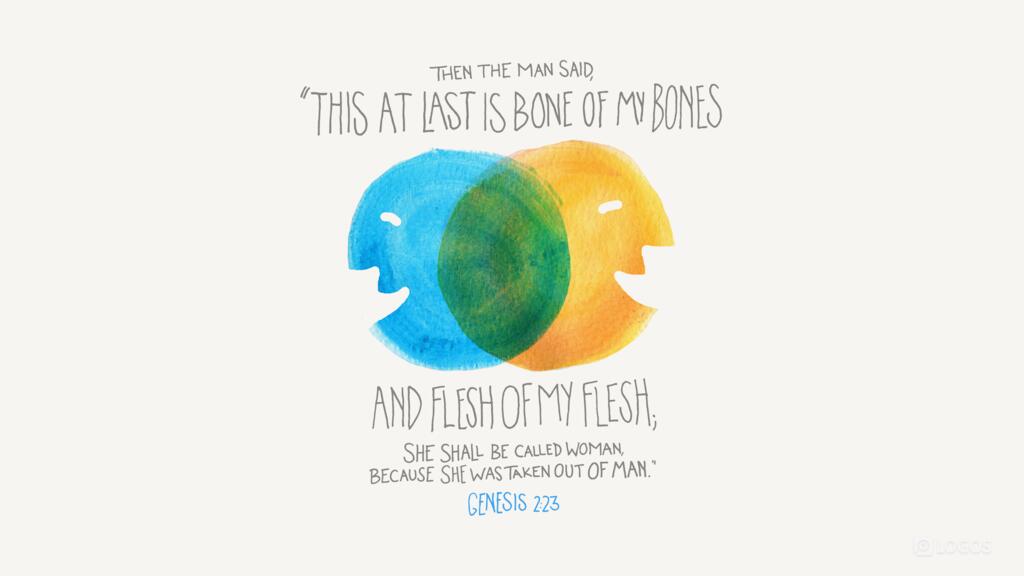
Then the man said,
“This at last is bone of my bones
and flesh of my flesh;
she shall be called Woman,
because she was taken out of Man.”
Therefore a man shall leave his father and his mother and hold fast to his wife, and they shall become one flesh. And the man and his wife were both naked and were not ashamed.
Copyright 2001 Crossway Bibles
NIVNew International Version (2011)
The man said,
“This is now bone of my bones
and flesh of my flesh;
she shall be called ‘woman,’
for she was taken out of man.”
That is why a man leaves his father and mother and is united to his wife, and they become one flesh.
Adam and his wife were both naked, and they felt no shame.
Copyright 1973, 1978, 1984, 2011 Biblica, Inc.
CSBChristian Standard Bible
And the man said:
This one, at last, is bone of my bone
and flesh of my flesh;
this one will be called “woman,”
for she was taken from man.
This is why a man leaves his father and mother and bonds with his wife, and they become one flesh. Both the man and his wife were naked, yet felt no shame.
Copyright 2017 Holman Bible Publishers
NLTNew Living Translation
“At last!” the man exclaimed.
“This one is bone from my bone,
and flesh from my flesh!
She will be called ‘woman,’
because she was taken from ‘man.’ ”
This explains why a man leaves his father and mother and is joined to his wife, and the two are united into one.
Now the man and his wife were both naked, but they felt no shame.
Holy Bible, New Living Translation, copyright © 1996, 2004, 2015 by Tyndale House Foundation. Used by permission of Tyndale House Publishers. All rights reserved.
LEBThe Lexham English Bible
And the man said,
“She is now bone from my bones
and flesh from my flesh;
she shall be called ‘Woman,’
for she was taken from man.”
Therefore a man shall leave his father and his mother and shall cling to his wife, and they shall be as one flesh. And the man and his wife, both of them, were naked, and they were not ashamed.
Copyright 2012 Lexham Press
KJV 1900King James Version
And Adam said, This is now bone of my bones, and flesh of my flesh: she shall be called Woman, because she was taken out of Man. Therefore shall a man leave his father and his mother, and shall cleave unto his wife: and they shall be one flesh. And they were both naked, the man and his wife, and were not ashamed.
Public Domain